 moonshot

Field service technicians’ wearable support is a way to capture permitted observations and revisit them, with the aim of making the next service visit better informed. This guide to AI wearables for field service technicians separates personal reflection from job records, customer information, and actions that require approval.
- AI wearables for field service technicians should support a defined task, not replace service records or safety procedures.
- Moonshot fits personal reflection: talk it through, consider a question, and choose the next step.
- Start with manual field notes before adding a wearable to your workflow.
- Keep customer conversations, equipment observations, and your interpretations separate.
Why wearable support matters for field service technicians
A service visit contains several kinds of information. A customer describes a problem. You inspect the equipment. You make a judgment about what to check next. Those are different sources, and your notes should preserve the distinction.
Consider a hypothetical visit: a customer says the fault happens after closing, but the equipment runs normally while you are there. A useful note preserves both facts. It does not turn the customer’s account into a verified diagnosis.
Your 2026 wearable decision should begin with that problem, not a feature list. Choose a task you can describe clearly, then decide whether a wearable belongs in it. A notebook or an approved service form gives you a manual starting point without introducing another capture method.
Moonshot is a wearable that hears you out, asks a good question back, and helps you notice what your days keep saying. Moonshot fits technicians who want to talk it through and choose their own next step. That is a personal reflection use, not evidence of diagnostic capability, service-system integration, or job-site suitability.
A field workflow for 2026
Job boundary
Start with one situation where a clearer note would help. Perhaps you leave a visit unsure which observation belongs in the handover. Perhaps an unanswered question keeps returning after the job is finished. Write down the situation before choosing a device.
Use your existing approved method first. Record the relevant observation in a service form, or write a private reflection without customer identifiers. Review whether that note actually helps when the next decision arrives. If it does not, adding a wearable does not fix an unclear purpose.
Keep the proposed benefit narrow. A reflection about how you explained a repair is different from a technical record of that repair. The former helps you learn from your own life; the latter needs the accuracy, access rules, and retention requirements of your service process.
A wearable should have a defined role, not an open invitation to capture the whole working day. Keep the boundary clear enough that you can explain it to a customer or supervisor without describing capabilities you have not verified.
- Name the moment you want to improve.
- Write the intended benefit in plain language.
- Identify the record that remains authoritative.
- Exclude safety-critical decisions from the trial.
- Define what information must stay out.
Permission boundary
Before capturing anything at a customer site, check the employer’s rules and the customer’s requirements. Do not assume that permission to enter a building includes permission to capture a conversation. Do not assume that a device worn openly makes its purpose clear.
Start with handwritten observations where your workplace permits them. If you propose another capture method, explain what you intend to capture and why. Confirm the permitted scope before use. A conversation about a fault, a photograph of equipment, and access to a calendar are separate decisions, not interchangeable permissions.
Make the stop condition explicit. If someone declines, use the approved manual process. If the location prohibits recording or wearable electronics, leave the device outside that workflow. A useful personal device does not create an exception to a customer’s site rules.
Your 2026 evaluation should distinguish device possession from authorized use. You can own a wearable and still have no permission to use it during a service visit. That boundary protects the usefulness of your notes by keeping the source and circumstances clear.
- Check employer and customer-site rules.
- Explain the proposed capture method.
- Obtain the required permission before capture.
- Treat each information source separately.
- Keep an approved non-recording alternative.
- Stop when permission is absent or withdrawn.
Source labels
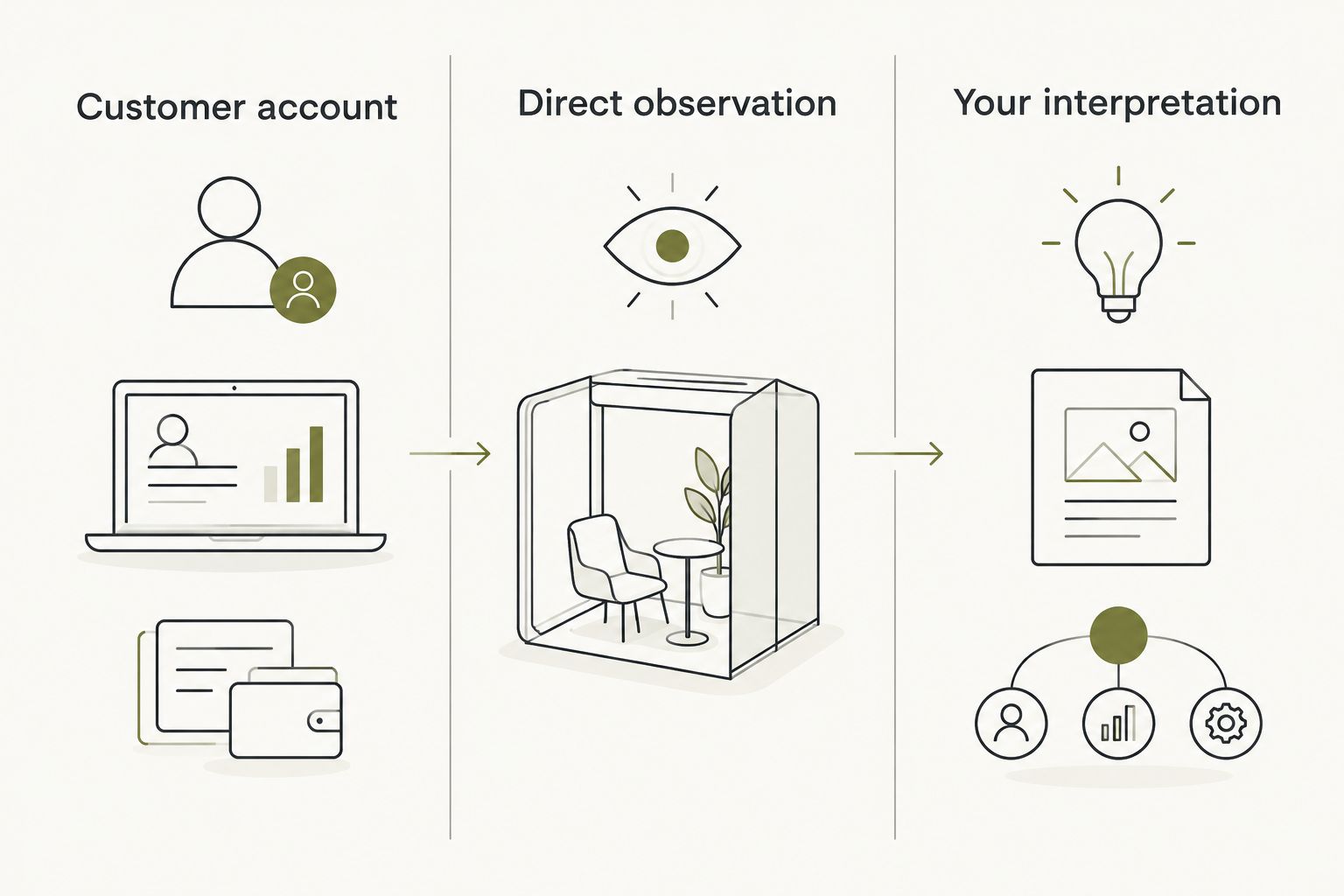
Keep a simple distinction in your notes: customer account, direct observation, and your interpretation. These labels prevent a remembered statement from becoming a finding merely because it appears beside technical details.
For example, write that the customer reported an intermittent noise. Separately record whether you heard it during the visit. Put your explanation in another field, with the check needed to support it. The example is a note-taking method, not a diagnosis.
Apply the same discipline to public material. A manufacturer’s published instruction is not a captured customer conversation. A summary of either source is not the original. When the distinction matters to a repair or handover, return to the authorized source rather than treating a shortened account as sufficient.
Manual labels work without any new device. If you evaluate a wearable, inspect how its output preserves those distinctions before letting that output influence your service record. Clear source labels matter more than fluent wording. A tidy paragraph can still blur what someone said with what you established.
- Label the customer account.
- Label your direct observation.
- Separate your interpretation.
- Identify the authorized public source.
- Mark an unverified explanation as unverified.
- Check important details against the original.
The source boundary is easiest to see when each kind of information has its own place. Keep the labels visible rather than merging everything into a single polished summary.
Reflection boundary
After the technical record is complete, consider whether there is something personal to talk through. You might keep postponing a question for your supervisor. You might notice that you leave explanations unfinished when a visit runs long. Those are reflection topics, not equipment findings.
Start manually: write what happened, what remains unresolved, and what you want to do differently. Keep customer names, access details, and confidential job information out of a personal reflection unless their use is expressly permitted. You do not need to reconstruct the entire visit to identify a useful next step.
Moonshot’s wearable role belongs here: it hears you out and asks a good question back. You choose the priority. The next step requires your yes; a suggestion does not become an instruction just because it is clearly phrased.
Keep the payoff human and specific. You asked the question you had been avoiding. You clarified an explanation before the next visit. You decided to show up prepared for a conversation. Do not turn those examples into promises about repair accuracy or business results.
- Finish the required service record first.
- Choose a permitted personal reflection topic.
- Leave unnecessary customer details out.
- Say it once in your own words.
- Decide whether the question helps.
- Choose the next step yourself.
Action boundary
A useful reflection ends with a decision you understand. It does not need to produce an action every time. Sometimes the right outcome is to ask for clarification, check an instruction, or leave the issue unresolved until you have better evidence.
Use a manual action note first. State what you will do and what approval it needs. Keep a personal intention separate from a customer commitment: wanting to call someone is not the same as promising that call on behalf of your employer.
Moonshot makes no calls and moves no money. Do not treat a reflection prompt as a submitted service update, a message to a customer, or a completed follow-up. Nothing should go out in your name without your yes, and workplace approval requirements still apply.
For your 2026 trial, distinguish a proposed step from an approved step and a completed step. That simple separation makes follow-through visible without suggesting that the wearable has done the work. You remain responsible for checking, approving, and completing the action.
- Write the proposed action plainly.
- Identify any workplace approval required.
- Check the recipient and content yourself.
- Give your yes separately for each action.
- Complete the task through the approved process.
- Mark completion only after it happens.
Trial review
Evaluate the narrow use you chose, not the idea of wearable technology as a whole. Begin with a baseline note made through your current process. Then compare it with the proposed workflow using permitted information and the same practical question.
Ask whether you can find the relevant observation, distinguish its source, and decide what to do next. Also check the added work: permission explanations, review, corrections, and transfer into the authoritative record. A convenient capture method is not convenient if you must repair its meaning afterward.
For Moonshot, keep the initial evaluation within week one and focused on personal reflection. Did the question help you choose something concrete? Did you retain control over the next step? Do not extend that test into a claim about long-term results or professional readiness.
Write your 2026 decision in ordinary terms: keep the narrow use, change the boundary, or return to the manual method. A successful trial proves that particular workflow useful to you. It does not prove every advertised use.
- Compare against your existing manual method.
- Review the source of each important detail.
- Record any correction or extra work.
- Check whether a useful decision followed.
- Confirm that permissions stayed within scope.
- Keep, revise, or stop the trial.
Options and limitations
Choose according to the record you need. Personal reflection, technical documentation, and customer commitments should not compete for the same role.
The options below describe workflow choices, not interchangeable products. A wearable can sit beside an approved service process, but its presence does not make it the authoritative record.
| Option | Best for | Useful contribution | Key limitation |
|---|---|---|---|
| Paper notes | A simple manual starting point | You choose exactly what to write | You must organize and transfer the notes yourself |
| Approved service forms | Required job documentation | Information goes into the designated record | Reflection needs can differ from required form fields |
| Permitted voice notes | Spoken observations where recording is authorized | You can talk through an observation | Capture requires permission; technical details still need checking |
| Moonshot wearable | Personal reflection after a permitted experience | It hears you out and asks a good question back | Do not treat it as a diagnostic tool or service-record system |
Start with the option that meets the job’s requirements. Add a personal wearable only for a separate use you can explain and evaluate. Do not move customer information into a new workflow merely because speaking feels easier than typing.
Common mistakes field service technicians make
Customer accounts treated as findings
A customer’s description helps define the investigation, but it does not establish what caused the fault. Preserve the account, then document what you observed. Keep an explanation separate until the relevant checks support it.
Personal reflection treated as the service record
A useful question about your day is not a verified repair history. Complete the required record through the approved process. Keep reflections separate unless your organization expressly authorizes their use in that record.
Capture permission treated as unlimited permission
Permission for a particular conversation does not authorize every later use of its contents. Check the allowed scope before sharing, transferring, or reusing information. Keep personal details out when they are unnecessary to the task.
Prompts treated as completed work
A suggested follow-up is not a customer contacted, an appointment changed, or a job closed. Check what actually happened. Record completion only after the approved action is finished.
A first-week result treated as broad proof
One useful reflection supports that narrow use. It does not establish diagnostic accuracy, technical compatibility, or suitability for every customer site. Keep your 2026 decision tied to the workflow you evaluated.
FAQ
What are AI wearables for field service technicians useful for?
A wearable is worth evaluating for a defined, permitted task such as capturing an observation or supporting personal reflection. Keep technical verification and required service records in the approved workflow.
Is a wearable better than handwritten field notes?
A wearable is not automatically better than handwritten field notes. Start with manual notes, then compare whether the proposed workflow makes relevant information easier to check without adding permission or correction problems.
Can I capture a customer conversation during a service visit?
Capture a customer conversation only when the applicable rules and required permissions allow it. Permission to enter a site is not permission to record there; use the approved manual alternative when capture is not authorized.
Can Moonshot diagnose equipment faults?
Do not use Moonshot as an equipment diagnostic tool. Its stated role is to hear you out, ask a good question back, and help you choose a next step.
Should wearable notes replace my service report?
Wearable notes should not replace the service record your organization requires. Verify relevant details and enter them through the approved process, keeping customer accounts separate from your findings.
What should I check before choosing a wearable in 2026?
Check the intended task, site permissions, source handling, review process, and approval boundary. Confirm any required technical capability from current product information rather than assuming it from the wearable category.
What is the best first use for a personal wearable after field work?
Start with a permitted personal reflection that needs no customer identifiers or confidential job details. Choose something concrete, such as deciding how to ask an unresolved question, and evaluate whether the next step is useful.
One last thing
A better note sometimes ends with an unanswered question. If the customer reported something you did not observe, preserving that gap is more useful than filling it with a confident explanation.
For your next permitted reflection, separate what was said, what you saw, and what you think it means. Then choose the smallest next step that would clarify the difference. That is how you learn from your own life without confusing reflection with proof.