 moonshot

A wearable can replace a notebook for spoken journal entries, but it does not replace the act of deciding what an experience means to you. In 2026, choose spoken capture if writing stops you from starting; keep a notebook if you value choosing your words, drawing, or thinking without a recording device.
- Can an AI wearable replace a notebook for journaling? For spoken entries, yes; for every kind of reflection, no.
- Moonshot is best for people who want to talk it through and choose the next step themselves.
- A notebook lets you choose every word; a captured conversation still needs your interpretation.
- Check recording controls, deletion, and export before replacing a journal with any wearable.
Can an AI wearable replace a notebook for journaling?
Yes for recording a spoken reflection. No as a complete substitute for everything a notebook lets you do. The useful distinction is not paper versus electronics. It is capturing your words versus working out what you mean.
Imagine that you record a thought after lunch: you keep meaning to call a friend. Later, you return to that thought and decide whether to make the call. The useful part is not having a record of lunch. It is having something specific to consider when you have room to act.
Use the same distinction when comparing wearables for journaling. A device that records an entry and a device that asks a relevant question serve different purposes. Neither gets to decide what matters to you.
| Approach | Best for | Main advantage | Main limitation |
|---|---|---|---|
| Notebook journaling | People who think through writing or drawing | You choose exactly what reaches the page | You need to stop and write |
| Spoken journaling with a wearable | People who find it easier to talk than write | You can express a thought without composing a written entry | Speaking is not suitable in every setting; device controls need checking |
| Wearable plus notebook | People who want spoken capture and written reflection | You can separate getting something down from deciding what it means | You maintain two places for entries |
A notebook is not automatically more thoughtful. A recording is not automatically more complete. Judge each method by whether you return to something useful, not by how much it holds.
Why this matters
Replacing a journal changes more than the object you carry. It changes how a thought becomes an entry. On paper, you select words as you write; when speaking, you can talk it through before knowing where the sentence will end.
Neither approach needs to win every time. You might want to say it once after a conversation, then write a sentence later about what you actually want to do. Keeping both is a reasonable choice, not an unfinished switch.
For a 2026 buying decision, begin with the moment you want to improve. Is it starting an entry, returning to an unfinished thought, or choosing the next step? Those are different needs, and recording alone does not answer all of them.
Notebook journaling
Best for: choosing your words and thinking on the page. A notebook gives you a blank surface rather than a required sequence of questions. You can cross out a sentence, sketch a room, leave a margin empty, or decide that an entry should stay unfinished.
That freedom also asks something of you: you must make the entry. If the notebook stays closed because writing feels like another task, its flexibility is not helping in that moment. Try a shorter entry before deciding that paper itself is the problem.
A useful paper entry can be just 1 sentence. Write what happened, what you think it means, or what you want to return to. You do not need all three every time.
Paper has privacy limits, too. Someone who can open your notebook can read it. Keeping an entry off a connected device does not remove the need to decide where you leave the physical journal.
Spoken journaling with a wearable
Best for: people who want to begin by speaking. A spoken entry lets you start with the words you have, rather than waiting for a sentence that sounds finished. That is a different way into reflection, not proof that the resulting entry is better.
The setting matters. A thought you would write on a crowded train might be something you would not say aloud there. Talking through your own day also differs from recording other people; do not treat permission for one as permission for the other.
Before choosing a wearable in 2026, check what actually happens between speaking and revisiting an entry. Does the device preserve a recording, produce text, offer a summary, or ask a question? Treat those as separate capabilities and confirm each one rather than assuming that a journaling label includes them all.
The limitation is straightforward: a record of what you said is not a final account of what you meant. If an interpretation misses the point, your correction should guide what you keep.
Wearable plus notebook
Best for: separating capture from reflection. Use spoken entries when you want to get a thought down. Use paper when you want to choose what deserves another look.
For example, you might speak about a conversation that stayed with you, then later write why one sentence mattered. The written entry does not need to copy the recording. It can disagree with your first impression.
The drawback is having two places to check. Give each a clear job: spoken entries hold what you want to revisit; the notebook holds what you have chosen to examine. If that distinction creates more work than value, use one method instead.
Do not turn the notebook into an index of everything recorded. The point is to select, not to create a second version of the same archive.
Why the right choice varies
The right journaling method depends on what you need at the moment of use. These factors are more useful than a claim that one format replaces another:
- Starting preference. Choose speech if talking helps you begin; choose paper if writing helps you work out the thought.
- Setting. Consider whether you can speak without sharing something private or recording someone else.
- Entry format. Handwritten marks and drawings serve a different purpose from spoken words.
- Return habit. Decide how you will revisit an entry before collecting more of them.
- Control. Check access, deletion, and export for a device; consider physical access for a notebook.
- Desired outcome. An entry can end with understanding, a question, or an action. You choose which fits.
There is no requirement to turn every observation into follow-through. Sometimes the honest result is that you do not know yet. A useful journaling method leaves room for that answer.
A first-week comparison
Use this as a personal exercise, not a product trial or a promise about results. Over 7 days, compare how the two formats serve the same purpose: helping you return to something you actually care about.
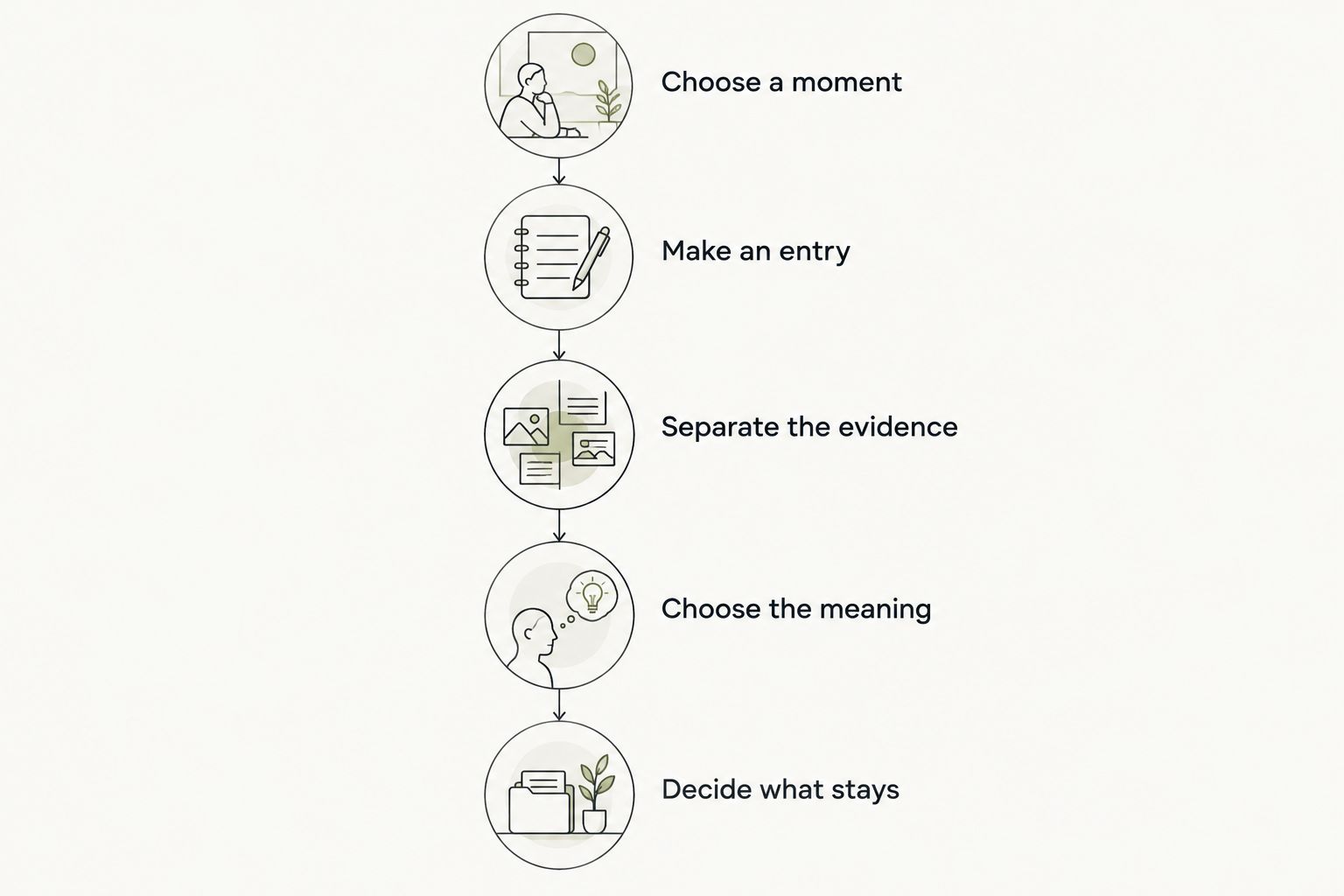
1. Choose a moment
Pick an ordinary event you want to revisit: a conversation, an idea, or something you kept putting off. Do not start by trying to document the whole day. A small subject makes the comparison easier to understand.
Keep the subject within what you are comfortable recording. If another person is involved, you can reflect on your own experience without capturing their conversation.
2. Make an entry
Write about the moment or talk it through using a method whose recording behavior you understand. On another occasion, try the other format. Give each a fair chance without forcing equal length or polished language.
Notice the practical difference. Did you start? Did you stop because the setting was wrong? Those observations matter more than whether an entry looks substantial.
3. Separate the evidence
When you revisit the entry, distinguish what happened from what you inferred. Someone saying they cannot meet is a fact you can record. Your explanation of why they said it is an interpretation.
A captured conversation is also different from a public source. If an entry includes outside information, keep its origin separate from your own words. Do not let a summary blur those boundaries.
4. Choose the meaning
Spend 5 minutes returning to one entry. Ask what still seems true and what you would phrase differently now. You are allowed to change your mind without treating the earlier entry as a mistake.
If a question helps, use it. If it pushes you toward an answer that does not fit, set it aside. Reflection should leave you with your judgment, not someone else's preferred conclusion.
5. Decide what stays
At the end of the week, keep the method you actually wanted to return to. You can keep both if they serve distinct purposes. You can also decide that a shorter paper habit is enough.
If an entry suggests an action, choose whether to take it. A thought about calling a friend is not permission to contact them. The next step needs your yes separately from the decision to record the thought.
Where Moonshot fits
Moonshot is best for people who want to talk it through and choose the next step themselves. The wearable hears you out, asks a good question back, and helps you notice what your days keep saying. The point is to learn from your own life, not to produce a complete record of it.
For journaling, Moonshot offers a starting point for a thought you want to revisit. You choose your priorities and separately grant each source; nothing goes out in your name without your yes. It makes no calls and moves no money.
That is not the same experience as a blank page. If drawing, private handwriting, or shaping a paragraph is the part you value, keep the notebook. Check the reservation page for the current offer, and distinguish a planned capability from something available to use.
Can I stop keeping a paper journal entirely?
Yes, if spoken entries meet your needs and you have checked how you can access and retain them. You do not owe a journaling habit a particular format. Keep paper only if it serves a purpose you would miss.
Before retiring a notebook, try returning to an older spoken entry. Confirm that you can find what you need and understand what is a recording, a summary, or an interpretation.
Is recording my day the same as journaling?
No. Recording creates material; journaling includes choosing what to examine. You can make a thoughtful entry from a small moment without recording the rest of the day.
Avoid making completeness the goal. A useful entry can help you decide how to show up for someone without preserving every conversation that came before it.
What should I check before choosing a wearable in 2026?
Check recording controls, source permissions, deletion, and export before treating a wearable as your journal. Ask what works now, what requires a connection, and what remains planned. A product description is not a substitute for a clear answer about a specific function.
Also check whether the process fits places where you actually reflect. A device can suit your preferences at home and still be the wrong way to make an entry in public.
FAQ
Can an AI wearable replace a notebook for journaling?
A wearable can replace a notebook for spoken entries, but it does not replace your interpretation. Keep paper if writing or drawing is part of how you think.
What's better for journaling, speaking or writing?
Speaking is the better fit if it helps you begin; writing is the better fit if choosing words on the page helps you reflect. Compare both using ordinary moments rather than expecting one format to suit everything.
Can I use a wearable and a notebook together?
Yes. Give them different jobs: use spoken entries to capture a thought and paper to examine what you want to keep.
Does a journaling wearable need to record everyone around me?
No. Reflecting on your own experience does not require recording other people's conversations. Check recording behavior and obtain permission where required before capturing others.
Is Moonshot a replacement for a handwritten journal?
Moonshot is an option for people who want a wearable that hears them out and asks a good question back. It does not provide the same experience as handwriting or drawing on paper.
What should I check before buying a journaling wearable in 2026?
Check recording controls, permissions, deletion, export, and which capabilities are available now. Confirm each function you need rather than assuming that a journaling label includes it.
Does every journal entry need an action?
No. An entry can end with a question or a clearer account of what happened. If you choose an action, that decision is separate from recording the entry.
One last thing
Before changing your journaling setup in 2026, open an entry you already have. Ask what would make it useful today. The answer might be another question, a correction, or the call you finally decide to make.
Choose the format that helps you return, not the one that promises to collect the most. A journal earns its place when you want to open it again.