 moonshot
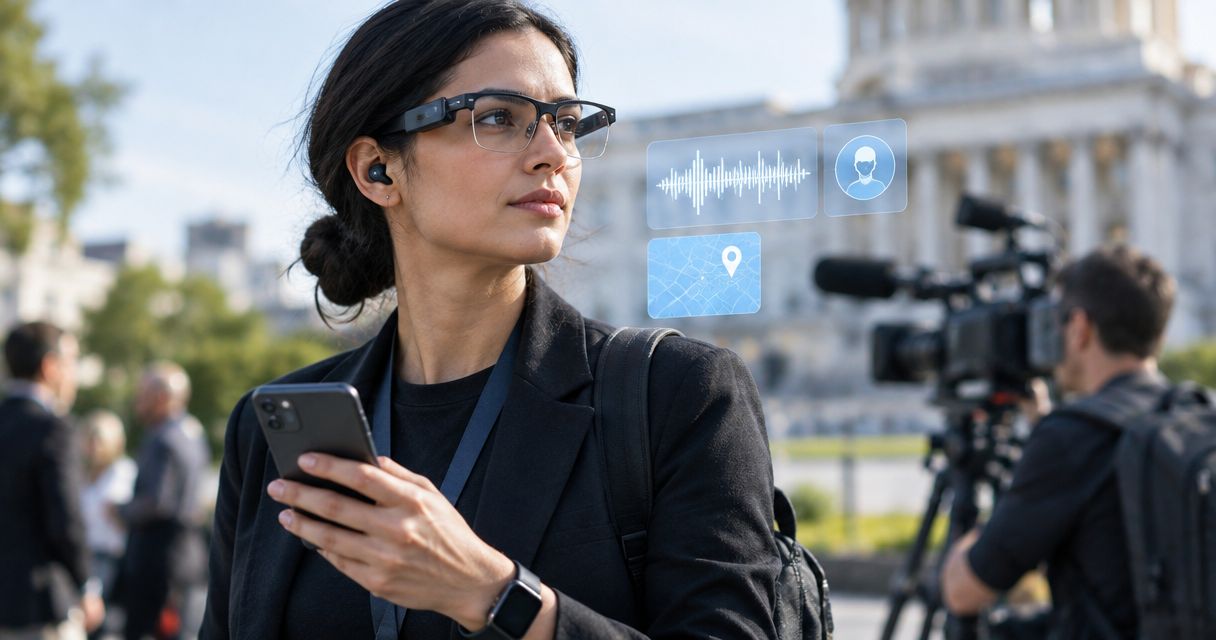
Journalists’ AI wearables are body-worn devices that use automated processing to turn captured material into prompts or summaries, with the aim of supporting reporting and follow-through. This guide explains how to handle a note such as a promised follow-up without confusing a personal reminder with a verified reporting record.
- Choose AI wearables for journalists around source consent, verifiable interview records, and editorial control—not automatic capture.
- Moonshot is best for journalists who want to talk it through, not replace reporting records.
- Keep interview recording separate from personal reflection; verify quotations against the original source.
- Require your yes before anything goes out in your name.
Why AI wearables matter for journalists
Journalists work with material that has different permissions and different evidentiary weight. An interview recording, an observation in your notebook, and a public document are not interchangeable. A wearable belongs in your workflow only when you can keep those distinctions intact.
Consider a hypothetical assignment. After an interview, you make a personal note that you promised to ask about a disputed date. Before the next conversation, that note gives you a specific question to prepare. The useful outcome is the question you remember to ask—not an automatically accepted account of what happened.
Moonshot is best for journalists who want to talk it through, not replace reporting records. Its stated role is a wearable that hears you out and asks a good question back. Treat that as a way to learn from your own life, not as evidence that it provides an interview-recording or newsroom system.
For a 2026 buying decision, separate the product’s stated purpose from the requirements of your assignment. Personal reflection and publishable evidence need different checks. A useful prompt does not establish a fact.
A reporting workflow for wearables
Start with a notebook, a permitted recording method, and your publication’s rules. You do not need a wearable to build a sound workflow. Add one only after you can explain what it contributes and what stays outside it.
Source boundaries
Before capturing anything, decide whether the material belongs in the device at all. Begin with a manual assignment note: what you intend to record, why you need it, and who has agreed. That note makes the boundary explicit before a conversation starts.
Check applicable recording law and your newsroom’s policy. Permission to speak with a journalist is not automatically permission for every recording or processing method. Explain the actual method you intend to use rather than describing everything as note-taking.
Keep sensitive source material outside an unapproved workflow. A source’s name, location, or connection to a story can matter even when the spoken content sounds ordinary. If you cannot explain the handling clearly, use the approved alternative.
- State what you intend to capture before recording.
- Confirm the interview’s agreed attribution terms.
- Check newsroom approval separately from source consent.
- Grant each source separately; avoid blanket access.
- Stop capturing when the agreed boundary changes.
Evidence separation
Maintain separate places for source material and your interpretation. The manual method is straightforward: keep the original record, then write a distinct working note. Label the working note so an editor can tell whether it contains a quotation, a paraphrase, or your own question.
Automated output needs the same separation. A summary is a derived account, not the original conversation. A suggested explanation is an inference until reporting supports it. A public source also needs its own citation; it does not become part of a captured interview merely because both appear in the same workspace.
Use a simple test when reviewing a claim: can you return to the material that supports it? If not, keep it out of publishable copy until you verify it. Readable output is not a substitute for traceable evidence.
- Preserve the original interview record.
- Mark quotations separately from paraphrases.
- Label personal observations as observations.
- Attach public-source citations to the claims they support.
- Keep generated interpretations outside verified copy.
Personal follow-through
Begin with a free method: after an assignment, write one thing you said you would do. Give it a concrete next step. A note such as checking a date with the interviewee is more useful than a broad instruction to finish the story.
Moonshot offers a different route for that personal reflection: it hears you out, asks a good question back, and turns one thing into a next step, with your yes on each one. Say it once, then decide whether that step deserves your attention. This is a personal choice, not an editorial assignment made by the device.
Keep the scope small during week one. Choose an ordinary commitment that does not require sharing confidential reporting. You remain responsible for the call, the message, and the reporting; the device makes no calls and moves no money.
- Choose one nonconfidential commitment to talk it through.
- Name the next step in plain language.
- Give your yes only when the step matches your priority.
- Keep source identities out of personal reflection when unnecessary.
- Complete the action yourself through an approved channel.
Field checks
Test the proposed workflow before taking it into an interview. Start manually with a consenting colleague and nonsensitive material. Check what you captured, whether you can find the original, and whether the resulting note preserves the speaker’s meaning.
A useful trial takes 10 minutes: make a short permitted recording using your approved method, write a summary, and compare the two. This is a suggested exercise, not a device performance claim. Repeat the exercise under the conditions relevant to your assignment rather than assuming a quiet-room result applies everywhere.
For a 2026 preorder, judge stated capabilities separately from planned ones. A description of what a product intends to do is not proof that a particular reporting workflow has shipped. Do not make an assignment depend on an unconfirmed function.
- Use nonsensitive material for the first trial.
- Confirm that the original remains accessible.
- Check names and negations against the original.
- Test the conditions your assignment actually requires.
- Keep an approved fallback ready.
Publication checks
Build a publication checkpoint that does not depend on the wearable. Read each proposed quotation against the original recording or your contemporaneous notes. Check whether surrounding context changes its meaning. Then verify the factual claims independently.
Ask 3 questions about each substantive claim: where did it come from, what supports it, and what remains uncertain? Those questions distinguish a fact from an inference without making the prose complicated. They also give your editor a clear route back to the evidence.
Approval for capture does not authorize publication or outgoing communication. Review recipients, wording, and attachments separately. Nothing should go out in your name without your yes, and confidential material still needs the publication’s handling rules.
- Verify quotation wording and context.
- Trace factual claims to their supporting sources.
- Mark unresolved inferences for further reporting.
- Review every intended recipient and attachment.
- Approve outgoing material as a separate decision.
Week-one review
Evaluate usefulness after 1 week of an approved, nonsensitive trial. Keep a manual record of the task you intended to complete and whether you completed it. You are looking for a specific payoff, such as preparing the follow-up question—not a larger pile of notes.
For Moonshot, keep the review aligned with its stated purpose: did talking something through help you choose the next step? Do not judge it as a substitute for recording, transcription, or fact-checking. Those are separate requirements with separate evidence standards.
Your 2026 review should also include friction. If checking the output creates more work than the task itself, simplify the workflow. If a permission question remains unresolved, stop using that material until you have an answer.
- Record the commitment before trying the workflow.
- Check whether you completed the intended action.
- Count correction work as part of the task.
- Remove sources that the task does not need.
- Keep only the method you can explain to your editor.
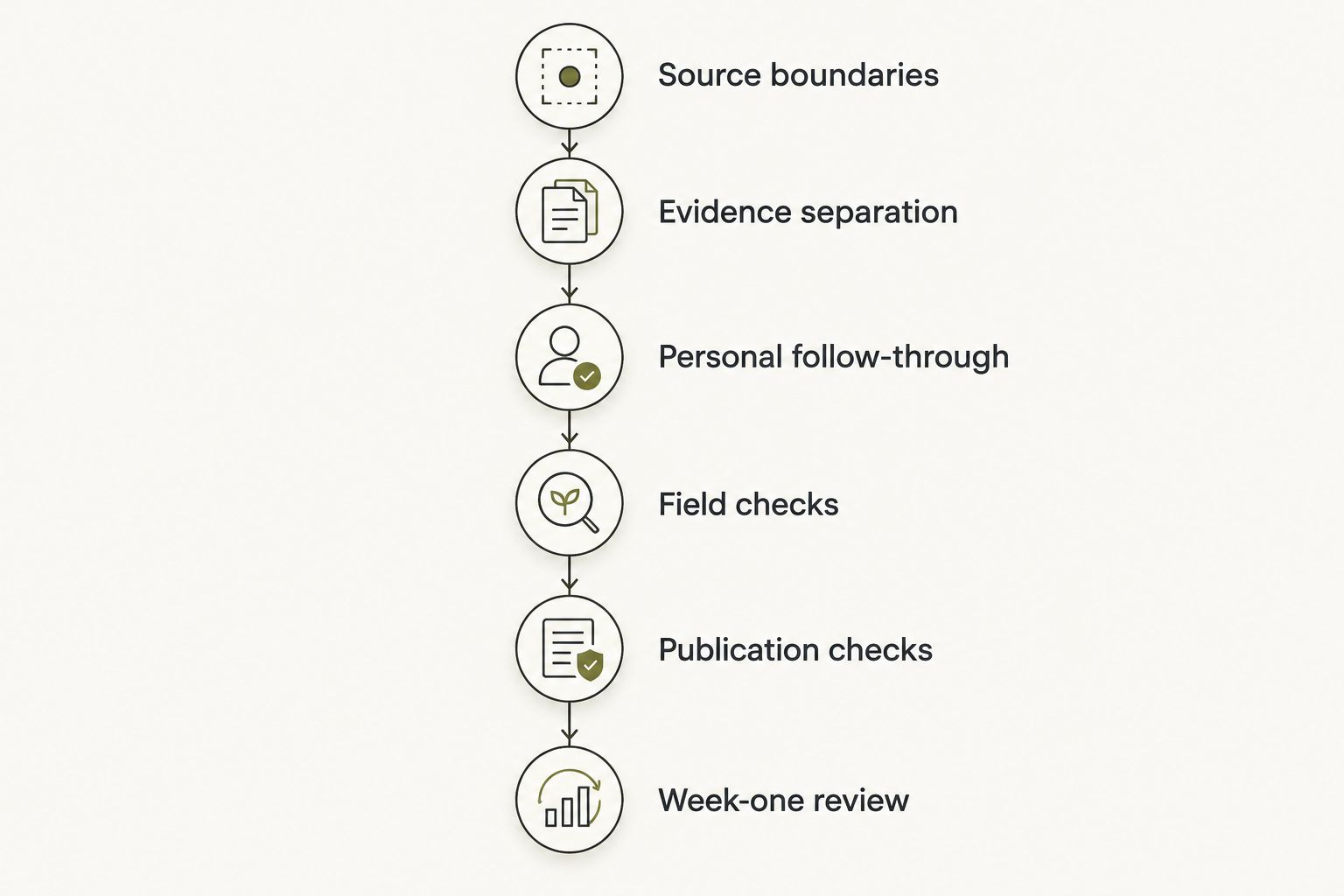
The workflow has a deliberate order: establish source boundaries, separate evidence, choose personal follow-through, conduct field checks, apply publication checks, and finish with a week-one review. A shortcut around the first two stages creates a verification problem later.
Options for different reporting tasks
Choose the option that fits the task, not the option that collects the most material. A notebook can support observations. An approved recorder can preserve an interview. A personal-reflection wearable serves a different purpose.
The following comparison is a decision aid for 2026, not a claim that every device in a category offers the same functions. Check the particular method against your newsroom’s requirements before using it with sources.
| Option | Best for | Main benefit | Key limitation |
|---|---|---|---|
| Notebook or manual task list | Observations and personal commitments | You choose exactly what to record | Notes are selective and need clear labels |
| Newsroom-approved audio recorder | Consented interviews requiring an original record | Preserves audio for quotation checks | Recording alone does not verify a claim |
| Approved transcription workflow | Reviewing a permitted interview recording | Provides text to check against audio | Transcription errors still need correction |
| Moonshot | Talking through personal follow-through | Hears you out and asks a good question back | Its stated reflection role does not establish a newsroom recording workflow |
Use the recording workflow for evidence and the reflection workflow for your own next step. Combining their outputs on a screen does not remove the distinction between them.
For a confidential investigation, newsroom approval comes before convenience. For a personal commitment after an ordinary assignment, a manual note remains a valid choice. The right method is the one that meets the task’s permission and verification requirements.
Common mistakes journalists make
Permission treated as a single decision
An interviewee agrees to a conversation, and the reporter assumes that agreement covers capture, processing, storage, and publication. Those decisions are different. Explain the intended workflow and follow the applicable legal and editorial requirements.
A summary treated as a quotation
A clear summary preserves an idea without necessarily preserving the speaker’s exact words. Putting quotation marks around it changes its evidentiary status. Return to the original record before quoting, and retain enough context to check meaning.
A personal prompt treated as a reporting lead
A question prompted by something you said is a starting point, not confirmation. Use it to plan reporting. Do not turn an inference about a person or event into a statement of fact without independent support.
Preorder language treated as a shipped workflow
A 2026 product description can help you understand the intended use. It cannot establish every export, security, recording, or approval function your newsroom needs. Confirm the exact requirement before making the product part of an assignment.
Capture treated as completion
Recording a commitment is not the same as acting on it. Keep the distinction visible: the note records what you intended; follow-through is the question asked, the source checked, or the message you approved and sent yourself.
FAQ
What are AI wearables for journalists?
AI wearables for journalists are body-worn devices that use automated processing on captured material to support tasks such as prompts or summaries. Their usefulness depends on source permission, verifiable records, and editorial control, not the amount they capture.
What is the best wearable workflow for confidential sources?
The best workflow for confidential sources is one your newsroom has approved for that material and purpose. Keep confidential reporting outside any device or processing method whose handling you have not confirmed.
Can I quote a wearable’s summary in my article?
A summary is not a verified quotation. Check the exact wording and context against the original recording or contemporaneous notes before using quotation marks.
Is a wearable better than a notebook for reporting?
A wearable is not automatically better than a notebook for reporting. A notebook supports selective observations; any recording or processing device adds requirements for permission, handling, and verification.
What is Moonshot best for in a journalist’s day?
Moonshot is best for journalists who want to talk it through and choose a personal next step. It hears you out and asks a good question back; that stated role is separate from maintaining verified interview records.
Does agreeing to an interview mean agreeing to wearable capture?
Agreement to an interview does not settle every recording or processing permission. Explain your intended method and check applicable law, source agreements, and newsroom policy before capture.
How should I evaluate a journalism wearable in 2026?
Evaluate a journalism wearable in 2026 through an approved, nonsensitive trial tied to a specific task. Check access to the original material, correction work, source boundaries, and whether the intended action actually happened.
One last thing
Write the question you want to ask before choosing the device you want to wear. That question gives you a purpose for capture—and a reason to leave unrelated material alone.
For your first week, pick one ordinary commitment and show up for it. The useful result is not everything you saved. It is the next step you chose and completed.