 moonshot

Lawyers’ use of AI wearables is the use of body-worn devices to capture permitted information and support reflection, with the aim of turning a useful thought into a chosen next step. This 2026 guide to AI wearables for lawyers separates a personal reminder, such as a friend you meant to call, from a client conversation that belongs under firm rules.
- AI wearables for lawyers need a defined purpose before any client information enters the device.
- Moonshot fits personal reflection; its consumer description does not establish suitability for confidential legal work.
- Start with a notebook, separate facts from inferences, and require your yes before any action.
- Evaluate recording permission, source access, and deletion before a first-week trial.
Why AI wearables matter for lawyers
A lawyer’s useful thought does not always arrive at a desk. You remember someone you want to call while walking home. You notice that you keep postponing the same personal decision. Those moments can be useful without becoming another work record.
The difficulty is the boundary. A personal reflection and a client disclosure can happen minutes apart, in the same room. A device’s convenience does not remove your responsibility to decide what belongs in it.
Moonshot describes a wearable that hears you out, asks a good question back, and helps you notice what your days keep saying. That description supports a personal-reflection use case. It does not establish firm approval, recording permission, or suitability for privileged material.
For lawyers in 2026, the first decision is not which device to buy. It is which information must stay out. This guide focuses on that decision, a practical first-week process, and the limits of the available product description.
First-week process
Scope: choose one personal payoff
Start without a wearable. Write down one thing you want to follow through on outside client work. Make it small enough to recognize when it happens: calling a friend, returning to an idea, or deciding whether to accept a personal invitation.
Set aside 10 minutes for a scope check before choosing a tool. Write the intended payoff and the information it requires. If the example needs a client name, case detail, or firm document, it is not a personal-only example.
A useful scope is narrower than your whole day. You do not need a record of every conversation to learn from your own life. You need enough context to understand the one thing you chose.
- Choose one personal outcome, not a general productivity goal.
- Describe the next step in ordinary language.
- Exclude client names, matter details, and firm documents.
- Define a setting where personal capture is appropriate.
Permission: check people and sources separately
Use a written checklist first. Identify who would be heard, where capture would happen, and which sources a proposed workflow would use. Permission to access one source does not establish permission to access another.
For work-related use, check firm policy and the applicable recording requirements before capture. Ask the responsible person at your firm to assess the specific workflow rather than the broad category of wearables. A private office, client meeting, and public event need separate consideration.
Keep source permission distinct from action approval. You can permit a personal note to be used for reflection without agreeing to send anything based on it. Your yes belongs at each decision, not only at setup.
- Check firm policy before introducing work information.
- Establish the applicable recording and consent requirements.
- Grant each source separately where source access exists.
- Identify how capture stops before entering a sensitive setting.
- Leave client meetings outside the trial unless specifically approved.
Separation: keep personal reflection outside matter records
The manual approach is straightforward: use a personal notebook for the personal thought, and use your approved work process for the matter record. Do not copy between them merely because the information is already written down.
A wearable is worth considering only if talking it through is easier for you than writing. Moonshot’s stated role is to hear you out and ask a good question back. Use that description to evaluate personal reflection, not to assume legal note-taking or document-handling capabilities.
Moonshot is best suited to lawyers seeking personal reflection, not a legal record. That verdict follows from its stated consumer purpose; it is not a claim about security controls or professional approval.
Keep the first-week example simple. You say it once: you want to call a friend you keep meaning to reach. You then choose whether that call is the next step.
- Keep personal notes separate from matter files.
- Use approved work systems for professional records.
- Remove identifying work details from personal examples.
- Evaluate the conversation experience without testing client capture.
Evidence: label what happened and what you inferred
You can do this on paper. Divide a note into the event you remember, your interpretation, and the action you are considering. The distinction prevents a useful question from turning into an unsupported conclusion.
For example, repeatedly mentioning a postponed call is an observation. Deciding why you postponed it is an inference. Neither gives a device authority to decide what matters to you.
A captured conversation is also different from a public source. The conversation records what participants said; a public source supports only the claims it actually contains. Neither becomes a verified fact merely because a system summarizes it.
In a 2026 evaluation, ask how you will inspect that distinction. If you cannot tell where a statement came from, do not use it as the basis for professional work.
- Label direct observations as observations.
- Mark interpretations as interpretations.
- Identify the source behind any factual statement.
- Check important claims against the underlying material.
- Keep unverified summaries out of professional decisions.
Approval: choose the next step yourself
Start with a handwritten action line. Write what you intend to do, who it affects, and whether you still want to do it. This makes approval a real decision rather than a habit of accepting suggestions.
The same standard applies when a device offers a next step. You choose priorities. Nothing should go out in your name without your yes. Access to a note is not approval to communicate, and permission to suggest is not permission to act.
The supplied description says the wearable turns one thing into a next step, with your yes on each one. It makes no calls and moves no money. Keep those boundaries intact rather than imagining a workflow beyond the stated product.
- Review the exact action before agreeing.
- Decide whether the suggestion matches your priority.
- Approve each outward action separately in any proposed workflow.
- Keep sending and professional commitments in approved systems.
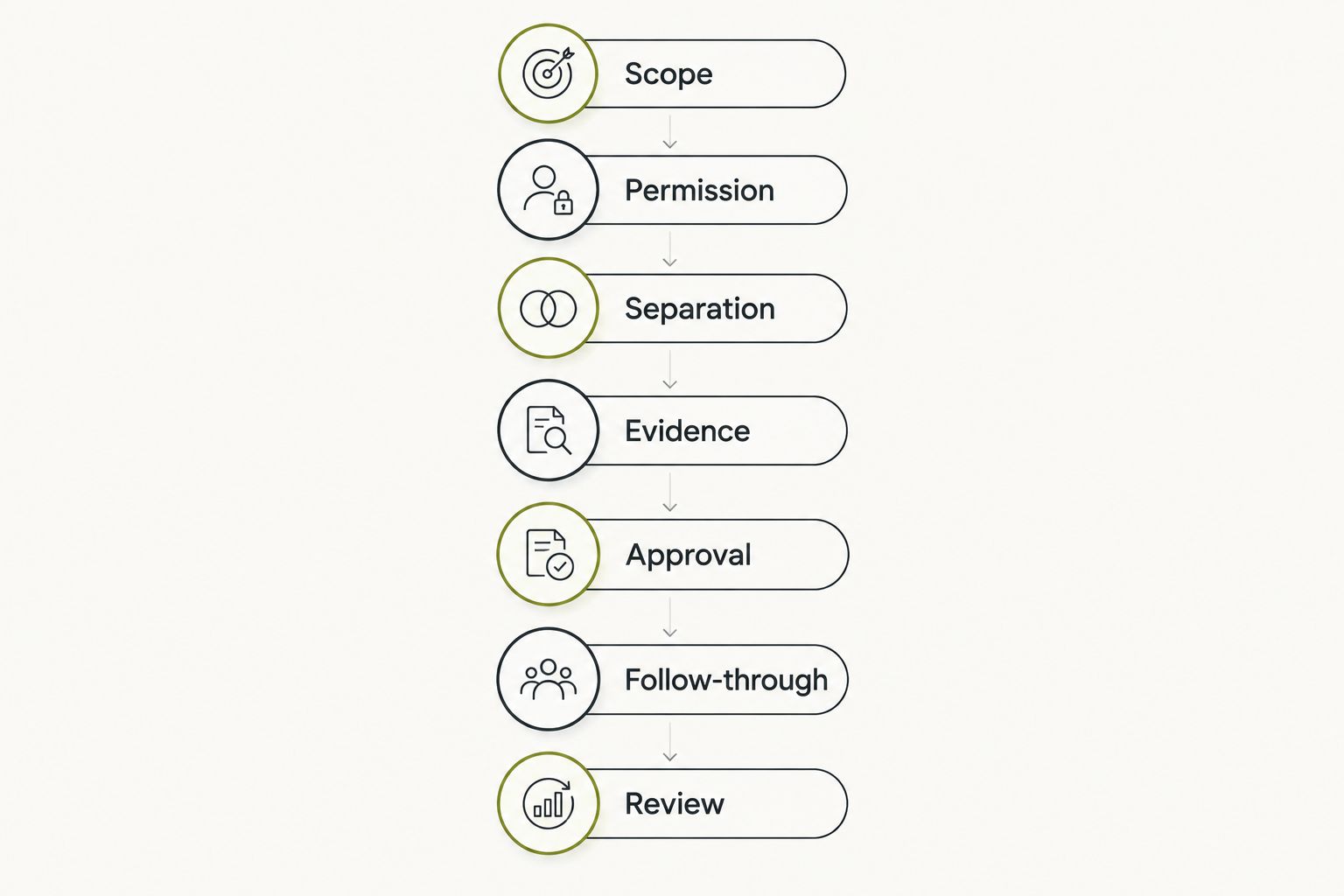
The process follows a clear sequence: Scope, Permission, Separation, Evidence, Approval, Follow-through, Review. Approval belongs before follow-through, not after it.
Follow-through: test the action rather than the output
Use a 5-minute review at the end of a trial day. Read the personal note, identify the next step you chose, and check whether you acted on it. This is a suggested review routine, not a product performance claim.
A long summary is not the payoff. The call you finally made is. If a question helped you decide not to make the call, that can also be a clear outcome, provided it was your decision.
Do not reward a tool for producing more material than you need. Judge whether it helped you talk it through and show up for the action you chose. Keep professional performance claims out of a personal trial.
- Record the one next step you approved.
- Note whether you completed, declined, or deferred it.
- Describe what made the question useful or unhelpful.
- Stop counting summaries as completed actions.
Review: decide whether the first week earned a place
Run the personal-only trial for 7 days, then decide whether to continue. This is an evaluation plan, not a promise that a device will deliver a particular result in a week.
Compare the experience with your original notebook method. Did talking it through help you choose? Did checking the output add work? Were the boundaries easy to maintain? Answer those questions before expanding the scope.
For a 2026 purchase decision, distinguish the preorder description from a shipped capability. A stated purpose does not demonstrate every workflow you imagine around it. Verify the current product status and any necessary controls directly before relying on them.
If permission, handling, or deletion remains unresolved, keep the trial personal-only or stop. A useful personal experience does not establish suitability for legal work.
- Compare the trial with your original manual method.
- Evaluate one payoff rather than an imagined future workflow.
- Verify current capabilities instead of assuming them.
- Resolve information-handling questions before expanding scope.
- Continue only when the benefit and boundaries are clear.
Options for lawyers in 2026
Choose the method according to the information involved. The easiest option for a personal thought is not automatically appropriate for a professional conversation. Each option below has a useful role and a limit.
| Option | Best for | Main advantage | Key limitation |
|---|---|---|---|
| Personal notebook | Lawyers testing a personal reflection habit | Lets you choose exactly what to write | Requires manual capture and review; physical access still matters |
| Typed personal note | Lawyers who prefer editing a thought before saving it | Makes it easy to separate an observation from an interpretation | Account access and information handling still need attention |
| Firm-approved work process | Lawyers handling matter-related information | Keeps the workflow within established professional procedures | Approval applies to the specific process, not every connected device |
| Moonshot wearable | Lawyers exploring spoken personal reflection | Hears you out and asks a good question back | The consumer description does not establish suitability for confidential legal work |
Start with the least complex method that serves the chosen payoff. A notebook is a sensible baseline because it lets you test the habit before evaluating a device. It is not automatically secure or appropriate for every kind of information.
A firm-approved process belongs in a different category. Its purpose is professional handling, not personal reflection. Do not treat the options as interchangeable simply because each can contain a note.
Common mistakes lawyers make
Client detail in a personal trial
A trial stops being personal-only when its usefulness depends on identifying a client or describing a matter. Remove those details before capture. If removing them defeats the purpose, move the task to an approved professional process.
Recording permission confused with device ownership
Owning a wearable does not settle whether a conversation should be recorded. Check the people, setting, applicable requirements, and firm rules. Do that before capture, not after someone asks what the device retained.
Reflection treated as evidence
A question can be useful without proving anything. Keep recollection, interpretation, and source-supported facts separate. Do not promote a personal summary into a professional record because it sounds clear or confident.
Preorder language treated as delivered functionality
A product description explains the intended experience. It does not prove that a particular legal workflow is available or approved. Verify the exact capability you need rather than building a decision around a planned or imagined feature.
Follow-through replaced with more capture
More notes do not establish a better outcome. Return to the action you chose at the start. If capture keeps expanding while the original next step stays untouched, narrow the process instead of adding another source.
FAQ
What's the best way for a lawyer to start using a wearable?
Start with one personal-only use case and test the same habit manually first. Keep client information out while you check permissions, information handling, and whether the experience helps you choose a next step.
Can lawyers record client meetings with a wearable?
Do not record a client meeting without checking firm policy, applicable recording requirements, and the necessary permissions. A consumer device description does not establish that a professional recording workflow is appropriate.
Is Moonshot intended to replace a lawyer's matter records?
The supplied description supports personal reflection, not replacement of matter records. Moonshot hears you out and asks a good question back; the description does not establish suitability for confidential legal documentation.
Is a wearable better than a notebook for personal reflection?
A wearable is the better fit only when talking it through serves your chosen personal goal better than writing. A notebook remains a useful baseline because you decide exactly what enters the note and review it manually.
Does recording permission also authorize actions?
No. Permission to capture information and approval to take an action are separate decisions. You choose priorities, grant each source separately, and require your yes before anything goes out in your name.
What should lawyers verify before choosing a wearable in 2026?
Verify the current product status, the exact capabilities you need, source permissions, information handling, and deletion controls. Confirm any professional workflow through your firm rather than inferring approval from a consumer description.
How should a lawyer judge a first-week trial?
Judge the trial by one chosen personal payoff, not the amount of material captured. Check whether a useful question helped you decide and whether the boundaries remained clear throughout the week.
One last thing
The best first-week example is not a client meeting. It is a personal thought with a clear boundary: the friend you mean to call, the idea you keep returning to, or the invitation you need to answer.
For your 2026 trial, choose the call. Keep work information out. Say it once, talk it through, and decide whether to make it. That gives you a concrete way to evaluate the experience without confusing personal usefulness with professional suitability.
The next step is yours. A useful question helps you choose; it does not choose for you.