 moonshot

AI wearables for small business owners are devices that use captured input to help you review information and decide what to do next. If you run a shop, studio, or service business, the useful outcome is concrete: something you said earlier helps you make the call you have been putting off.
- AI wearables for small business owners should support a chosen next step, not create another inbox.
- Moonshot is for owners who want to talk it through and choose the next step themselves.
- Start with written notes or voice notes before choosing a wearable.
- Check recording consent, source permissions, and approval controls before sharing business conversations.
Why wearables matter for small business owners
An owner’s day crosses several kinds of work. You discuss a delivery, answer a customer, and return to an unfinished decision. A useful note preserves the detail that changes your next move, not just the fact that a conversation happened.
Consider an ordinary example. You make a note after speaking with a customer: they want a clearer explanation before agreeing to the work. Later, that note gives you a specific task—rewrite the explanation—rather than a vague reminder to follow up.
The test for 2026 is whether a captured moment helps you choose a useful action. A longer record is not automatically a better result. You still decide which customer matters today and which idea can wait.
Moonshot hears you out, asks a good question back, and helps you notice what your days keep saying. That makes reflection the relevant comparison, not a replacement for the systems that run your business.
A practical selection process for 2026
Begin with a task you already understand. A device is easier to evaluate when you can name the moment it should help with and the boundary it must respect.
The process below starts manually. You can use it without buying anything, then judge whether a wearable removes a particular source of friction.
One priority
Choose one unfinished matter before comparing devices. It might be a customer explanation, a supplier question, or an idea you keep mentioning but have not examined. Avoid starting with the entire business.
Write the matter in plain language. Instead of improving customer communication, use explaining what happens after a customer approves the work. The second version gives you something to inspect and change.
Set aside 5 minutes as a starting exercise. This is a suggested work boundary, not a claim about how quickly any product delivers results. Stop when you have a question you can answer or an action you can take.
- Name the unfinished matter.
- Write the decision you need to make.
- Identify the detail you keep losing.
- Define what useful follow-through would look like.
A manual starting point
Use a notebook or a phone note to capture the thought first. Say it once or write it once, then return to it when you have room to decide. This shows you whether the problem is capture, review, or action.
Separate what happened from what you think it means. A customer asking for an explanation is a fact. Assuming they no longer want the work is an inference. Those require different next steps.
Give yourself 1 sentence for the factual note before adding your interpretation. This constraint is a writing exercise, not a product limit. It helps you see whether the original detail survived your summary.
- Record what was actually said or done.
- Label your interpretation separately.
- Add the question that remains unanswered.
- Note where the information came from.
- Keep unrelated customer details out of the note.
A wearable fit
Compare the manual routine with the experience you want. If you avoid writing because you need to talk it through, a wearable built around reflection addresses a different need from a notebook. If you already write useful notes but never revisit them, easier capture alone does not resolve the problem.
Moonshot is for owners who want to talk it through and choose the next step themselves. It hears you out and asks a good question back. The useful outcome is turning one thing into the next step, with your yes on each one.
That is a narrow role. Moonshot makes no calls and moves no money. Keep the decision and the business action separate: noticing that you want to contact someone is not the same as contacting them.
- Identify why the manual routine falls short.
- Match the device to that specific difficulty.
- Keep business execution in your existing process.
- Check what is offered now versus described as planned.
- Choose a first-week use rather than a broad promise.
Source boundaries
Decide what you are willing to capture before using a device around customers or staff. Start with your own spoken reflection after a conversation. That lets you evaluate the habit without treating every business interaction as material to record.
A captured conversation and a public source are different things. Your account of a conversation is different again. A useful review preserves those distinctions instead of presenting every statement as an established fact.
Recording rules depend on where a conversation occurs and who participates. Check the applicable requirements and explain any proposed recording before it begins. A person’s permission to speak with you is not a blanket invitation to capture or share the exchange.
- Choose each source separately.
- Explain proposed recording to participants.
- Check applicable recording requirements.
- Exclude sensitive information that the task does not need.
- Distinguish direct statements from your interpretation.
The next step
Turn the note into an action you control. A useful question makes the decision clearer; it does not make the decision for you. Ask what you know, what you still need to establish, and what you are willing to do.
For the customer example, the next step might be drafting a clearer explanation. You review the wording before sending it. Nothing goes out in your name without your yes.
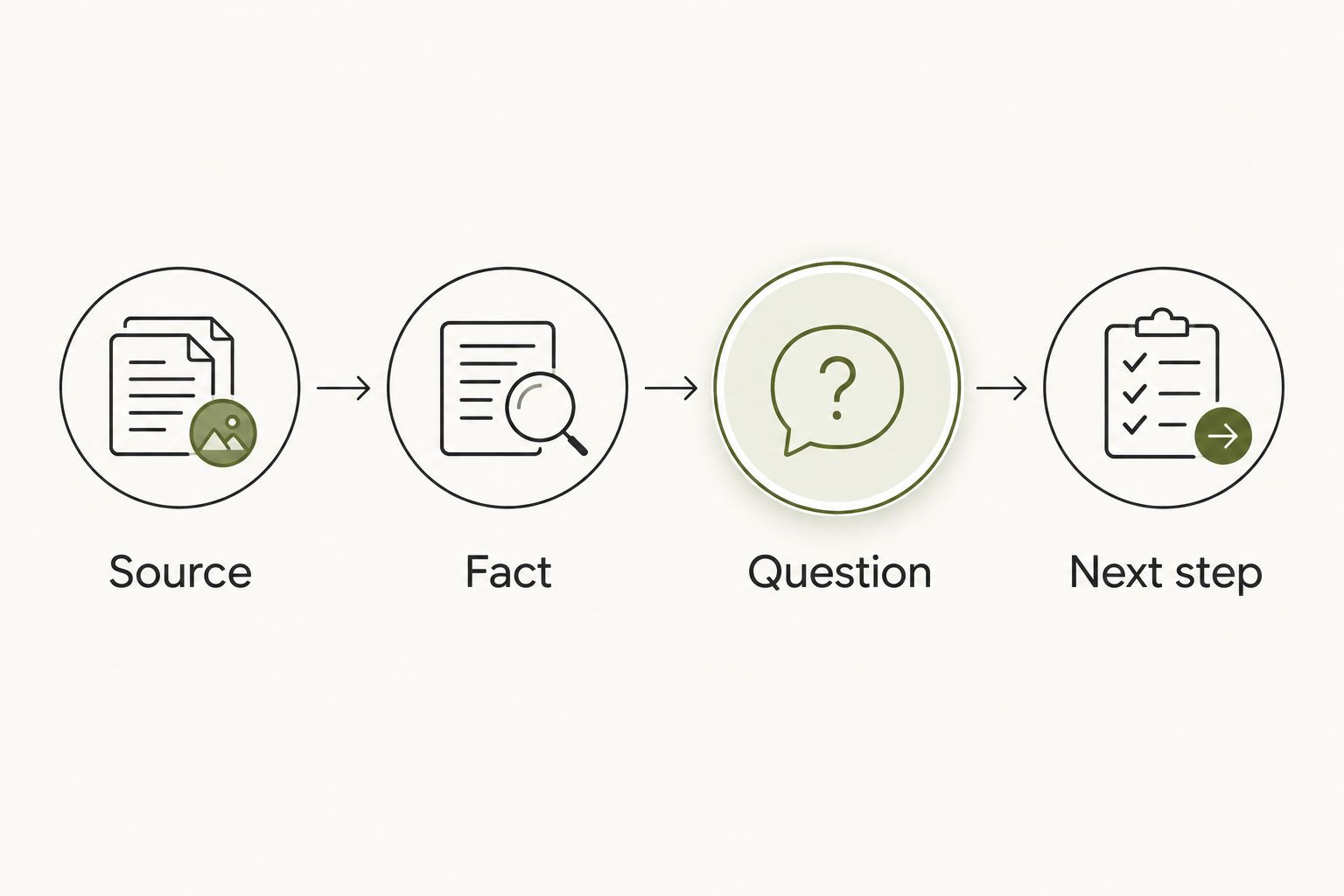
Keep the chain visible: source, fact, question, next step. That makes it easier to catch a mistaken inference before it becomes an unnecessary message or commitment.
- Source: identify the original note or conversation.
- Fact: preserve the detail you can verify.
- Question: state what still needs your judgment.
- Next step: choose an action you approve.
A first-week review
Evaluate the routine over 7 days as a suggested trial of your own workflow. This is not a promised product result. Review whether a captured detail helped you do something useful, and whether the process respected the boundaries you set.
For a 2026 buying decision, distinguish an available capability from an intended one. A demonstration, an exploratory concept, and a shipped function are not interchangeable. Base your decision on the current offer rather than filling gaps with assumptions.
Look for a specific payoff: the explanation you rewrote, the question you clarified, or the call you chose to make. If the routine produces more material but no useful decision, reconsider the routine before adding more sources.
- Review the action you originally chose.
- Identify the captured detail that helped.
- Record whether you followed through.
- Check whether the process added unwanted work.
- Keep, simplify, or stop the routine.
Options for different owner workflows
The best starting point depends on where your process breaks. Written notes support deliberate selection. Voice notes let you talk without composing a written sentence first. A reflection wearable offers a different way to return to what you have expressed.
These are workflow choices, not interchangeable business systems. None removes your responsibility to verify a statement or approve a customer-facing action.
| Option | Best for | Main benefit | Key limitation |
|---|---|---|---|
| Written notes | Owners who want to select details deliberately | You choose the wording and what to leave out | You must make time to write and revisit the note |
| Phone voice notes | Owners who prefer to talk it through | You can preserve your own spoken account | A recording still needs review and an action decision |
| Moonshot | Owners who want a question back while reflecting | It hears you out and helps turn one thing into a next step | It makes no calls and moves no money |
| An existing task list | Owners who already know the next step | The chosen action has a place in the work queue | A task entry does not resolve an unclear decision |
Choose the option that addresses the missing part of your workflow. If the decision is already clear, another capture method is not the first thing to fix. Put the action where you will actually review it.
For 2026, compare wearable options against this manual baseline. Ask what changes in your day, not how many features appear in a description. Also check the current terms, permissions, and available functions before committing to a device.
Common mistakes small business owners make
Whole-business scope
Starting with every conversation creates a difficult evaluation. You cannot tell whether the device helped with a customer question, an internal decision, or neither.
Choose one matter first. Expand the routine only after you can explain which detail helped you follow through and why that detail belonged in the process.
Assumptions presented as facts
A short reply from a customer does not establish what the customer thinks. Treating an interpretation as evidence can send you toward the wrong action.
Preserve the original statement. Write the interpretation separately, then choose whether you need a clarifying question rather than a response built on an assumption.
Recording without agreement
An owner’s interest in better notes does not settle another person’s expectations. Customer conversations and staff discussions deserve an explicit boundary.
Explain what you propose to capture and check the rules that apply. When recording is not appropriate, make your own limited note afterward without presenting it as a complete record of the exchange.
Capture mistaken for completion
Saying that you should contact a supplier is not follow-through. It is the beginning of a decision about what you need to ask and when you will ask it.
Choose the next step, then put it into your work routine. The point is not to collect more unfinished intentions; it is to show up for the one you chose.
Future promises treated as current functions
A planned capability does not answer a present business requirement. Nor does a polished illustration establish how a device behaves in your actual work.
Check the current offer and keep your first-week expectation specific. For a 2026 purchase, judge the function you can evaluate now, not the broadest possible version of the idea.
FAQ
What are AI wearables for small business owners useful for?
AI wearables for small business owners are useful to evaluate for capturing input, reviewing a detail, and choosing a next step. Start with one owner-controlled task and compare the experience with a written or spoken note.
Is a wearable better than taking notes on my phone?
A wearable is not automatically better than a phone note. Use phone notes as your baseline, then judge whether the wearable addresses a specific difficulty with capture or reflection.
Who is Moonshot for?
Moonshot is for owners who want to talk it through and choose the next step themselves. It hears you out, asks a good question back, and helps you learn from your own life.
Can I use a wearable during customer conversations?
Check recording requirements and obtain appropriate agreement before capturing a customer conversation. Start with your own reflection afterward when a shared recording is not needed or appropriate.
Will a wearable contact customers for me?
Do not assume a wearable will contact customers for you. Moonshot makes no calls and moves no money; review each proposed business action separately and give your yes before anything goes out in your name.
How should I evaluate a wearable in the first week?
Evaluate whether one captured detail helped you choose and complete a useful next step. Also review whether the process respected your source boundaries and added work you did not want.
What should I check before buying a wearable in 2026?
Check current functions, recording controls, source permissions, and the terms of the offer before buying a wearable in 2026. Distinguish a planned capability from one that is available to use.
One last thing
A useful result does not have to be a new idea. Sometimes the earlier note already contains the answer: the customer needed a clearer explanation, and you knew which sentence was confusing.
Before adding another source, return to that detail. Choose the next step yourself. The call you finally make matters more than the record of every time you considered making it.