 moonshot

Teachers’ AI wearables are body-worn devices with software that processes captured information, with the aim of turning an observation into a useful next step. This guide separates private reflection from classroom recording, where students, school rules, and other people’s information change the decision.
- AI wearables for teachers should start with private reflection, not classroom recording.
- Moonshot fits teachers who want to talk it through and choose their own next step.
- A notebook or voice memo lets you test a teacher reflection routine before choosing a wearable.
- Check school approval and recording controls before capturing anyone else’s conversation.
Why AI wearables matter for teachers
A lesson ends, another class arrives, and the small thing you wanted to change gets crowded out. Perhaps your instructions needed an example. Perhaps you meant to ask a colleague how they explain the same idea. The useful result is not a longer record of the day. It is remembering what you wanted to do differently.
AI wearables for teachers belong in that discussion only when they serve a clear purpose. Start with your own reflection, not a recording of your students. You can say what you noticed after class without including names, grades, or a student’s exact words.
Moonshot is a wearable that hears you out and asks a good question back. Moonshot fits teachers who want to talk it through and choose their own next step. That is a personal reflection use case, not evidence that the device is approved for classroom recording.
For your 2026 decision, keep those uses separate. A device suited to noticing something in your own day is not automatically suited to handling school information. Convenience does not settle permission.
A teacher’s starting point
Imagine that you wrote a short note after an earlier lesson: the explanation needed a worked example. Before teaching the topic again, you read that note and add an example to your plan. The earlier observation makes the next moment useful.
That scene works without a wearable. It gives you a fair test for one: does the device help you carry an observation into a decision, or does it merely create more material to review?
Your teaching judgment stays central. A captured conversation records what someone said; a public source supplies information published elsewhere. Neither establishes what a student understood. Your interpretation is a separate claim, and you should label it that way.
A practical setup for 2026
1. Your use case
Choose a task that belongs to you. Private reflection after a lesson is a narrower starting point than recording a whole school day. It also makes the result easier to assess: you either changed an instruction, prepared a question, or decided not to act.
Start manually. Write a sentence in a notebook or make a private voice memo on an approved device. Try a 5-minute reflection after work. That duration is a suggested limit, not a claim about how long a device needs.
Avoid turning the trial into another obligation. You do not need an account of every lesson. Choose one observation that you want to carry into tomorrow, and stop when you have written the next step.
- Pick one task, such as revising an explanation before repeating a lesson.
- Describe your own teaching choice rather than an identifiable student’s behavior.
- Set a 5-minute limit so reflection does not become a second planning session.
- Define the result in plain words: add an example, ask a colleague, or leave the plan unchanged.
2. School permission
Before bringing a recording device into school, check the rules with the person responsible for technology or student information. Ask about the exact activity you intend to do. Permission to wear a device is not the same as permission to capture classroom conversations.
The manual route is straightforward: reflect privately, away from students, and leave school information out. A wearable becomes an option only after you understand its controls and the school’s requirements. Other people also need to understand when a conversation is being captured.
Treat a 2026 purchasing decision as separate from a school approval decision. A preorder, a product description, or your own willingness to use a device does not answer the school’s questions.
- Ask whether personal recording devices are permitted in the spaces you use.
- Describe the information you intend to capture, not just the device category.
- Confirm the process for informing people and obtaining any required permission.
- Keep the device out of classroom recording until the relevant approval is clear.
3. A private reflection routine
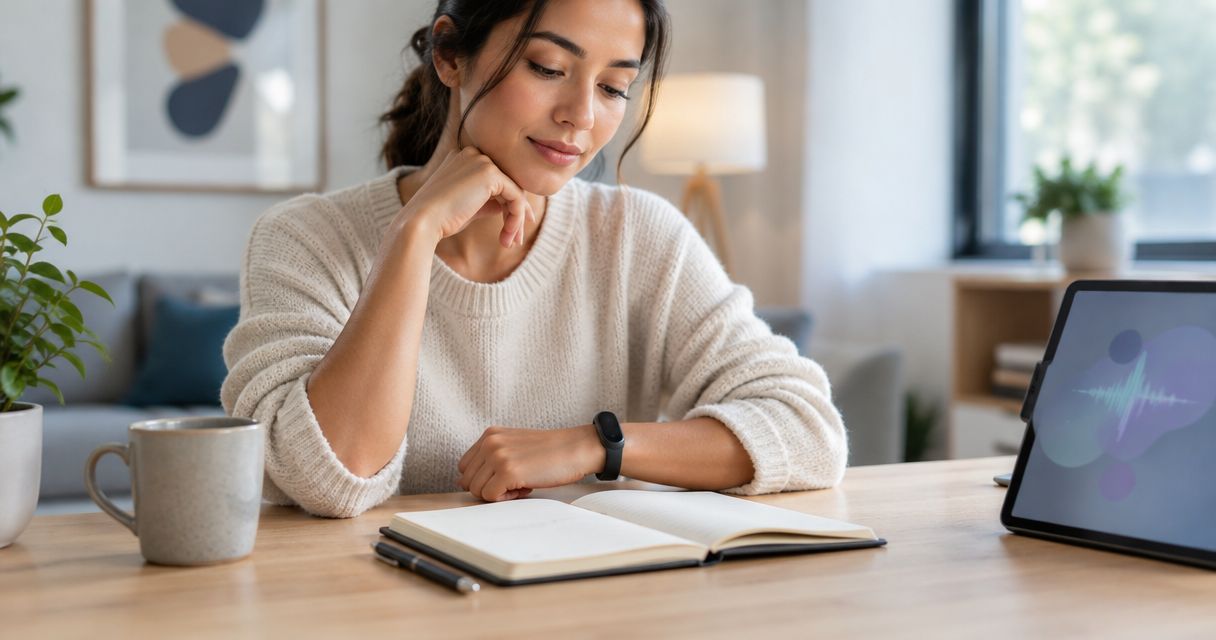
Begin with something you can say without a name or quotation: your explanation ran ahead of the example, or you want to make an instruction shorter. A notebook lets you capture that thought without opening another source. A voice memo lets you talk it through, but still requires a suitable place to record.
Moonshot offers a different shape for that moment: it hears you out and asks a good question back. Its stated purpose is to help you learn from your own life. Keep the teacher use case within that description rather than treating it as a classroom analysis product.
For an initial week, choose one private reflection and one next step. The test is useful follow-through, not the amount you capture. You should be able to say what you chose and why.
- Choose a private setting where other people’s conversations will not enter your reflection.
- Say it once, in your own words, without a student’s name or identifying details.
- Separate what happened from what you think it means.
- Choose whether the observation deserves a next step at all.
4. Facts and interpretations
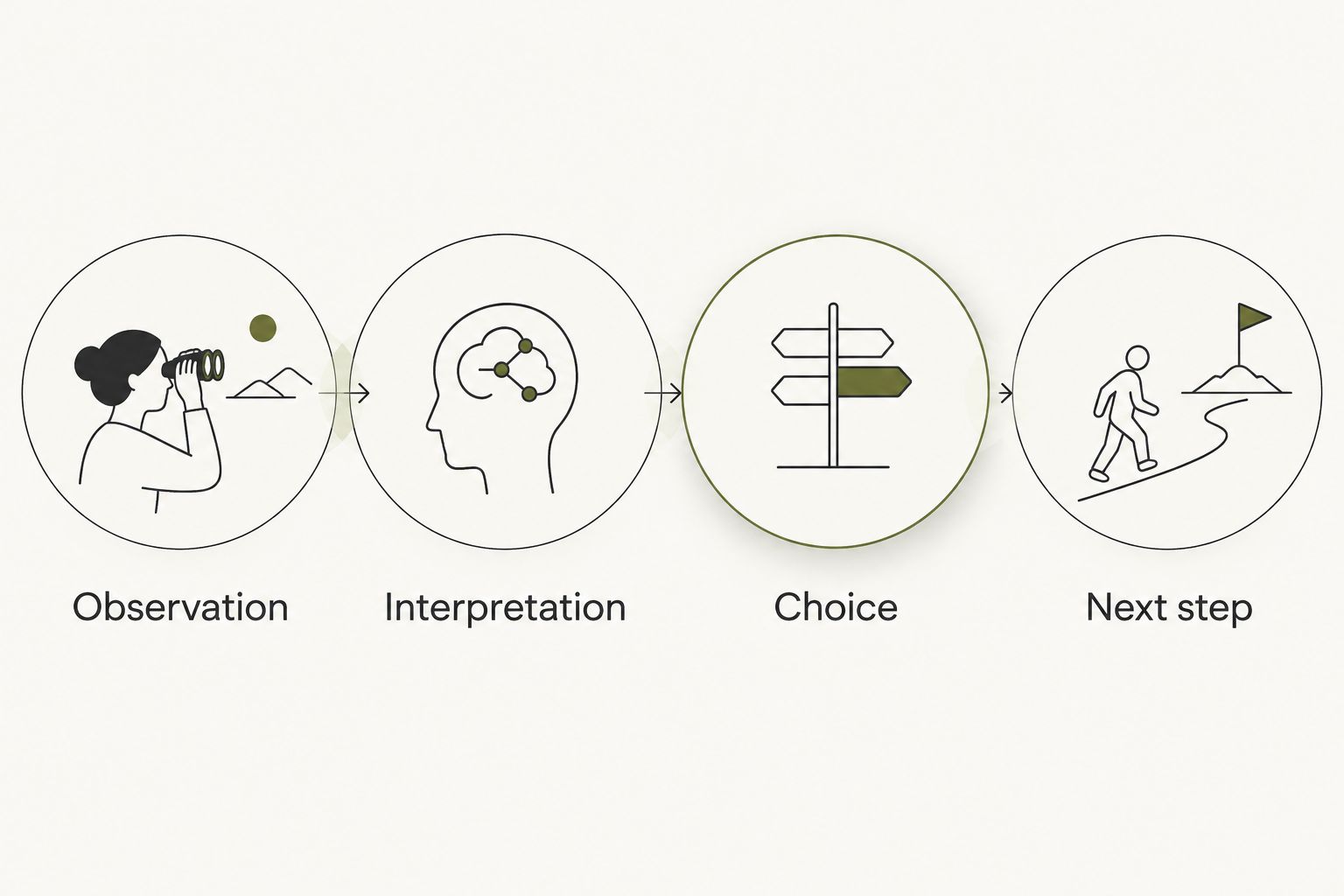
Use a simple note before asking any device to help you think. Write the observation first. Then write your interpretation separately. Finish with a decision you can make yourself.
For example, you explained a task twice. That is an observation. The instruction was unclear is an interpretation. Rewrite the opening instruction is a possible choice. Keeping those apart prevents a confident summary from becoming a stronger claim than the evidence supports.
This distinction matters in your 2026 evaluation because fluent wording can hide uncertainty. A useful question invites you to inspect the interpretation; it does not turn an inference into a fact.
- Observation: Record something you directly noticed, without adding an explanation.
- Interpretation: Label what you think the observation means.
- Choice: Decide whether to change something, ask a question, or do nothing.
- Next step: Write the action you have actually chosen.
5. Your approval boundary
A question is not an instruction to act. A suggestion is not permission to contact someone. If a reflection brings a colleague or a parent to mind, you decide whether to reach out and what to say.
Moonshot turns one thing into a next step, with your yes on each one. It makes no calls and moves no money. Do not treat that description as a promise to send messages, update school records, or operate school systems.
Keep priorities separate from permissions. Choosing to work on lesson preparation does not grant access to a calendar, a conversation, or a school document. Assess each source separately before granting access wherever that option exists.
- Choose the priority yourself rather than accepting every suggested task.
- Review the next step before agreeing to it.
- Grant each information source separately rather than assuming broad permission.
- Keep messages to families and colleagues under your direct review and control.
6. A bounded trial
Use a 7-day trial of your routine, whether you start with paper, a voice memo, or a wearable. This is a suggested evaluation period, not a product performance claim. Keep the task narrow enough that you can tell what changed.
At the end, look for a concrete result: an example added to a lesson, a question prepared for a colleague, or a decision to stop revisiting something that needs no action. Captured material is not the result. Your chosen action is.
For a 2026 purchase, assess current functions separately from planned ones. A planned feature cannot satisfy today’s requirement. Check the current product information rather than assuming school-system access, recording controls, or other capabilities from the category label.
- Use the same reflection task throughout the 7-day trial.
- Note whether each reflection produced a useful decision or more work.
- Check current functions against your task before choosing hardware.
- Stop if the routine depends on information you should not capture.
- Keep the simplest method that helps you show up for the next step.
Options for teacher reflection
There is no single best format for every teacher. Choose by the kind of information involved and the work you want to do afterward. For private reflection, test the routine before choosing the hardware. For classroom information, resolve school requirements first.
| Option | Best for | Practical advantage | Key limitation |
|---|---|---|---|
| Paper notebook | Teachers testing a short reflection habit | You control exactly what you write | You must revisit the note and decide what to do |
| Private voice memo | Teachers who prefer to talk it through | You can capture your own wording | Audio can include other people if the setting is unsuitable |
| Moonshot wearable | Teachers seeking personal reflection with a question back | It hears you out and leaves the next step to your yes | Its personal reflection description does not establish classroom approval |
| School-approved recording workflow | Teachers with an authorized school recording task | The task can follow the school’s designated process | Approval for one purpose does not establish permission for every purpose |
A notebook is not less useful because it is simple. A wearable is not more useful because it produces more material. Match the method to the task, then consider the extra handling each method requires.
Common mistakes teachers make
Personal reflection becomes classroom capture
A teacher’s private note about an explanation is different from audio containing student conversations. Do not slide between those uses because the device is already with you. Set the boundary before entering the room, and follow the school’s process for anything beyond private reflection.
An inference becomes a student fact
A summary that says a student was confused carries more certainty than an observation that the instruction needed repeating. Keep your interpretation visible. If you need to understand what a student understood, use an appropriate teaching check rather than treating a device’s wording as evidence.
Future functions drive the purchase
A roadmap describes an intention, not a function you can rely on today. For your 2026 decision, list the current functions needed for your chosen task. Do not buy for an assumed connection to school systems or an assumed recording safeguard.
Every observation becomes homework
A useful reflection does not need to produce a task every time. Sometimes the next step is to leave the lesson alone. Your yes matters because you choose priorities; you are not obliged to follow every question into another commitment.
More capture replaces follow-through
A growing collection of notes can still leave tomorrow’s lesson unchanged. Choose one observation and act on it before adding another system. The practical payoff is the example you prepared or the conversation you chose to have, not a fuller account of the day.
FAQ
What are AI wearables for teachers useful for?
AI wearables for teachers can support private reflection when their current functions match that task. Start with your own observations outside class, and treat classroom recording as a separate approval decision.
Can I wear a recording device in my classroom?
Check your school’s rules before wearing or using a recording device in the classroom. Permission to wear it does not by itself establish permission to capture students or other people.
Is a wearable better than a notebook for teacher reflection?
A wearable is not automatically better than a notebook. A notebook is a clear starting point for testing whether a short reflection leads to a useful next step.
Is Moonshot intended for recording my students?
Moonshot’s stated purpose is personal reflection: it hears you out, asks a good question back, and helps you notice what your days keep saying. That description does not establish approval or suitability for recording students.
What should I leave out of a private teaching reflection?
Leave out student names, identifying details, and other people’s quoted conversations. Describe your own teaching choice and separate the observation from your interpretation.
Will Moonshot make calls or take action without my approval?
Moonshot makes no calls and moves no money. Its described next step requires your yes; do not assume that it sends messages or changes school records.
How do I evaluate a teacher reflection routine in 2026?
Try one narrowly defined reflection task for 7 days and assess whether it led to a useful decision. Check current product functions and school requirements separately before choosing a wearable.
One last thing
Before adding a device, write tomorrow’s smallest useful change on paper. Add the example. Shorten the instruction. Prepare the question you wanted to ask.
Then ask what help you actually need to follow through. If you want to learn from your own life, start with something you have chosen to notice. The next step should still be yours.