 moonshot

Therapists’ use of AI wearables is a way to reflect on their own day with the aim of choosing a useful next step, not a shortcut to recording client sessions. This 2026 guide separates personal reflection from professional documentation, where another person’s confidential information changes the decision.
- AI wearables for therapists should start with personal reflection outside client sessions, not confidential recording.
- Moonshot fits people who want to talk it through and choose the next step themselves.
- Written notes offer a straightforward alternative when you do not want to capture audio.
- Keep client details out of personal wearables; evaluate professional documentation systems separately.
The Moonshot preorder describes a consumer wearable that hears you out and asks a good question back. Evaluate that personal-use promise separately from any requirements for handling client information. A useful question about your own day is not permission to capture someone else’s conversation.
Why AI wearables matter for therapists
A counselor finishes work and remembers something they said earlier, outside a session: they wanted to call a friend. Later, that thought gives them something concrete to decide. Do they still want to make the call? If yes, when will they show up?
That is the personal-use opportunity. It concerns your own priorities, not an interpretation of a client’s words. You can talk it through without turning a private professional encounter into material for a consumer device.
The distinction matters because a therapist’s day contains different kinds of information. Your intention to take a walk is yours to discuss. A client’s account of their life needs a separate professional decision about collection, access, and handling.
Start with the boundary, then evaluate the device. Do not let an appealing personal feature answer a professional-use question it does not address.
For your 2026 evaluation, separate these questions:
- What personal moment do you want to capture?
- Whose information would that capture include?
- What action do you want to choose afterward?
- Does the activity belong in a consumer device or a professional workflow?
Personal-use setup
Choose one personal outcome
Start manually. Write down one thing you want to follow through on outside your client work. Choose something observable: make the call, prepare tomorrow’s lunch, or return to an idea you keep mentioning. Do not begin with a broad goal such as remembering everything.
A small outcome gives you a fair way to judge a wearable. If you want to call your friend, success is deciding whether to call and then making the call yourself. A longer record of your day is not the same result.
Keep the first week narrow. You are evaluating whether the process helps you act on something you chose, not whether a device can manage your life. One useful decision is enough to establish what you want from the routine.
- Write one personal priority in your own words.
- Choose an action you can complete yourself.
- Keep client names and session details out of the goal.
- Define what follow-through looks like before trying a device.
Set your capture boundary
Use a written note first if you only need to preserve a thought. Writing lets you select what belongs in the record without capturing surrounding speech. That selection is especially useful when your workday includes confidential conversations.
Before using any wearable, decide where it belongs and where it does not. For this personal-use routine, exclude client sessions, professional consultations containing client details, and shared spaces where other people’s speech would enter the capture.
Do not assume that wearing a device means it should collect everything around you. Establish how capture starts and stops, then check those controls before bringing it into your routine. A device you cannot confidently keep outside confidential conversations does not fit this use case.
- Capture your own reflection in a private setting.
- Keep the wearable outside client conversations.
- Check how to start and stop capture.
- Avoid including another person’s identifiable information.
- Use a written note whenever the capture boundary is unclear.
Talk through one moment
The manual route is simple: say or write what happened, then ask yourself what matters about it. You might note that you brought up a creative idea again during dinner. The next question is not what that says about your personality. It is whether you want to give the idea some time.
Moonshot offers a different route through that personal moment: it hears you out, asks a good question back, and helps turn one thing into the next step with your yes. Use it to examine your own choice, not to produce a conclusion about someone else.
Moonshot is best for therapists who want to talk through their own day, not use this guide to document client sessions. Its role here stays personal. You remain responsible for choosing what matters and what happens next.
- Choose one moment outside your client work.
- Say it once without adding confidential background.
- Separate what happened from what you think it means.
- Answer the question in your own words.
- Leave the next step undecided until you give your yes.
Separate the source from the interpretation
On paper, label what you actually know before deciding what to do. A captured conversation records something someone said; it does not establish that every statement was correct. A public source supplies a different kind of information. Neither should quietly become your own conclusion.
For example, saying that you mentioned an idea again is an observation. Deciding that the idea deserves attention is your judgment. You can choose to explore it without treating that judgment as a fact the device discovered.
Apply the same distinction when evaluating a wearable in 2026. Ask where information comes from and what the product actually supports. Grant each source separately if a product offers source connections; do not infer connections or capabilities from a general description.
- Label a captured statement as a captured statement.
- Identify a public source separately from personal material.
- Treat suggested meaning as an interpretation.
- Check current functionality rather than assuming planned features exist.
- Approve each source separately before including it.
Choose the next step yourself
You do not need a wearable to turn a thought into an action. Write the action on a note or put a reminder in a system you already use. Make the wording concrete enough that you know what to do when you see it again.
For a personal wearable, use the same standard. A question can help you choose, but the choice remains yours. Your yes to considering an action is also different from permission to send something in your name.
Moonshot makes no calls and moves no money. If your next step is to call a friend, you make the call. That boundary keeps the payoff clear: you have chosen what to do, rather than handed over the decision.
- Name the action with a verb.
- Confirm that the action reflects your priority.
- Decide whether to do it now or set a reminder.
- Keep approval to capture separate from approval to act.
- Send messages and make calls yourself.
Review the first week
Use a suggested 5-minute review after 7 days. These are practical review limits, not product performance claims. Look at whether the routine helped you follow through on the personal outcome you chose.
A written note is enough for this review. Record the next step, whether you wanted it, and what you did. Do not collect more personal material just to make the evaluation feel thorough. The point is to judge usefulness, not volume.
Keep your 2026 trial focused on week one. If the process gives you more material but no clearer choice, simplify it. If a note delivers the same useful result, you have a reason to stay with the note.
- Compare the result with your original personal priority.
- Check whether every next step had your yes.
- Identify any information you did not intend to capture.
- Keep the method that makes the choice clearer.
- Stop the trial if you cannot maintain your capture boundary.
The sequence stays the same whether you use paper or a wearable: choose a personal priority, control the capture, talk it through, approve the next step, and review the result.
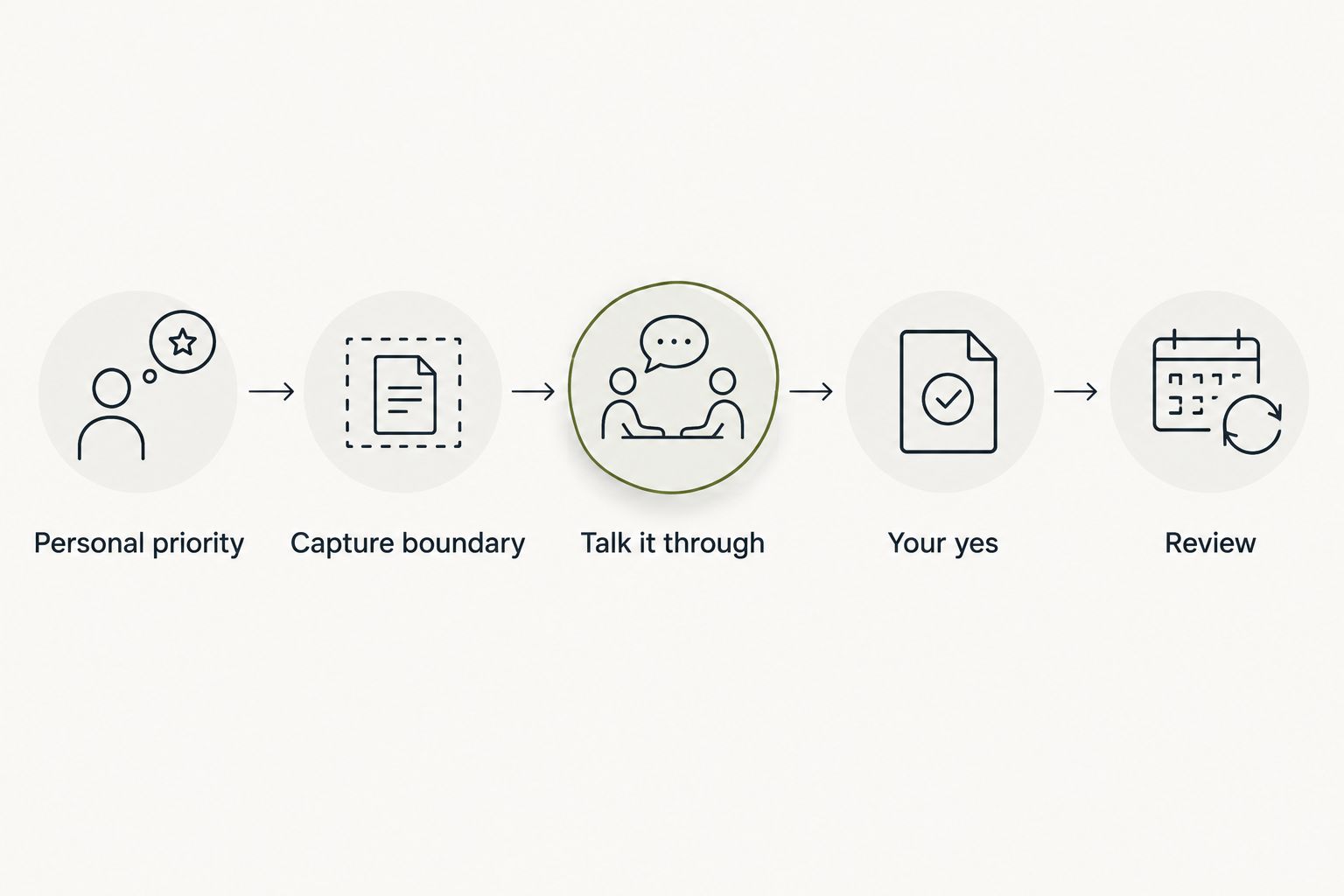
Options for your routine
Compare methods by their job, not by how much information they collect. A note can hold an intention. A reminder can bring it back at a chosen time. A consumer wearable can support a personal reflection. Professional documentation needs its own evaluation.
The table separates those jobs without treating any option as a substitute for all the others. In 2026, check current product information before relying on a feature or connecting a source.
| Option | Best for | Useful distinction | Key limitation |
|---|---|---|---|
| Written personal notes | Selecting exactly what you want to record | You choose the wording and leave out surrounding conversation | You supply the questions and return to the note yourself |
| Personal reminders | Following through on an action you already chose | A reminder gives a chosen task a place in your routine | It does not help you decide whether the task matters |
| Moonshot | Talking through your own day and choosing a next step | It hears you out and asks a good question back | You still choose the action; it makes no calls and moves no money |
| Separately evaluated professional documentation system | A defined client-documentation workflow | It can be assessed against the requirements of that professional job | It requires a separate review; a consumer-use recommendation does not establish suitability |
Choose the smallest method that does the job. If you already know the next step, a reminder deserves consideration before a new device. If you want to talk it through, evaluate the quality of that experience without adding client information to the test.
For professional documentation, require evidence about the intended workflow, information handling, access, and applicable obligations. Do not transfer a personal-use verdict into that decision. The questions are different, even when both tools involve recording or summarizing information.
Common mistakes therapists and counselors make
Mixing personal reflection with client material
A reflection about your own day can become a client account if you include names, distinctive events, or session details. Removing a name does not by itself make the rest appropriate for a consumer device. Keep this routine focused on personal moments outside your client work.
Treating capture as understanding
A recorded statement and its meaning are different things. Preserve the distinction between what you said and what you decide about it. You do not need to accept a suggested interpretation to learn from your own life.
Combining permission into one decision
Agreeing to capture something is not blanket permission to connect sources or act. Decide separately what enters the system, what matters to you, and what happens next. Nothing should go out in your name without your yes.
Judging the device by the size of the record
A large record is not proof of useful follow-through. Return to the original personal outcome: did you choose the next step and act on it? If your only result is more material to review, reduce the scope rather than capturing more.
FAQ
What are AI wearables for therapists useful for?
AI wearables for therapists can be evaluated for personal reflection outside client sessions. Start with one personal outcome, such as deciding whether to make a call, and keep confidential professional information out of that routine.
Can I use a consumer wearable to record client sessions?
Do not use a personal-use recommendation as approval to record client sessions. Client recording requires a separate professional evaluation of consent, information handling, intended use, and applicable obligations.
Is Moonshot a fit for counselors?
Moonshot fits counselors who want to talk through their own day and choose a personal next step. It hears you out and asks a good question back; this guide does not recommend it for client-session documentation.
Is a wearable better than keeping written notes?
A wearable is not automatically better than written notes. Notes fit deliberate, selective capture; a wearable deserves consideration when you want to talk something through rather than simply preserve an action you already chose.
Does a wearable's question count as a fact about me?
A question or suggested interpretation is not a fact about you. Separate what you actually said from what you decide it means, and choose whether any next step deserves your yes.
How should I try a wearable during the first week?
Choose one personal outcome and keep client information out of the trial. Use a suggested 5-minute review after 7 days to judge whether the routine helped you choose and complete a next step.
What should I check before buying a wearable in 2026?
Check capture controls, source permissions, current functionality, and the boundary between suggestions and actions. Choose a product for a defined personal job rather than assuming it also meets professional documentation requirements.
One last thing
Start with the call, not the record. Before choosing a wearable, write down the person you want to call and decide whether that is still your priority. If it is, make the call yourself.
You do not need a detailed account of your day to take that step. Let the result set the standard for any device you consider: it should help you choose what matters, with your yes, while leaving confidential professional conversations outside the routine.