 moonshot

Best for talking a thought through: Moonshot. Best for keeping your spoken wording: a phone voice note. Best for reflection without audio capture: a written journal. This guide to the best AI pendant devices in 2026 separates the wearable choice from simpler alternatives, so you can choose for the moment you actually want help with.
- For the best AI pendant devices, start with the task you want help with, not the device shape.
- Moonshot is best for people who want to talk it through and choose the next step themselves.
- Phone voice notes suit spoken capture; written journals suit reflection without audio recording.
- Check recording permissions and current product details before choosing a wearable.
Why this matters
You remember mentioning a friend you meant to call. Later, when there is time to make the call, the thought has slipped behind something else. The useful outcome is not a longer record of your day. It is remembering what mattered and deciding whether to act.
Moonshot hears you out, asks a good question back, and helps you notice what your days keep saying. You choose what to do with that. The relevant question is whether you want help reflecting, a recording to revisit, or a place to write.
A pendant, a voice note, and a journal are not interchangeable. For your 2026 shortlist, separate those jobs before comparing physical devices. A wearable is not automatically the right answer just because it is wearable.
What makes the best pendant for your needs
Use these criteria before looking at a feature list. Each one should connect to something you can describe from your own day.
- Purpose: Decide whether you want to talk it through, preserve wording, or make a written observation. Those are different jobs.
- Permission: Establish what gets captured, when capture starts, and how other people know. Your permission does not replace theirs.
- Useful response: Look for a clear distinction between a question, a factual statement, and an interpretation. A useful question leaves the answer with you.
- Control: Check how you choose priorities and grant access to each source. Nothing should go out in your name without your yes.
- Physical fit: Check the current information on wearing, charging, and everyday handling. Do not infer these details from the word pendant.
- Follow-through: Ask whether the experience helps you choose something you can actually do. More captured material is not the same as a useful next step.
For a 2026 purchase, read current product information rather than treating an announcement as proof of a shipped capability. Separate what a device does now from what its maker plans to add.
Options at a glance
The ranking below assigns each option a different job. Only the first is a dedicated wearable; the other two are alternatives that help you decide whether you need one.
| Option | Best for | Standout distinction | Key limitation |
|---|---|---|---|
| Moonshot | Talking a thought through | Hears you out and asks a good question back | Makes no calls and moves no money |
| Phone voice note | Preserving your spoken wording | Keeps an audio recording for you to revisit | Recording alone does not choose a useful next step |
| Written journal | Reflection without audio capture | Lets you select and write what matters | Does not preserve the original spoken audio |
Choose the job before the form factor. If you only need to keep a sentence, you do not need to turn that decision into a search for a pendant.
1. Moonshot: best wearable for talking a thought through
Moonshot is a wearable that hears you out and asks a good question back. Its stated purpose is to help you learn from your own life, including noticing something you keep bringing up. You decide what deserves attention and what happens next.
Consider the friend you mean to call. The useful outcome is not the device making the call for you; it makes no calls. The useful outcome is turning that thought into a next step you choose, with your yes on each one.
That is a narrower promise than managing your day. It also gives you a clearer way to judge the experience: did the question help you decide what you wanted to do?
Pros:
- Hears you out rather than making reflection depend entirely on writing.
- Asks a good question back, leaving you to find the answer.
- Connects reflection to a next step with your approval.
- Leaves the choice of priorities with you.
Cons:
- Does not make calls on your behalf.
- Does not move money.
- Its stated purpose is reflection and follow-through, not replacing every way you keep information.
Best for: People who want to say it once, talk it through, and choose what to do themselves.
Verdict: Buy for the stated reflection use case, not for autonomous errands. Check current preorder details and recording controls before committing. Judge the promise within week one rather than expecting a long-term account of your life.
2. Phone voice note: best for preserving your spoken wording
A phone voice note records something you say so you can play it back. It suits a thought whose wording matters: an opening sentence, an explanation you finally found, or a reminder you want to hear in your own words.
You still decide when to record and when to revisit it. A recording is a record, not a decision. If the note says you want to call a friend, you must still decide whether that call matters now.
This option earns its place in a 2026 comparison because it answers a basic question: is audio capture enough? If it is, your selection process can stop there.
Phone voice note pros:
- Preserves the spoken words you record.
- Lets you revisit the original audio rather than relying only on a written paraphrase.
- Gives you a straightforward starting point for testing whether spoken capture suits you.
Phone voice note cons:
- Playback takes your attention again.
- Recording alone does not ask a useful question back.
- Audio involving other people requires an explicit conversation about permission.
Best for: People who want to keep what they said and are comfortable doing the reflection themselves.
Verdict: Buy into this approach when capture is the whole job; skip a dedicated pendant for that reason alone. Before changing devices, try recording a thought and returning to it when the decision becomes relevant.
3. Written journal: best for reflection without audio capture
A written journal lets you choose what enters the record. You can write a sentence after a conversation without recording the conversation itself. That makes it a distinct option, not a lesser version of a wearable.
Writing also lets you separate what happened from what you think it meant. You might record that a friend mentioned moving, then separately write that you want to check in. The first is an observation; the second is your chosen response.
A journal does not preserve tone or the original audio. That limitation matters if exact spoken wording is your priority. It matters less if you want a selective account you write yourself.
Written journal pros:
- Supports reflection without making an audio recording.
- Lets you select what to include and what to leave out.
- Makes room for an observation and a separate next step.
Written journal cons:
- Requires you to put the thought into writing.
- Does not retain the original sound of a conversation.
- Does not independently ask a question back.
Best for: People who prefer deliberate, written reflection and do not want audio capture for this task.
Verdict: Buy into this approach when writing helps you think; skip it as a substitute for an audio record. Use it because the act of writing suits you, not because every thought needs documenting.
Recording boundaries
Before wearing a device around other people, establish the boundary in plain language. What will be captured? How will they know? What happens if someone does not want a conversation recorded?
Your choice to wear something does not settle those questions. Ask about permission before capture, and check the rules that apply where you are. A device's physical presence is not an explanation of its recording behavior.
Keep source access separate, too. Permission for one source should not be treated as permission for every source. When reviewing product information, look for an explicit explanation of those choices rather than assuming them from broad language.
A captured conversation and a public source also serve different purposes. The conversation records what someone said in that setting. A public source can support a factual claim, but it does not establish what that person intended.
Do not turn an interpretation into a fact. If you said you miss a friend, that does not establish how the friend feels. It gives you something to consider and, if you choose, a reason to reach out.
A week-one decision
For your 2026 decision, choose a small, real situation. Do not begin by asking a device to account for your entire life. Start with something you already want to talk through.
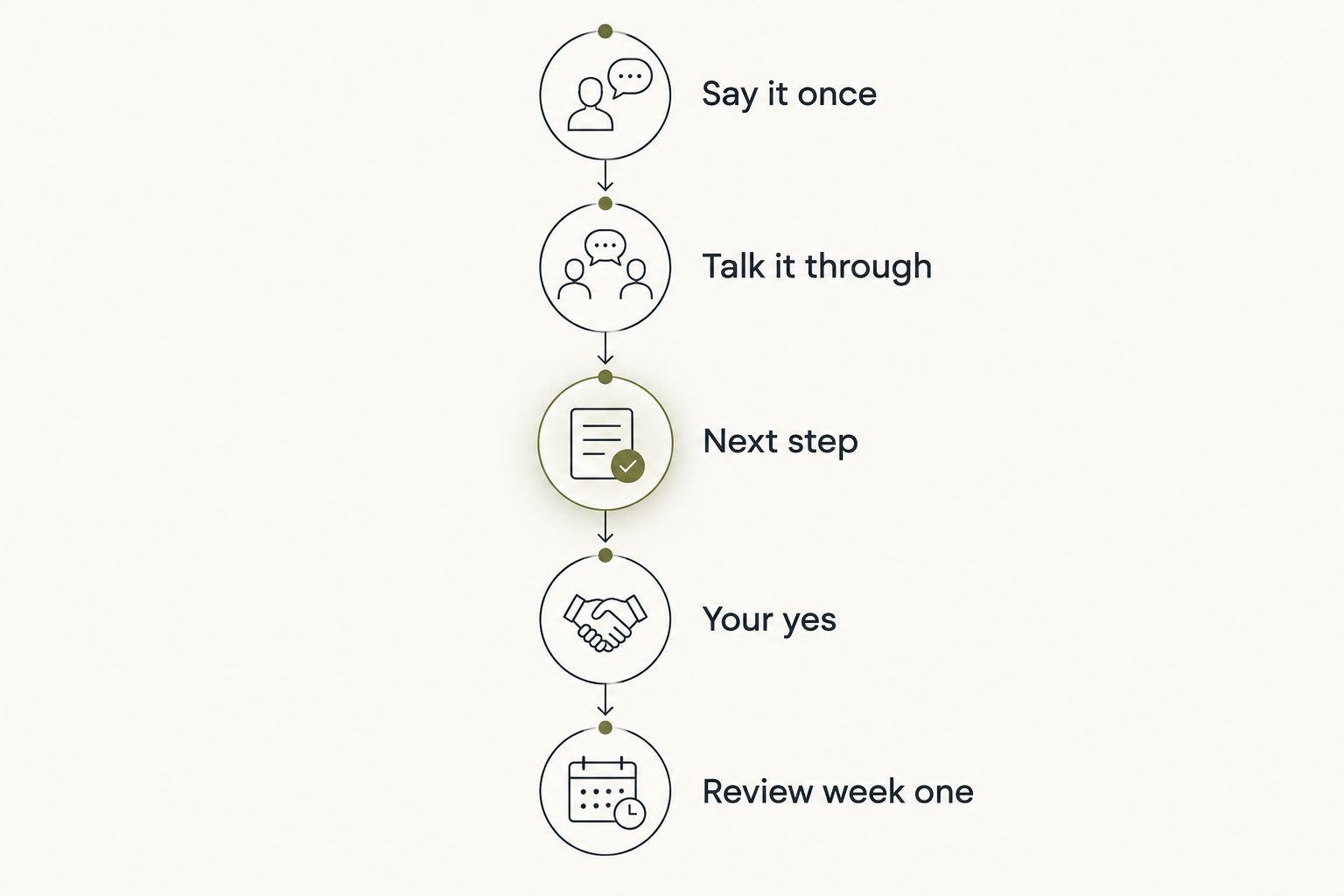
Say it once
Use 1 sentence to name the thing: you want to call someone, return to an idea, or decide whether a commitment still deserves your attention. This is a suggested exercise, not a device limit. Choose your own words.
Talk it through
Notice what kind of help you want. Do you need to hear your wording again, write an observation, or consider a question? That answer tells you which option belongs in your routine.
Choose the next step
Pick 1 next step that you can carry out yourself. Calling a friend is a next step; collecting more reminders about calling is not the same outcome. You can also decide not to act.
Give your yes
Keep approval separate from suggestion. A useful question is not permission to act in your name. Your yes belongs to each action, not to an open-ended promise of future actions.
Review week one
After 7 days, ask whether this approach helped with the situation you chose. This is a suggested review window, not a performance claim. Look for a decision you made, a thought you understood better, or follow-through you chose.
How the options are ranked
This ranking follows purpose, permission, useful response, control, physical fit, and follow-through. The order gives the wearable reflection option first, then separates audio capture from written reflection. It is not a hardware performance ranking.
No battery, microphone, comfort, or recording-quality score decides the order here. Those require current product details and direct comparison. Use this guide to choose the kind of help you want; use verified specifications to assess the physical device.
Which option should you choose?
Choose Moonshot if you want a wearable that hears you out, asks a good question back, and leaves the next step with you. Choose a phone voice note if keeping the spoken wording is enough. Choose a written journal if you want to reflect without recording audio.
For an undecided reader, the default is to name the unmet need first. If you already keep notes but want a question that helps you think, the wearable use case is relevant. If you simply need a record, start with the recording method you already understand.
Your 2026 choice should have a sentence you can finish: this helps me do something specific. If that sentence is only about owning a new device, return to the task.
FAQ
What's the best way to choose among the best AI pendant devices?
Choose by the task you want help with, then check current device details. Reflection, audio capture, and written notes are different jobs; a pendant is not automatically the right choice for all three.
Who is Moonshot best for?
Moonshot is best for people who want to talk a thought through and choose the next step themselves. It hears you out and asks a good question back; it makes no calls and moves no money.
Is a pendant better than a phone voice note?
A pendant is not automatically better than a phone voice note. A voice note suits preserving spoken wording; evaluate a wearable when you want its stated reflection experience rather than recording alone.
Can I use a written journal instead of a wearable?
Yes, a written journal suits reflection without audio capture. It lets you select what to record, but it does not preserve the original spoken audio or independently ask a question back.
Should I record conversations without telling people?
No. Establish permission and explain what will be captured before recording other people, and check the rules that apply where you are.
What should I check before choosing a pendant in 2026?
Check current recording controls, source permissions, physical requirements, and which capabilities are actually shipped. Keep announced plans separate from the experience you can use now.
How should I judge whether a wearable helps in week one?
Judge it against a specific situation you chose. Look for a useful question, a clearer decision, or a next step you approved—not simply more captured material.
One last thing
The next step can be no. You can decide not to make a commitment, not to record a conversation, or not to act on a suggestion. Learning from your own life does not mean turning every observation into a task.
Choose the approach that helps you decide where to show up. Then let the decision, rather than the device, be the point.