 moonshot
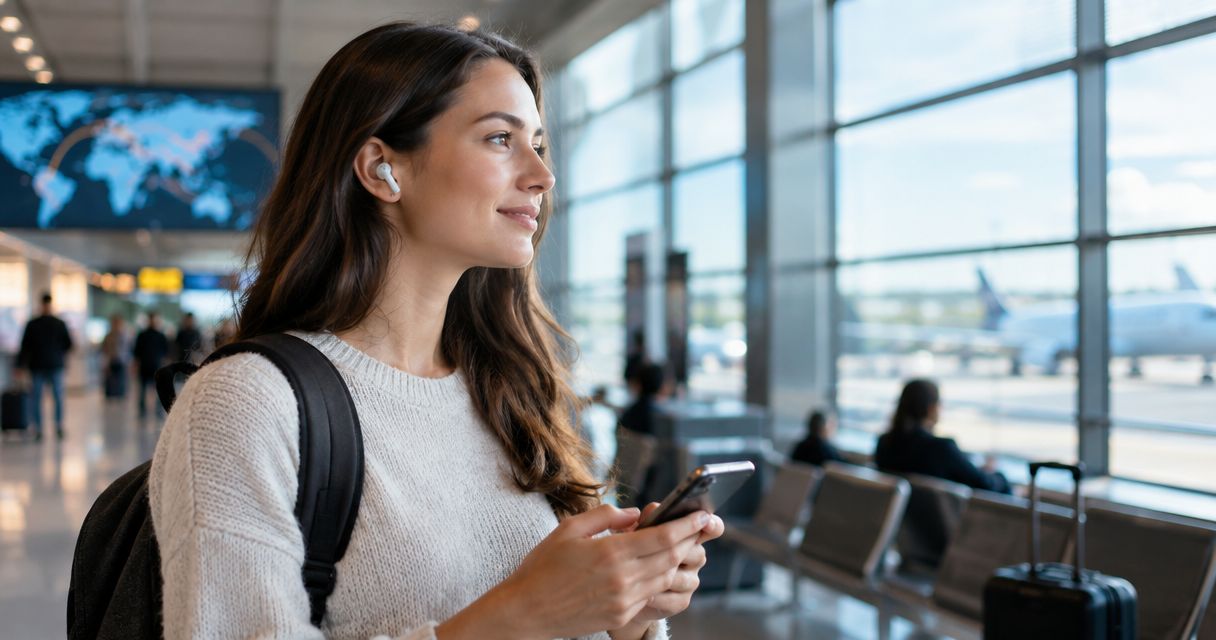
An AI wearable can be used internationally while traveling only where its required services, connections, and recording practices are supported and permitted; crossing a border does not establish that support. Before relying on it, confirm destination coverage, offline behavior, language support, and consent requirements for the specific device.
- Can an AI wearable be used internationally while traveling? Confirm destination support before relying on connected features.
- Internet access does not establish language support, account access, or permission to record.
- Test offline behavior before departure; distinguish saved material from features that require a connection.
- Moonshot is a wearable for reflection; confirm international support separately before making it part of your travel plans.
Travel readiness
A useful travel moment is small. You saved a thought about calling someone before leaving home; later, you return to it and decide what to say. That benefit depends on being able to retrieve what you captured, not simply on having a charged device in your bag.
For your 2026 trip, separate carrying a wearable from using its connected features abroad. A device can be physically with you while a needed service is inaccessible. Start with the wearables for travel guide, then verify the requirements of the particular device you intend to take.
Treat international use as a feature-by-feature check, not a single yes-or-no promise. Recording, retrieving saved material, and processing a new request are different tasks. Confirm each task that matters to your trip rather than assuming that success with one establishes the others.
Can an AI wearable be used internationally while traveling?
Yes, when the specific wearable supports your destination and intended use. There is no category-wide guarantee that every wearable works in every country, understands every language, or continues its usual functions without internet access.
Use these 5 checks before departure. They are a verification process, not a claim that any particular product offers the features described.
- Destination support. Ask whether the device, account, and required service can be used in every country on your itinerary. Include transit stops if you expect to use it there.
- Connection requirements. Establish whether the function you need depends on a paired phone, an internet connection, or another service. Check the whole connection path.
- Offline behavior. Identify what remains accessible without a connection, what stops working, and what happens to anything captured during that period.
- Language support. Check the languages you will speak and hear. Ask about the actual task, such as capturing your own spoken thought, rather than accepting a general language label.
- Permission and setting. Check applicable recording rules and the venue's policy. Explain the intended use to other participants before capturing a conversation.
Keep the answers somewhere you can read without the wearable. A support message stored only inside the service you are trying to troubleshoot is not a useful travel reference.
For a 2026 departure, check current documentation close to your trip. An old demonstration is evidence of what was demonstrated, not confirmation of current destination support.
Connected use and offline use
Your travel plan should distinguish a connected session from a period without connectivity. Neither mode is automatically better. The right choice depends on which task you need and what the manufacturer explicitly supports.
| Use situation | Best for | Useful when | Limitation to check |
|---|---|---|---|
| Connected use | Tasks explicitly documented as requiring internet access | The destination and connection are supported | Account access, network restrictions, and connection interruptions |
| Offline use | Tasks explicitly documented as working without internet access | You have tested the exact function beforehand | Capture, retrieval, and later synchronization can have different requirements |
| Device-free fallback | Keeping an essential thought or instruction accessible | You cannot confirm service access | You must maintain the fallback yourself |
Choose the mode by the task, not by the presence of a connection symbol. A successful connection does not prove that a particular request will work. Likewise, a device that captures something offline does not necessarily let you retrieve or process it offline.
For a fallback, keep essential addresses, booking details, and your own short notes in a form you have checked independently. Do not make a discretionary wearable the only place you keep information you need to reach your accommodation.
That is not a reason to leave it at home. It is a reason to give it a clear job and keep essential travel logistics independent of that job.
Destination differences
International use varies because several separate conditions have to line up. Check these factors against your actual itinerary rather than treating an international shipping option as proof of international operation.
- Service territory. Confirm that the required service supports use in the destination, not merely account creation in your home country.
- Connection path. A feature's requirements can include both the wearable and the phone or network it depends on. Verify the complete setup.
- Language and task. Support for a language does not establish performance for every accent, mixed-language conversation, or intended use.
- Recording context. A private conversation, a public presentation, and your own spoken note raise different permission questions.
- Power and transport. Check the supplied charging equipment and your carrier's current instructions for the device and any batteries you carry.
For your 2026 itinerary, write down the countries where you intend to use the wearable and the tasks you expect it to perform. This turns a vague support question into something a manufacturer can answer directly.
For example, ask whether you can retrieve an existing note without a connection in your destination. That is more useful than asking whether the device is travel-friendly. Avoid treating a broad answer as confirmation of an unmentioned feature.
Before-departure test
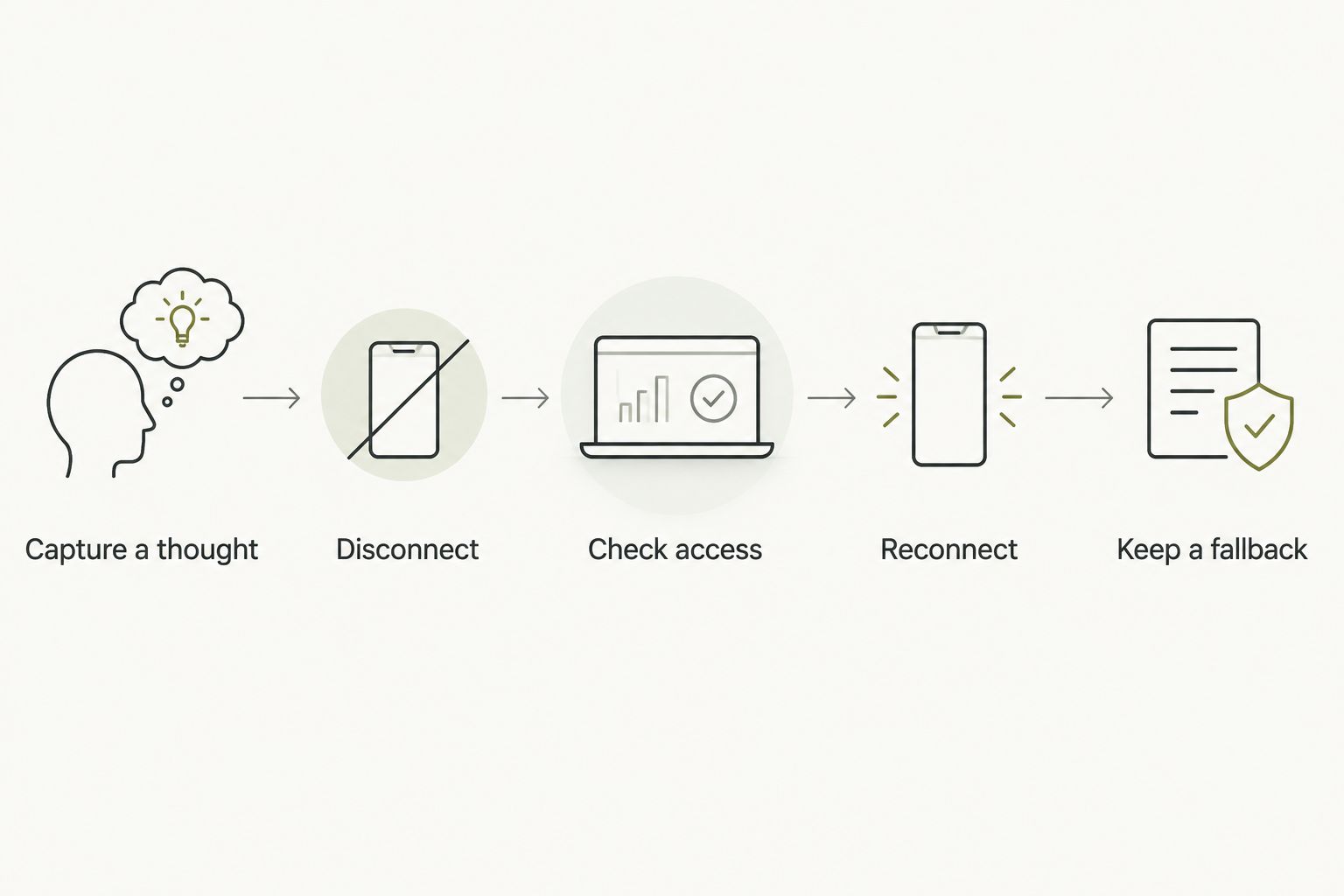
Test the wearable in 2 settings: your usual connected setup and a setup without internet access. This is a practical test plan, not a performance benchmark. It shows you which questions still need an answer before you leave.
Use an ordinary, non-sensitive thought for the test. Choose something you can recognize afterward, such as a reminder to ask a friend about a book. Do not use someone else's conversation merely to check whether a feature works.
- Capture a thought. Save a short item using the device's documented method. Check that you can find it again in your normal setup.
- Disconnect. Remove internet access using the controls relevant to your setup. Do not assume disconnecting one component disconnects every component.
- Check access. Try the specific retrieval or capture task you expect to need while traveling. Record what works and what does not.
- Reconnect. Restore the documented connection and check the result. Confirm whether anything created during the interruption appears as expected.
- Keep a fallback. Put the essential information you need elsewhere, then check that you can reach it without the wearable's service.
A successful home test establishes behavior under those test conditions. It does not establish destination support, local permission, or reliability on an unfamiliar network. Keep those checks separate.
Conversations and permission
Being able to capture a conversation does not establish that you should capture it. Before using a wearable around other people, explain what you intend to do and ask whether they agree. If they decline, do not capture the conversation.
Check local requirements separately. A person's agreement does not replace applicable law, and a venue can have its own restrictions. For a 2026 trip, use current destination guidance rather than assuming the rules at home apply abroad.
Keep the source clear when you review material later. A conversation you captured is not the same as a public source. A suggestion drawn from what someone said is not automatically a verified fact.
Suppose someone mentions a place to visit. Treat that as their recommendation, not confirmation of opening hours or entry requirements. Check the current public information before building your day around it.
Permission to capture and permission to act are separate decisions. Sharing a summary, sending a message, or adding another source should require its own deliberate choice. Do not treat agreement to one conversation as blanket approval for unrelated uses.
If recording controls are central to your decision, review the wearable privacy features guide. Use it to form specific questions, then confirm the answers for the device you are considering.
Moonshot and a travel next step
Moonshot is a wearable best suited to people who want to talk it through and choose the next step themselves. It hears you out, asks a good question back, and helps you notice what your days keep saying. That purpose is different from a guarantee of international connectivity or travel guidance.
Consider a small first-week use: you return to a thought about a friend you meant to call, decide the call matters, and choose how to show up. The payoff is your follow-through, not an action taken without you. You can say it once, consider it again, and decide whether it still deserves your attention.
Moonshot turns one thing into a next step, with your yes on each one. It makes no calls and moves no money. Its wearable format does not, by itself, establish supported countries, offline functions, or language coverage.
The fit is clear if you want to learn from your own life; the travel decision still needs device-specific answers. Check the reservation page for current product information before treating any planned capability as something you can use on your trip.
Can I use a wearable abroad without mobile data?
You can use only the functions explicitly supported by the device's available connection or offline mode. If a function requires internet access, the absence of mobile data matters unless another supported connection supplies it.
Ask about the actual task. Accessing an existing item, capturing a new item, and processing that item need separate answers.
Does international support include every language?
International support does not establish support for every language. Confirm the language and task you need, including whether you expect to speak alone or capture a conversation with permission.
Do not assume that recording speech establishes accurate understanding or translation. Use another verified method for information where a misunderstanding would have serious consequences.
Can I rely on a wearable for travel instructions?
Do not make a wearable your only source for essential travel instructions. Keep confirmed addresses and necessary documents accessible independently, and check current public sources for rules or schedules.
A captured recommendation is useful context. It is not a substitute for checking the fact you will act on.
FAQ
Can an AI wearable be used internationally while traveling?
Yes, if the specific device supports the destination, required connections, and intended use. Confirm recording permissions and offline behavior separately before relying on it.
Will my wearable work when my phone has no signal?
Only functions supported without that phone connection will work. Check the manufacturer's requirements and test the exact task before departure.
Does airport Wi-Fi guarantee that a wearable will work?
No. Internet access alone does not establish destination support, account access, or compatibility with the connection the device requires.
Can I record conversations with a wearable while abroad?
Check applicable law and venue rules, explain the intended use, and obtain agreement before capturing a conversation. Do not record if another participant declines.
Will a wearable understand conversations in another language?
Only rely on language capabilities explicitly documented for the device and task. Capturing speech does not establish accurate understanding or translation.
What should I check about charging before an international trip?
Check the supplied charger's input requirements, the destination's outlets, and current carrier instructions. Do not assume that a plug adapter changes electrical compatibility.
Is Moonshot confirmed to work in every country?
Do not treat Moonshot as confirmed for every country. Check current product information and obtain destination-specific answers before depending on it abroad.
One last thing
Ask a narrower question before you pack: can I retrieve this particular thought where I am going, using the connection I expect to have? That answer is more useful than a general claim about international use.
For 2026 travel, make your final check about the moment you actually care about. Keep the important information accessible independently. Let the wearable earn its place through a useful task, not an assumption.