 moonshot

An AI wearable can estimate emotional cues in a conversation, but it cannot establish what someone feels from their voice or words alone. In 2026, treat an emotion label as an inference to check with the person—not a fact, a diagnosis, or permission to act.
- Can an AI wearable detect emotions in conversations? It can infer cues, not establish another person’s feelings.
- A transcript records words; an emotion label adds an interpretation that needs checking.
- Ask the person what they meant before turning a conversation label into a decision.
- Moonshot is for people who want to talk it through, not have a wearable decide how someone feels.
Why this matters
You leave a conversation thinking it went well. Later, a summary describes the other person as frustrated. That label introduces a new claim, and the next step depends on whether you treat it as evidence or interpretation.
The useful question is not whether a device can produce an emotion label. It is whether the label deserves your trust. Before allowing conversation capture, review the permission questions in this guide to wearable privacy features.
A recording can help you revisit what was said. It cannot replace asking what someone meant, especially when your interpretation affects a relationship or a decision.
Can an AI wearable detect emotions in conversations?
An AI wearable can classify features associated with emotion, such as word choice, pitch, speaking pace, or pauses, if its software supports that analysis. Those features are observable signals. The emotional state assigned to them is an interpretation.
That distinction matters because the same signal fits different explanations. A short answer can reflect irritation, concentration, or simply a preference for fewer words. A raised voice does not tell you whether someone is excited, angry, or trying to be heard across a noisy room.
There are several ways to examine a conversation. None gives you direct access to another person’s inner experience.
| Approach | Best for | Useful evidence | Main limitation |
|---|---|---|---|
| Transcript review | Checking what was said | Recorded words and stated commitments | Text leaves out delivery and can contain transcription errors |
| Voice-cue analysis | Identifying delivery worth revisiting | Changes in pitch, pace, or pauses | Delivery does not establish a particular feeling |
| Direct check-in | Understanding what someone meant | The person’s own explanation | People can choose not to explain or need time to answer |
For a 2026 purchase decision, ask what the wearable actually does with these inputs. Conversation capture, transcription, and emotion classification are different functions; a claim about one does not establish the others.
Words are evidence of words
If someone says they are disappointed, a faithful transcript supports the statement that they described themselves as disappointed. It does not prove how strongly they felt it, why they felt it, or whether they still feel that way later.
Keep the attribution intact. Reporting that someone expressed disappointment is different from declaring that the device detected disappointment.
Delivery is evidence of delivery
A long pause is a long pause. Calling it hesitation adds an interpretation; calling it reluctance adds another.
That interpretation can become useful when you check it against context. Without context, the label risks sounding more certain than the evidence allows.
Emotion labels and personal meaning
Consider a conversation about a weekend plan. Someone says they are fine with staying home, then pauses before changing the subject. A system might interpret the exchange as disappointment, but the recording alone does not settle that question.
You have a better next step: ask whether staying home is what they want. The value comes from making space for their answer, not from winning an argument about the label.
The same distinction applies to your own words. If you repeatedly bring up a friend you mean to call, you can decide that the call matters without assigning yourself an emotional category. Noticing what you said can be enough.
A useful prompt opens a question. An unsupported label closes it too early.
Why emotion inferences vary
Emotion analysis depends on more than the presence of a microphone. These factors change what a conversation signal means and how confidently you should interpret it:
- Recording conditions. Background noise, distance, and overlapping speech affect what a system captures. Unclear audio weakens the evidence before interpretation begins.
- Speaking habits. A naturally quiet voice or brief speaking style does not establish sadness or annoyance. Interpretation needs context about the speaker, not just a category label.
- Language and expression. Sarcasm, indirect phrasing, and differences in expression complicate literal readings. The same sentence can serve different purposes in different conversations.
- Conversation context. A discussion about bad news differs from a disagreement about plans. A short excerpt can omit the event that explains the speaker’s response.
- The task being measured. Recognizing a predefined label is different from explaining a real conversation. A performance claim needs a named task and a clear account of how success was judged.
These are reasons to check the interpretation, not reasons to ignore the conversation. When a label conflicts with what the person tells you, do not give the label automatic priority.
A conversation check you can use
Suppose you revisit a captured conversation and notice an uncertain ending. Rather than asking a wearable to settle what the other person felt, separate the evidence from your interpretation.
- Check the words. Read the relevant passage and, where you have permission and access, compare it with the recording. Do not build a conclusion on a mistaken transcript.
- Name the inference. Identify what you are adding. The person paused is an observation; the person regretted agreeing is an interpretation.
- Ask directly. Use a question that leaves room for correction. Ask whether the plan still works rather than announcing that you detected reluctance.
- Choose the next step. Decide what you want to do after hearing the answer. A useful follow-up might be changing the plan or leaving it as agreed.
- Approve any action. Reviewing a suggestion is separate from authorizing a message or another outward action. Keep your yes attached to the specific action.
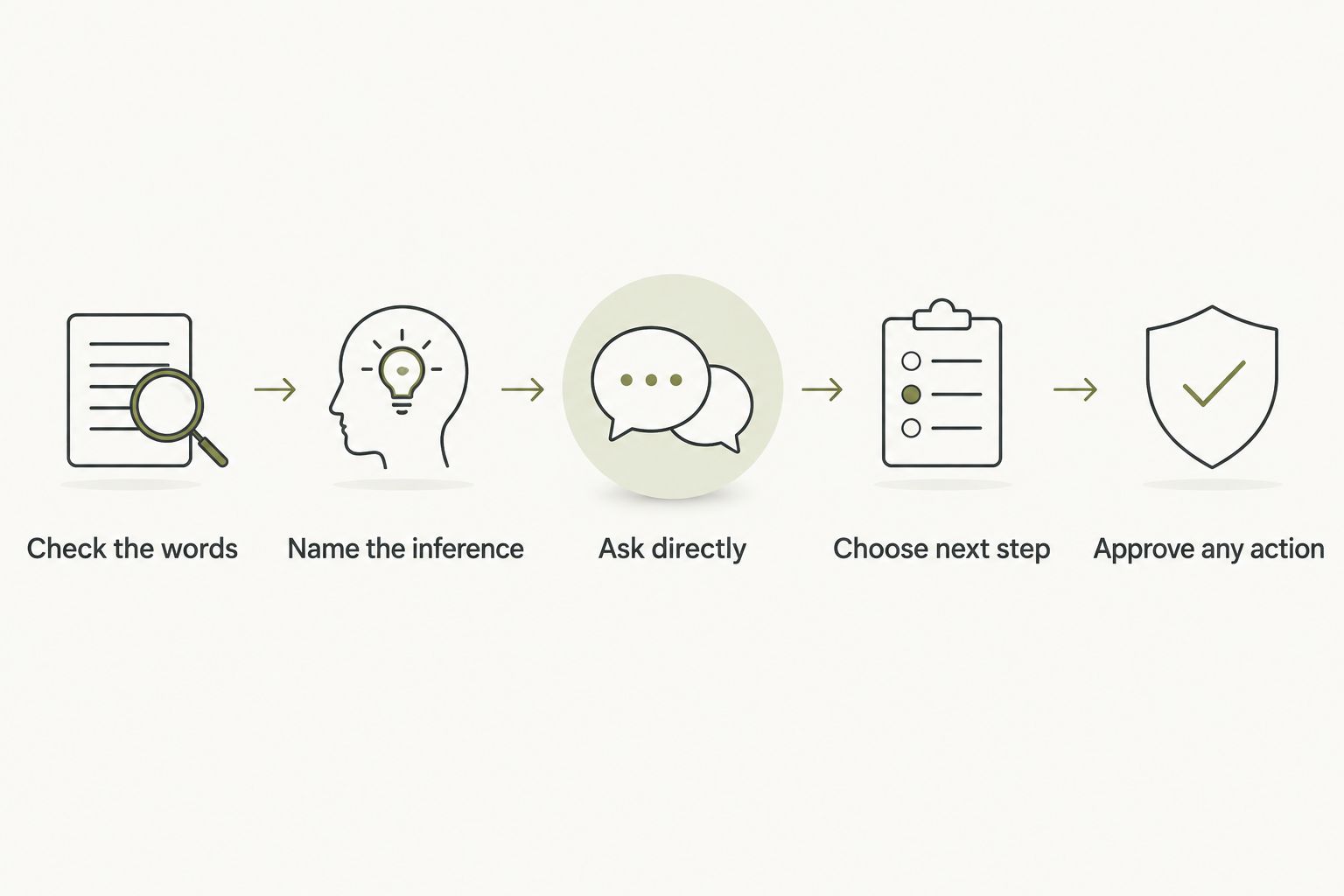
This process does not require an emotion score. It gives you a way to use a conversation record without treating a software-generated interpretation as the final answer.
For your 2026 evaluation, try describing the benefit without the word detection. If the benefit is remembering a commitment or preparing a better question, evaluate that function directly.
Product claims and proof
A convincing demonstration shows what went into an interpretation and what came out. A polished summary alone does not show whether the system captured the words correctly or assigned a useful emotional meaning.
Ask the seller to distinguish a captured conversation from a public source. A statement drawn from your recording has a different origin from a general explanation about communication, even when both appear in the same response.
Then separate a fact from an inference. A statement that a speaker declined an invitation is different from an explanation that the speaker felt excluded. You should be able to tell which part came from the conversation and which part was added.
Finally, separate a planned capability from a shipped one. For a 2026 preorder, evaluate the stated product rather than treating an exploratory demonstration as proof of what you will receive.
Evidence that answers the right question
If a seller presents a performance figure, ask what was measured. A score for identifying predefined emotions in prepared recordings does not, by itself, establish performance in your conversations.
Ask whether the evaluation covered spontaneous speech, the language you use, and recording conditions relevant to you. Also ask what happens when the system cannot make a useful interpretation.
A clear limit is more useful than a confident claim with no defined task. You need enough detail to judge the claim, not merely a percentage detached from its setting.
Permissions before interpretation
Before using conversation capture, establish what is being recorded and make sure the people involved understand it. Recording requirements differ by location and setting; check the rules that apply rather than assuming possession of a wearable gives permission.
Keep source permissions separate. Permission to capture one conversation is not blanket permission to connect unrelated personal sources or use every available record to interpret someone.
For a 2026 buying decision, ask how recording starts and stops, what controls you have, and how deletion works. Treat an unanswered question as unanswered—not as a promise about privacy or retention.
The same boundary applies to action. An interpretation that someone wants a follow-up does not authorize sending one in your name. Review the proposed action separately from the conversation summary.
A wearable for talking it through
Moonshot is a wearable that hears you out, asks a good question back, and helps you notice what your days keep saying. Moonshot is for people who want to talk it through, not have a wearable decide how someone feels.
Here is a useful way to frame the goal: you captured a thought about a friend earlier, and you return to it when deciding whether to reach out. The payoff is the call you choose to make, not a claim that a device knows what the friendship means.
The limit matters just as much. That description does not establish an emotion-detection feature or justify interpreting another person’s private feelings. Choose what matters to you, grant each source separately, and keep outward actions subject to your yes.
To learn from your own life, you do not need every conversation assigned a label. You need a question worth answering and a next step you want to take.
Can a wearable tell whether someone is angry with me?
A wearable cannot establish that someone is angry with you from a conversation recording alone. Even when a system identifies cues associated with anger, those cues do not establish their cause or who they concern.
Ask about the exchange itself. A question about whether something landed badly leaves more room for an honest answer than telling someone a device has already decided.
Is emotion detection the same as conversation transcription?
Emotion detection is not the same as transcription: transcription represents spoken words, while emotion classification adds an interpretation. Both need checking, but they make different claims.
A transcription error concerns what was said. An emotion-label error concerns what the speech supposedly meant about someone’s feelings.
Should I use emotion labels to decide what to say next?
Use emotion labels as a reason to check context, not as instructions for your response. Start with what the person actually said and ask a question when the meaning remains unclear.
Follow-through belongs to you. A suggested response is not a substitute for deciding whether it fits the person and the conversation.
FAQ
Can an AI wearable detect emotions in conversations accurately?
An AI wearable can estimate emotional cues, but accuracy depends on the task, recording conditions, and evaluation. A label does not establish someone’s feelings; ask for evidence relevant to real conversations before relying on a performance claim.
Can a wearable tell whether someone is upset with me?
A wearable cannot establish that someone is upset with you from their voice or words alone. Ask about the conversation rather than treating an inferred emotion as proof.
Can a conversation transcript show how someone felt?
A transcript can preserve what someone said about their feelings, but it does not independently verify those feelings. Keep the speaker’s own account separate from an added interpretation.
Does a pause mean someone is uncomfortable?
A pause does not establish discomfort. It can reflect thinking, turn-taking, or something outside the conversation, so check the context before assigning meaning.
Does Moonshot read emotions?
Moonshot’s stated role is to hear you out, ask a good question back, and help you notice what your days keep saying. That description does not establish emotion-reading capability.
What should I ask before allowing a wearable to record?
Ask what is captured, how recording starts and stops, and what deletion controls exist. Establish permission for the conversation and check the recording rules that apply to the setting.
Can I use a wearable summary to send a follow-up automatically?
A conversation summary is not permission to send a follow-up in your name. Review the proposed action and give approval separately.
One last thing
Before your next follow-up, remove the emotion label from your summary. Keep the words, the stated commitment, and the unanswered question.
If you still know what to ask, the label was not necessary. Show up for the answer, then choose the next step.