 moonshot
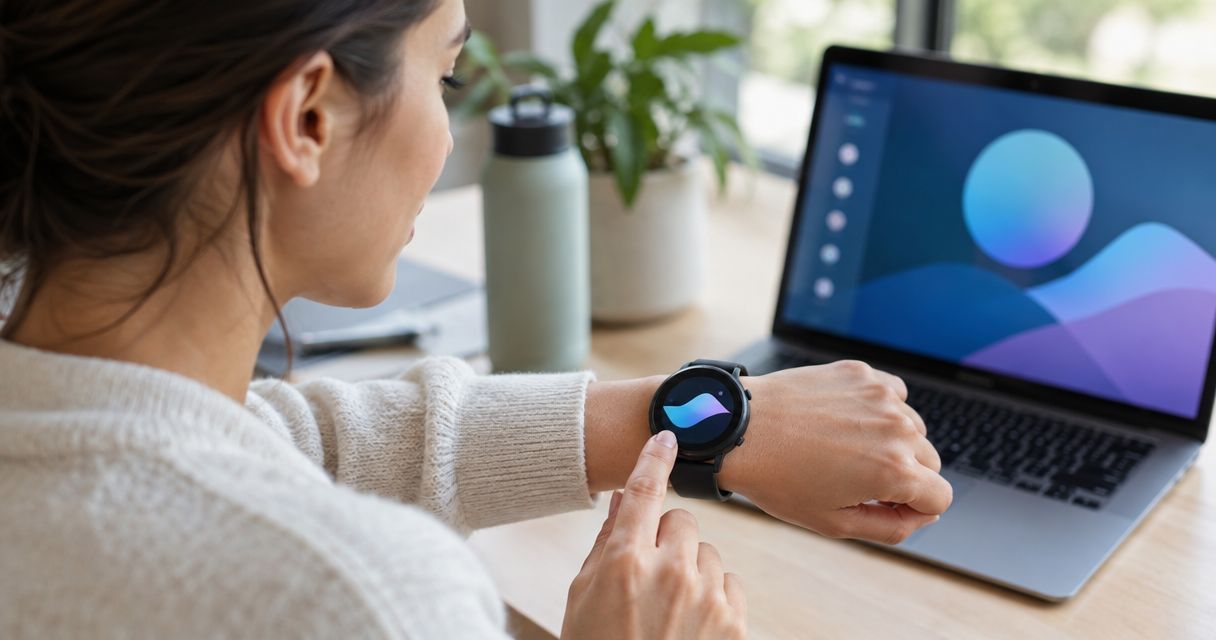
Yes—an AI wearable can flag a potentially important moment automatically when it has access to the relevant capture and a way to identify something worth revisiting. Treat the flag as a suggestion, not a verdict: what you said is evidence, but why it matters and what happens next remain your decisions.
- Can an AI wearable flag important moments automatically? Yes, but a suggested highlight is not proof of importance.
- Separate captured words from inferred meaning, and require approval before any outward action.
- Moonshot is a wearable for people who want to talk it through and choose the next step themselves.
Can an AI wearable flag important moments automatically?
Yes, but automatic flagging should mean bringing something back for your consideration, not deciding your priorities. A captured promise, a question you left open, or an idea you deliberately recorded can provide a useful starting point. None proves that you want to act now.
For a 2026 purchase decision, distinguish these approaches rather than treating every mention of automatic capture as the same feature. Your guide to wearables ranked by privacy features is a useful place to continue examining permissions.
| Approach | Best for | Useful part | Limitation to check |
|---|---|---|---|
| You mark the moment | Something you already know matters | You identify the reason to return | You must remember to mark it |
| The device suggests a highlight | Reviewing something you chose to capture | A suggestion gives you a starting point | The inferred importance can be wrong |
| You review a capture yourself | Understanding an ambiguous conversation | You assess the words in context | You must spend time reviewing it |
These are ways to handle a moment, not claims that every wearable offers each option. Ask for a demonstration of the approach you want. A feature name alone does not tell you what the device captures, how it selects a highlight, or whether you can correct it.
Why this matters
Suppose you deliberately capture a thought after lunch: you want to call a friend about something they mentioned. Later, returning to that thought gives you a useful choice. You can make the call, leave yourself a note, or decide it no longer needs attention.
The payoff is the call you finally made—not the existence of another recording. A useful flag preserves enough context to help you decide without presenting an unfinished thought as an obligation.
That distinction also protects ordinary conversation. You can wonder aloud without making a commitment. You can say something once without asking a device to make it a priority.
The right standard is a useful suggestion you can inspect, correct, or decline. Automatic selection is only the beginning of that standard.
The evidence behind a useful flag
Captured words
A useful highlight should let you inspect the underlying words. If you said you wanted to call a friend, the capture should support that statement rather than replace it with a broader interpretation of the relationship.
Check what the highlight actually rests on. A conversation you chose to capture is different from a public source. A statement from another person is also different from your own commitment to act.
Inferred meaning
A highlight such as an unfinished commitment contains an interpretation. The words might support it, but the interpretation is not the original event. You should be able to disagree without having to dispute what was captured.
This matters when a conversation includes a hypothetical, a joke, or a plan you later changed. A device should distinguish what was said from what it thinks the words imply. Do not accept confident wording as a substitute for that distinction.
Your decision
Recognizing a moment and acting on it are separate jobs. A flag can bring an idea back; it does not establish permission to send a message or speak in your name.
Your yes belongs at the action itself. Permission to capture a thought should not become permission to contact someone about it. A useful review keeps that boundary visible.
A practical check before you choose a wearable
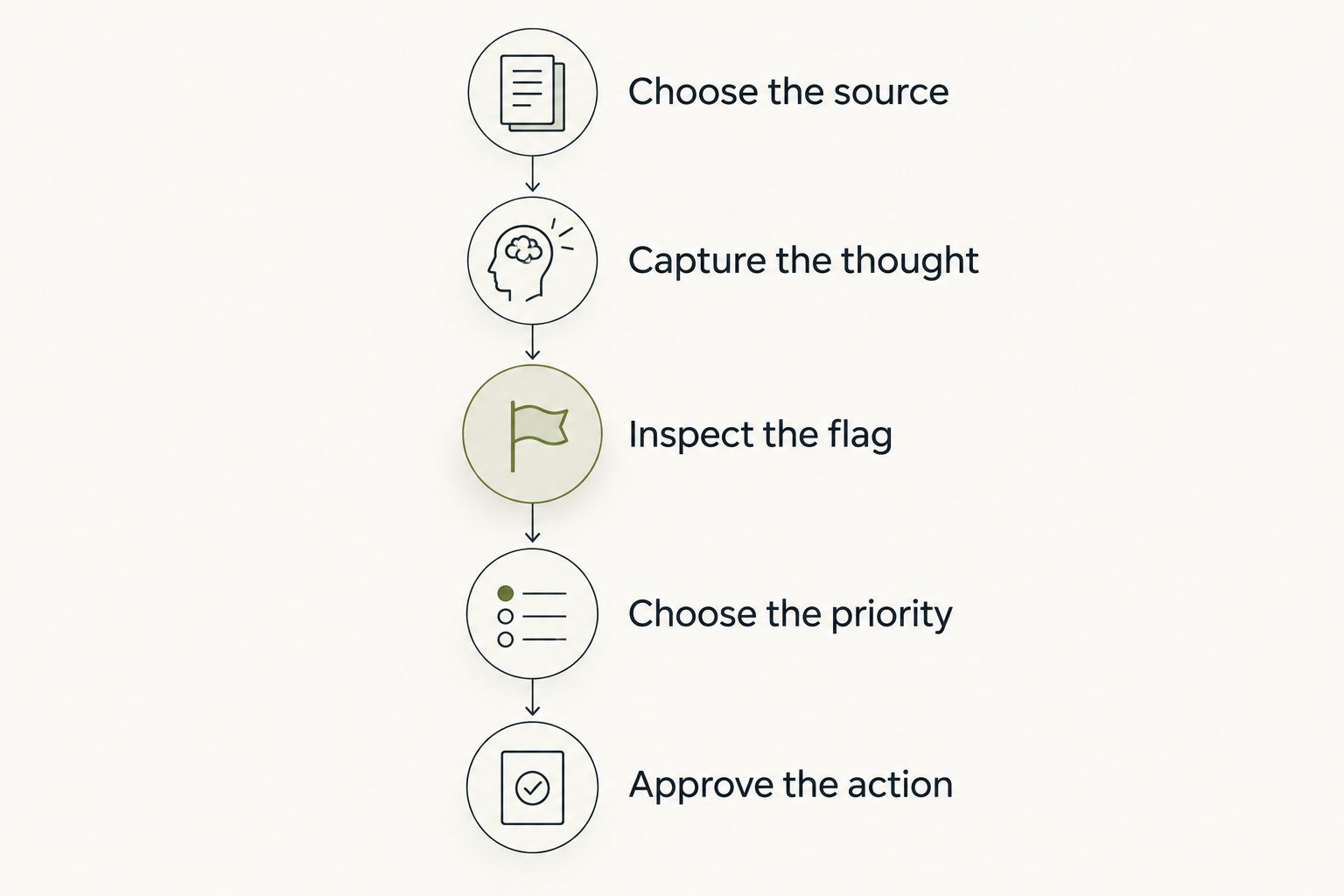
Use a deliberately captured, ordinary example when reviewing a demonstration in 2026. Pick something you are comfortable sharing, such as a thought about calling a friend. Do not use a private conversation just to find out how a feature works.
- Choose the source. Establish exactly what you are allowing the device to use. Permission for one capture is not permission for every other source.
- Capture the thought. Say it once in your own words. Include enough context to distinguish a possibility from a commitment.
- Inspect the flag. Compare the suggested highlight with the captured words. Look for added meaning, missing qualifications, or a changed intention.
- Choose the priority. Decide whether the moment deserves attention now, later, or not at all. The device's suggestion is not your instruction.
- Approve the action. If an outward action is proposed, review it separately. Nothing should go out in your name without your yes.
The sequence tests more than whether a device can produce a summary. It tests whether you can understand the suggestion and keep control of the next step.
After the demonstration, change the meaning of the example. Explain that you have already made the call or decided against it. Check whether you can correct or dismiss the suggestion without creating another task.
A successful check is not a dramatic result. It is a faithful capture, an understandable suggestion, and a decision that remains yours. Ask whether the demonstrated behavior is available now or is a planned capability; a description of future behavior is not evidence of a working feature.
Why automatic flagging varies
The question is not simply whether a wearable can find a highlight. It is whether the highlight has enough support to be useful in your situation. These factors give you concrete things to examine in a 2026 demonstration:
- Source permission. A suggestion should use only the sources you separately allow. Do not infer access to a calendar, messages, or another account from a general product description.
- Capture context. A brief phrase can leave out a condition or change of mind. Check whether the source supports the complete meaning of the flag.
- Your stated priority. Something you mention is not necessarily something you want to pursue. You choose what deserves follow-through.
- Fact and inference. Captured words and a proposed interpretation should remain distinguishable. Ask what evidence supports the interpretation.
- Correction and approval. A useful review lets you reject a suggestion. Any outward action needs a separate decision, not assumed permission.
These checks do not require you to know how a product ranks highlights internally. They require the product to make its output understandable. If you cannot tell where a suggestion came from, you cannot judge whether it deserves your attention.
Moonshot and the next step
Moonshot is best for people who want to talk it through and choose the next step themselves. The wearable hears you out, asks a good question back, and helps you notice what your days keep saying. The point is to learn from your own life, not receive a set of priorities chosen for you.
That approach has a clear use and a clear boundary. Moonshot turns one thing into a next step, with your yes on each one; it makes no calls and moves no money. If the payoff you want is a call, you still make the call.
For your first week, keep the question small: did returning to something you said help you choose how to show up? Do not turn that example into an assumption about total recall, access to unapproved sources, or features beyond those explicitly described.
Does automatic flagging mean a wearable records everything?
No—automatic flagging does not establish what a wearable records. Capture and selection are separate questions, and you should verify both before using a device around other people.
For a 2026 evaluation, ask what starts capture, what ends it, and how you can tell it is happening. Do not assume continuous recording, a camera, or permission to capture someone else merely because a product can identify highlights.
Can a flagged moment become an action without my approval?
A flagged moment should remain a suggestion until you approve the next step. Identifying a possible commitment does not authorize a message, a call, or any other action in your name.
Check approval at the point where the action would happen. General access to a source and permission for a specific outward action are different decisions. Keep them separate even when the proposed action seems sensible.
FAQ
Can an AI wearable tell which moments matter most to me?
A wearable can suggest a potentially important moment, but the suggestion does not establish your priorities. Inspect the captured words and decide whether the interpretation fits.
Do I have to mark every important moment myself?
You do not have to mark a moment yourself when the device offers automatic highlight suggestions. Verify that specific feature rather than assuming that capture or summaries include it.
What's the difference between a highlight and a reminder?
A highlight identifies something to review; a reminder brings something back for attention. Check whether a product offers either function and whether creating a reminder requires your approval.
Can a wearable understand a private joke or a changed plan?
Do not treat a suggested interpretation as proof that a wearable understood a private joke or changed plan. Compare the flag with the source and check that you can correct or dismiss it.
Does Moonshot make the call after it brings something back?
Moonshot makes no calls and moves no money. It helps turn one thing into a next step, with your yes on each one.
What should I check before choosing a wearable in 2026?
Check what the wearable captures, which sources you separately permit, and how a suggested highlight is supported. Ask for a demonstration of correction and approval, and distinguish available behavior from planned features.
One last thing
A flag you dismiss can still be useful. It gives you a chance to say that an old idea no longer fits, a promise is already complete, or a thought was only something you needed to say aloud.
Try that in a demonstration. Choose an example with no action attached and see whether leaving it alone is a valid outcome. The next step can be a decision not to act. A useful wearable should leave room for your no as well as your yes.