 moonshot

Sometimes, but an AI wearable has no special right to record a conversation without consent. In the United States, federal law generally permits a participant to record, subject to exceptions, while some state laws require every participant’s consent for protected conversations. For a 2026 purchase or recording decision, check the applicable law, who is participating, and whether the conversation is private before you capture anything.
- Can an AI wearable record conversations without consent? Sometimes; federal and state recording laws determine the answer.
- Owning the wearable does not authorize recording other people’s private conversations.
- Ask before recording, and stop when someone declines or withdraws permission.
- Moonshot is for people who want to talk it through and choose the next step.
Can an AI wearable record conversations without consent?
A participant can sometimes record without telling the other participants, but that is not a nationwide permission slip. Federal law generally follows a one-party-consent rule. State laws can impose additional requirements, and a conversation across state lines needs particular care.
The relevant federal provision is 18 U.S.C. § 2511(2)(d). It generally allows a person to intercept a communication when that person is a party to it or one party has given prior consent. The provision includes an exception where the interception is for the purpose of committing a criminal or tortious act.
These are useful starting points for a 2026 recording decision, not substitutes for checking the law that applies to your circumstances:
| Situation | Legal starting point | Practical limit |
|---|---|---|
| You participate in the conversation | Federal law generally permits recording with one party’s consent | A state law can require more |
| Every participant agrees | Agreement addresses the central consent question | Workplace rules, confidentiality duties, and other restrictions still matter |
| You are not participating | Wearing or owning the device does not supply consent | Do not assume you can capture nearby conversations |
| People are in different states | More than one jurisdiction can be relevant | Do not assume your home state’s rule controls |
| The conversation happens in public | Privacy expectations affect some recording protections | A public location does not automatically make every conversation unprotected |
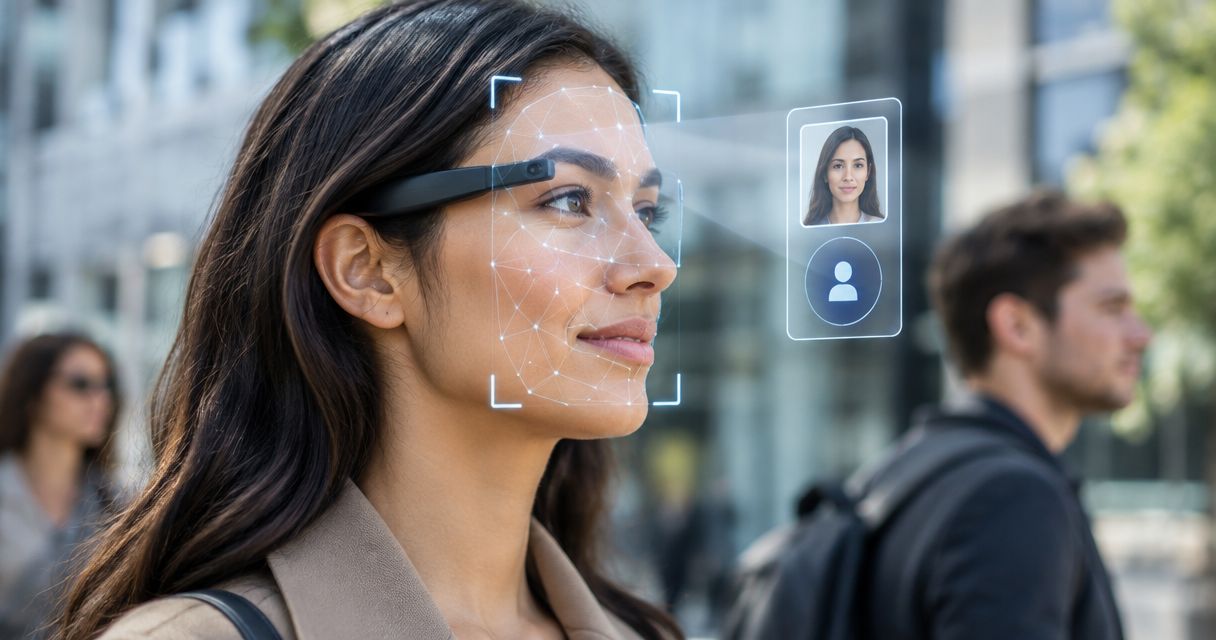
The device’s form does not change the starting question. A microphone worn on your body still raises recording-law issues when it captures someone else’s speech.
Why this matters
A friend agrees to talk over lunch. That does not necessarily mean the friend agrees to have the conversation recorded, transcribed, stored, or shared. Those are separate questions, and treating them separately makes the choice clearer.
You might want to revisit an idea someone helped you articulate. The useful outcome is remembering the idea—not collecting a private conversation the other person never agreed to preserve. Ask about the capture before you think about the follow-through.
The Moonshot wearable is described as something that hears you out and asks a good question back. That purpose does not establish permission to capture another person’s words. Your interest in remembering and their decision about recording both deserve a place in the conversation.
One-party consent: a participant’s permission
One-party consent generally means that one participant’s permission can satisfy the applicable recording-consent requirement. If you are that participant, your own consent can be enough under the federal rule, subject to its exceptions.
It does not mean that any person holding a recorder can authorize any recording. If you leave a wearable behind to capture a discussion you are not part of, your ownership of the device does not make you a participant.
New York Penal Law § 250.00 illustrates the participant-consent approach through its definitions of wiretapping and mechanical overhearing of a conversation. The details still matter: the type of communication, how it is captured, and other applicable laws can affect the result.
Best for your decision: treat one-party consent as a legal rule to verify, not a default setting to assume. Asking openly remains the clearer practice when you want another person to understand what is happening.
All-party consent: everyone’s agreement
All-party consent means the applicable law requires the consent of every participant for the covered recording. The phrase is sometimes called two-party consent, but a conversation can involve more than two people.
California Penal Code § 632 addresses recording a confidential communication without all parties’ consent. Its protection turns on confidentiality as defined by the statute; it is not simply a ban on recording every sound in California.
Washington’s RCW 9.73.030 generally requires all participants’ consent to record covered private communications or conversations, with statutory exceptions and provisions concerning announcements. These distinctions are why a state label alone is not enough to resolve a particular recording.
For a 2026 wearable purchase, separate the product question from the permission question. A device’s ability to capture speech does not establish whether a specific conversation is lawful to record.
Best for your decision: obtain clear agreement before capturing a private conversation. If someone declines, leave the recording off rather than trying to resolve a legal disagreement at the table.
Why recording requirements vary
The legal answer depends on the circumstances, not just the wearable. Check these factors before recording:
- Jurisdiction. Federal law supplies one framework; state law can add protections. Cross-state calls introduce another issue to resolve.
- Participation. Recording your own conversation is different from intercepting a conversation between other people.
- Privacy. Some statutes protect private or confidential communications specifically. A quiet discussion differs from a speech delivered to an audience.
- Consent. Who agreed, what they agreed to, and when they agreed matter. Permission to speak is not automatically permission to record.
- Purpose. The federal participant-consent exception does not cover interception undertaken for a criminal or tortious purpose.
- Additional duties. Workplace policies, professional obligations, and confidentiality agreements can restrict recording or use even when a recording statute permits capture.
Do not reduce this to a map with two colors. The statute’s wording, exceptions, and interpretation matter, especially when the conversation involves sensitive information or participants in different places.
A recording check before you start
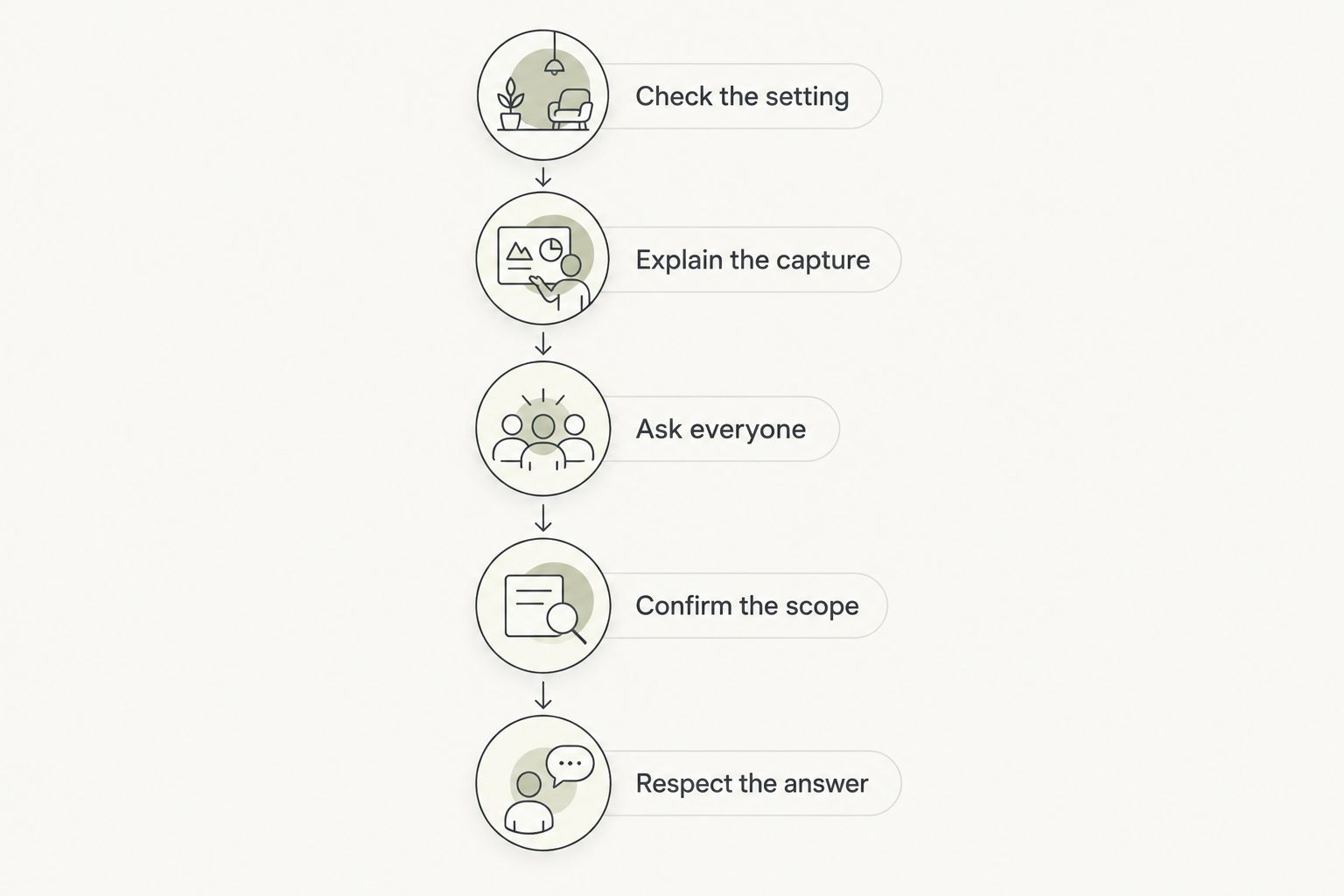
Use this sequence before a meeting, interview, or private conversation in 2026. It is a practical consent process, not a guarantee that every legal requirement has been met.
- Check the setting. Identify where participants are and whether workplace, venue, or professional restrictions apply. If the applicable law is uncertain, do not record while guessing.
- Explain the capture. Say whether you want to preserve audio, create a transcript, or make a summary. Describe only what the device actually does.
- Ask everyone. Give each participant a real opportunity to decline before capture begins. Do not treat silence or continued conversation as a reliable substitute for clear agreement.
- Confirm the scope. Explain the intended use and audience. Permission for a private recording is not permission to publish it.
- Respect the answer. Stop if someone objects or withdraws permission. If a new participant joins, address consent before capturing their contribution.
A request works better when it is ordinary and specific. Tell people what you want to retain and why. Let the answer change what happens next.
An announcement after recording has already started does not turn earlier capture into prior consent. Build the check into the start of the conversation, not the end.
Consent to record is not consent to share
Keep the permission as narrow as the agreement. Someone can agree to a recording for your private reference without agreeing to a public post, a workplace distribution, or use in promotional material.
Recording, transcription, storage, and disclosure are different activities. A recording law does not settle every question about how captured information can be processed or used. Confidentiality duties and privacy laws can apply separately.
Before using any wearable in 2026, read the current documentation for the capture and processing you intend to use. Check what is retained, where processing happens, who can access it, and what deletion controls are documented. Do not infer those answers from a product description.
Be equally careful with the words that come back. A captured conversation is a source; a summary is a representation of that source. An inference about what someone meant is not the same as something they actually said.
Can I record someone in a public place?
A public place does not create blanket permission to record every conversation within reach. Some laws depend on whether the communication is private or confidential, and location is only part of that assessment.
A speaker addressing an audience and two people speaking quietly at a nearby table are different situations. Do not assume that being able to hear speech gives you permission to preserve it.
For a wearable, make the boundary practical: capture only the conversation you have permission to capture. If you cannot avoid collecting a neighboring private discussion, leave recording off.
What if someone says no after recording starts?
Stop recording when someone withdraws permission. Then discuss what should happen to the material already captured, including any transcript or shared copy.
Do not promise deletion from every location unless you have verified what the system permits. Stopping future capture and removing existing material are different tasks.
If a dispute has arisen, get legal advice before making decisions about preserving or deleting a recording. Evidence-preservation obligations can complicate an otherwise straightforward request.
A useful next step without recording everyone
Earlier, you mentioned a friend you keep meaning to call. Later, you can talk it through: what do you actually want to say? The next step belongs to you, and it does not require a recording of the friend’s private conversation.
Moonshot is for people who want a wearable that hears you out while leaving the choice with you. Say it once, consider the question back, and decide whether there is something you want to do. Your yes matters on each next step.
The limit matters too. Moonshot makes no calls and moves no money; follow-through remains yours. A useful question can help you decide how to show up without turning that decision into an action taken on your behalf.
That is a practical way to learn from your own life. Reflect on your own words, distinguish what happened from what you inferred, and do not make someone else’s unapproved recording the price of remembering something important.
FAQ
Is it illegal to wear a recording device?
Wearing a device is not the same as lawfully recording with it. The legal question depends on what it captures, consent, the applicable jurisdiction, and the circumstances.
Can I record a conversation if I am part of it?
Federal law generally permits a participant to record under 18 U.S.C. § 2511(2)(d), subject to exceptions. State law can require every participant’s consent for protected conversations.
Does a light on a wearable count as consent?
Do not assume a light establishes consent. A visible indicator does not by itself show that every participant understands and agrees to the recording; ask clearly before capture begins.
Can my employer ban recording even in a one-party-consent state?
A workplace recording can raise policy and confidentiality issues even when a recording statute permits capture. Labor protections and other laws can also affect whether a particular workplace restriction is lawful.
Can I record a call with someone in another state?
A cross-state call requires checking the laws that can apply to both participants’ locations. Do not assume the recording rule in your own state settles the question.
Is a transcript different from an audio recording for consent?
A transcript does not automatically avoid recording or interception law. Check how the speech is captured and processed, not just whether the final result is text.
Do these consent rules still matter for wearable recording in 2026?
Yes, wearable recording in 2026 still requires attention to federal law, applicable state law, and the circumstances. A product’s recording capability is not legal authorization to use it in every conversation.
One last thing
The clearest permission is specific enough to refuse. Someone should understand what you want to capture, what you plan to do with it, and how to ask you to stop.
Before your next recorded conversation, settle that first. A useful record begins with a choice people know they are making.
This article provides general information, not legal advice. Consult a qualified attorney about a particular recording or dispute.