 moonshot

Yes—an AI wearable can summarize your day automatically if it supports daily summaries and has material you have permitted it to capture. The summary covers that material, not everything that happened, and automatic summarizing does not mean permission to send messages or take action.
- Can an AI wearable summarize my day automatically? Yes, when daily summaries are supported and capture is permitted.
- A daily summary should distinguish captured conversations, public sources, and inferences.
- Moonshot is for people who want to talk it through and choose their own next step.
- Check current features before preordering; a planned feature is not a shipped feature.
Why this matters
A useful daily summary gives you something you can recognize and check. Suppose you captured a thought about calling a friend. Seeing that thought later can help you decide whether to make the call; it does not establish what your friend wants or give a device permission to contact them.
Moonshot describes a wearable that hears you out, asks a good question back, and helps you notice what your days keep saying. That is a reflection-led purpose. Evaluate automatic daily summaries separately rather than treating the word wearable as proof of a particular feature.
For a 2026 purchase, the practical question is what the device does now, with the sources you choose. Start there, not with a demonstration of what it might do later.
Can an AI wearable summarize my day automatically?
Yes, when automatic daily summarization is a supported feature—but the result is a summary of available material, not a complete account of your day. You need to establish what gets captured, what starts the summary, and how you can check its claims.
Use this sequence before relying on a daily recap:
- Check capture. Establish what you deliberately record or otherwise permit the device to receive. Wearing a device is not a clear explanation of its recording behavior.
- Check timing. Find out whether a summary appears automatically or requires you to request it. These are different experiences.
- Check sources. Look for a distinction between a captured conversation, information from a public source, and a conclusion drawn from either.
- Check corrections. Establish how you can address an inaccurate account before using it to make a decision.
- Check approval. Keep reading a recap separate from approving an action. A suggested next step is not your yes.
A feature description should answer these questions in plain language. If it only says the device understands your day, look for a concrete example of what goes in and what comes back.
Summary, reflection, and follow-through
These outputs serve different purposes. A recap tells you what was captured. A reflection asks what it means to you. A proposed action gives you something to accept, change, or decline.
| Output | Best for | Useful result | Limit to keep in view |
|---|---|---|---|
| Daily summary | Reviewing captured material | A shorter account you can check against its source | Anything outside the source material is outside the account |
| Reflection question | Thinking through something you said | A question that helps you choose what matters | A question is not evidence that an interpretation is correct |
| Proposed next step | Turning an intention into a decision | An action you can approve, edit, or reject | A suggestion does not authorize action |
Do not judge a reflection tool only by how much it can condense. A short question about the call you keep mentioning can serve a different purpose from a detailed account of every captured conversation.
The trade-off is real. A recap suits a factual review. A question asks more of you because you still have to answer it. Neither output should pretend to settle your priorities for you.
Capture boundaries
An automatic summary still needs a defined source. Before you use a wearable around other people, establish when capture starts, when it stops, and how the people involved know what is happening.
Do not equate a device being nearby with permission to record. A private conversation, a shared workplace, and a personal spoken note present different situations. Follow applicable recording rules and the requirements of the setting.
For a 2026 evaluation, ask for an explanation of capture rather than inferring it from a product image. A wearable's shape does not tell you whether it records continuously, waits for an explicit instruction, or uses another method.
Also keep source access specific. Permission for one source should not stand in for permission for another. You choose what to share, and you choose which priorities deserve attention afterward.
Captured conversation versus public source
A captured conversation records something someone said in a particular setting. A public source supplies information from outside that conversation. Combining them must not erase the difference.
For example, saying you want to visit a place does not establish its opening hours. An opening-hours claim needs its own source. A useful account keeps your intention separate from outside information about carrying it out.
That distinction matters even when the resulting paragraph reads naturally. Readability is not a substitute for knowing where a claim came from.
Facts and inferences
A daily recap should not quietly turn a tentative remark into a decision. If you said you were considering calling a friend, the factual account is that you considered it. The conclusion that you committed to calling is an inference.
Use these distinctions when you review a summary:
- Statement versus commitment. Mentioning an idea does not mean you agreed to pursue it.
- Question versus conclusion. Asking whether something matters does not establish that it does.
- Your words versus someone else's. A shared conversation needs clear attribution.
- Past intention versus current choice. You can change your mind after saying something.
A summary should preserve uncertainty where the original conversation contains uncertainty. Shortening a conversation is useful only if the shorter version keeps its meaning.
Do not treat an interpretation of your mood or motives as a fact about you. Return to the words and circumstances you recognize. You remain the person who decides whether an observation fits.
Why daily summaries vary
Compare the conditions behind the output, not just the writing. A polished paragraph can still leave out the distinction you needed.
- Permitted material. A summary can only draw on material available to the system. Your capture choices define that boundary.
- Context in the source. A remark separated from its surrounding discussion is harder for you to assess accurately.
- Purpose of the output. A factual recap and a reflection question answer different needs. Decide which one you want.
- Source attribution. You need to distinguish what you said from outside information and interpretation.
- Current feature status. A planned daily recap is not the same as a daily recap you can use in the shipped product.
- Approval boundaries. Producing text and acting on that text are separate permissions. Check both.
During a 2026 purchase decision, use the same captured example to evaluate each claimed behavior. Ask what the example establishes, rather than accepting a general promise of usefulness.
From a captured thought to a chosen action
Consider an illustrative situation: earlier, you captured yourself saying you wanted to call a friend. Later, you review that thought and decide whether it still matters. This is an example of a useful decision process, not a claim about a particular device interface.
The sequence is simple:
- Captured thought: You said you wanted to call.
- Review: You check that the account reflects what you meant.
- Your choice: You decide whether to act, defer, or leave it alone.
- Next step: You choose what you will do yourself.
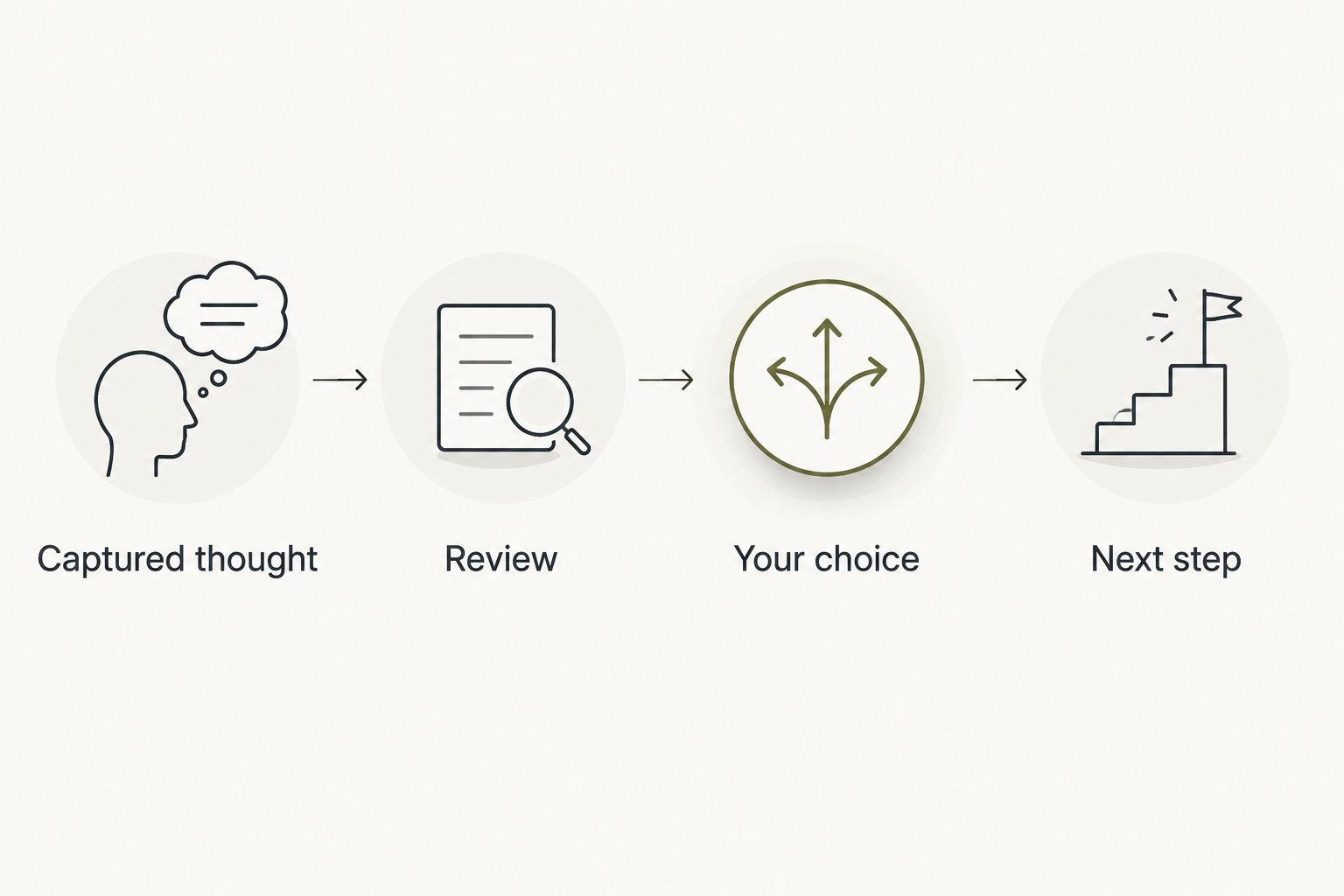
The useful moment is not a device declaring that the call matters. It is you recognizing the thought and choosing what to do with it. You might make the call. You might decide that another commitment needs attention first.
For this purpose, follow-through means carrying out a choice you made. It does not mean accepting every suggestion or turning every passing remark into a task.
Moonshot's role
Moonshot is a reflection wearable for people who want to talk it through and choose their own next step. It hears you out, asks a good question back, and turns one thing into a next step with your yes on each one.
That makes the fit specific: you want to learn from your own life, not have a device decide what your life means. The useful question is whether the experience helps you recognize something worth acting on.
The boundary is equally specific. Moonshot makes no calls and moves no money. You still have to show up for the choice you make. If your requirement is an automatic daily recap, check the current feature description for that exact behavior before preordering.
Current features and planned features
For a 2026 preorder, distinguish what is available now from what is described as planned. A demonstration, a concept, and a shipped feature are not interchangeable evidence.
Look for concrete answers about the experience you are buying:
- Does the current feature description explicitly include automatic daily summaries?
- What input does that feature use?
- Does the description explain how you review the result?
- Which parts require a separate permission or your approval?
Judge the first week by a specific payoff, not a promise that every part of your day will become useful. The call you chose to make is a clearer outcome than a large collection of observations you never revisit.
Can a wearable summarize conversations it did not capture?
A wearable cannot summarize an uncaptured conversation from that conversation itself. If you later describe the exchange, a summary of your account is different from a summary of the original exchange.
Keep that difference visible. Your retelling supplies your recollection and perspective, not an independent record of everyone else's words.
Does an automatic summary give a wearable permission to act?
An automatic summary does not give a wearable permission to act. Reading information, proposing a next step, and carrying out an action are separate things.
Require your yes for anything that goes out in your name. The fact that you mentioned an intention earlier is not enough.
Should I choose a wearable for summaries or reflection?
Choose summaries when your priority is reviewing captured material; choose reflection when your priority is deciding what that material means to you. Check that the current product supports the experience you actually want.
Neither choice removes your role. A recap needs checking, and a question still needs your answer.
FAQ
Can an AI wearable summarize my day automatically?
Yes, if the wearable supports automatic daily summaries and has material you have permitted it to capture. The result covers that material, not everything that happened during your day.
Does automatic summarizing mean a wearable is always recording?
No. Automatic summarizing does not, by itself, establish how recording works. Check the device's current explanation of when capture starts and stops.
Will a daily summary know which things matter most to me?
You choose which things matter most to you. Treat a suggested priority as something to consider, not a decision already made on your behalf.
Can a daily recap mix my conversations with public information?
Check which sources the feature uses and whether it identifies them. A captured conversation and a public source should remain distinguishable in the result.
Is a daily summary the same as a list of things I agreed to do?
No. A daily summary can include ideas, questions, and tentative intentions. Check the original context before treating a statement as a commitment.
Does Moonshot make calls for me?
Moonshot makes no calls and moves no money. It hears you out, asks a good question back, and turns one thing into a next step with your yes on each one.
What should I check before preordering a wearable in 2026?
Check whether the feature you want is current rather than planned. Then check its capture boundaries, source permissions, review process, and approval requirements.
One last thing
Start with a statement that contains uncertainty. Use a thought such as considering a call, rather than a firm commitment to make it. Then check whether the recap preserves that distinction.
This gives you a concrete standard for a 2026 evaluation: does the shorter account still sound like what you meant? A useful summary leaves room for your decision. It does not make that decision look settled before you have made it.