 moonshot

Yes—an AI wearable can transcribe meetings automatically if it supports audio recording and speech-to-text conversion, but automatic transcription does not necessarily mean automatic meeting detection. You still need permission to record, a clear way to control capture, and a review before treating the transcript as an accurate account.
- Can an AI wearable transcribe meetings automatically? Yes, when recording and speech-to-text are supported.
- Automatic transcription does not establish recording permission or guarantee an accurate meeting record.
- Keep transcription, meeting summaries, and approved follow-through separate.
- Moonshot is for people who want to talk it through and choose the next step.
Can an AI wearable transcribe meetings automatically?
Yes, but check what the word automatic covers. A wearable can record speech while a connected service converts that audio into text. That does not establish whether recording starts automatically, whether processing happens during the meeting, or whether you must submit the recording afterward.
For a 2026 purchase, separate the process into these stages:
- Recording: Something starts and stops audio capture. Check whether that is a deliberate control or a supported trigger.
- Transcription: Speech-to-text processing produces a written version of the recording. Check whether processing happens during capture or afterward.
- Review: You check names, decisions, and passages where the words or speaker are unclear.
- Follow-through: You choose what to do with the record. A transcript is not permission to send a message or accept a task.
A promise about one stage does not establish the others. A device that records audio is not necessarily a transcription service, and a service that produces text does not necessarily identify speakers.
Moonshot describes a wearable that hears you out, asks a good question back, and helps you notice what your days keep saying. Treat that purpose separately from any requirement you have for a word-for-word meeting record.
Why this matters
You leave a meeting remembering that someone agreed to send the revised draft. Later, you need to know who agreed, which draft they meant, and whether they named a deadline. Those are different questions from whether the conversation was recorded.
A transcript gives you text to examine. It does not settle an ambiguous agreement on its own.
Choose a meeting workflow around the record you need, not the appeal of automatic capture. If you need exact wording, review the relevant passage. If you need a next step, confirm the owner and the commitment rather than turning a tentative suggestion into an assignment.
Automatic transcription and automatic recording
Automatic transcription concerns converting speech into text. Automatic recording concerns when capture starts and stops. Keep those claims separate when reading a 2026 product page.
A useful description should let you trace what happens from the start of a meeting to the point where you can read the result. Words such as capture, remember, and summarize do not explain that process by themselves.
| Workflow | Best for | Benefit | Limitation to check |
|---|---|---|---|
| Transcription during capture | Reading text while a conversation continues | Makes a written draft available during the conversation | Check whether live text is supported and whether it changes after processing |
| Transcription after capture | Reviewing a meeting afterward | Separates recording from later reading | Check what starts processing and when the text becomes accessible |
| Recording without transcription | Keeping audio for later listening | Preserves an audio record | Does not provide searchable text by itself |
| Summary after capture | Reviewing the main points | Offers a shorter account | Is not a substitute for exact wording |
These are workflow categories, not a list of features every wearable includes. The right question is not simply whether a device records meetings. Ask what you receive afterward and what you must do to get it.
For example, a summary that says a proposal was discussed does not prove the proposal was approved. Return to the relevant wording when that distinction changes the next step.
A meeting transcription workflow
Use this sequence to evaluate a wearable without assuming capabilities that its description does not state. It also keeps recording permission separate from permission to share the result.
Establish permission
Before recording, check the rules that apply to the meeting, your workplace, and the people taking part. Recording laws differ by jurisdiction, and workplace policies can impose separate requirements.
Make the recording understandable to participants. Do not treat a wearable's small size or unobtrusive appearance as permission to capture a conversation without their knowledge.
For a work meeting, include the handling of the resulting text in that discussion. Permission to record does not automatically answer who should receive a transcript or where it belongs.
Start capture
Confirm how recording starts, how you know it is active, and how you stop it. Do not assume that wearing a device means it recognizes every meeting you intend to record.
Check the scope before the conversation begins. You want the intended discussion, not an unexplained recording window that includes unrelated conversations before or after it.
Review text
Read the passages that matter to your decision. Pay particular attention to names, dates, amounts, negations, and statements that change a commitment.
If the transcript includes speaker labels, verify the labels before assigning an action. Clear-looking text can still attach a statement to the wrong person; presentation is not proof of accuracy.
Approve follow-through
Turn a reviewed passage into a proposed next step, then decide whether you agree. Keep sending, sharing, and accepting commitments as separate decisions.
A transcript can help you prepare a message. It should not stand in for your yes to send that message in your name.
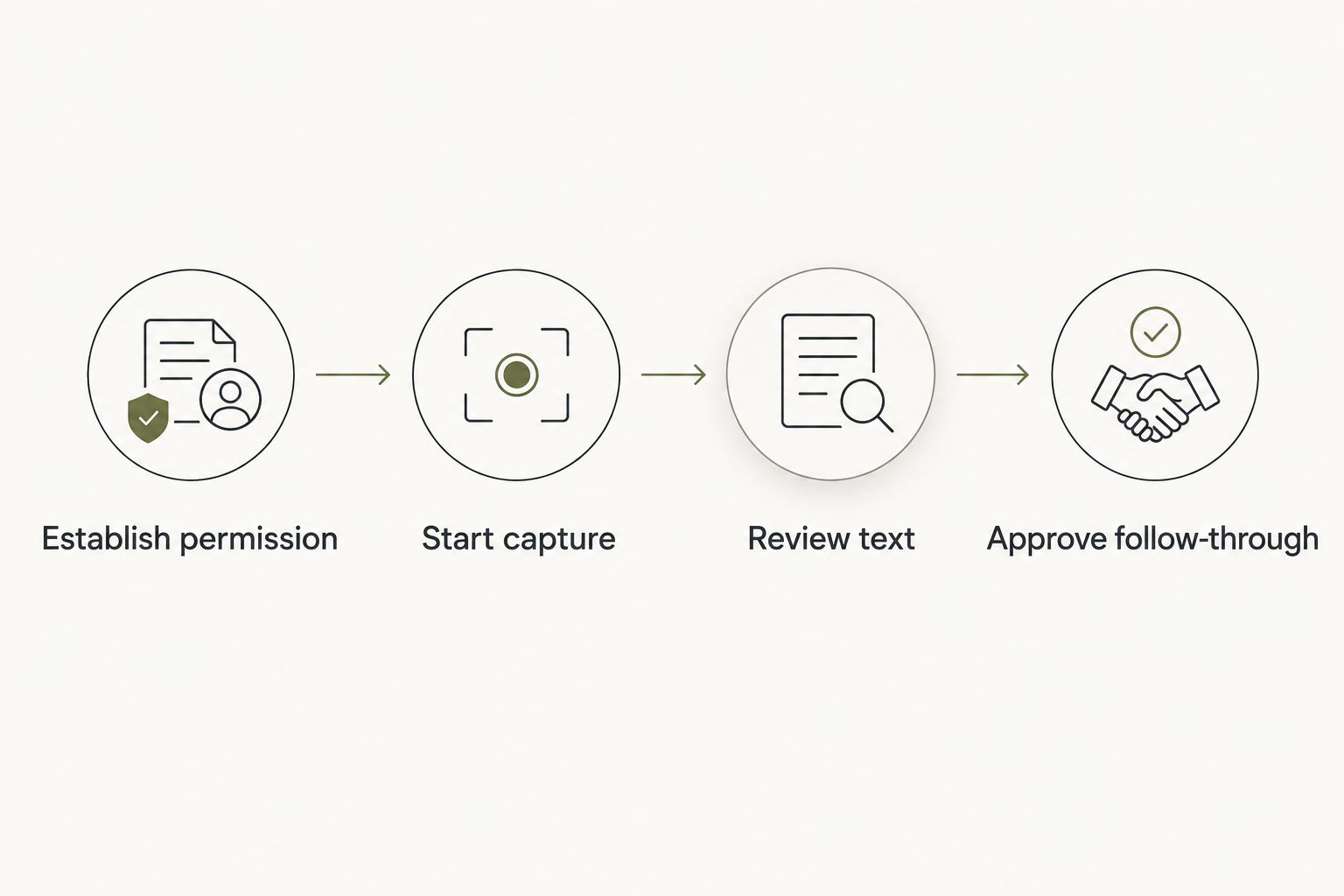
The useful outcome is not simply a file of words. It is a record whose source you understand and a next step you have chosen. Keep those decisions visible when judging whether automation actually helps you.
Why the meaning of automatic varies
The question becomes easier when you replace the broad promise with specific questions. For your 2026 shortlist, ask about these boundaries rather than treating automatic as a complete feature description:
- Capture control: What starts recording, what stops it, and how do you verify its state?
- Processing: Does transcription begin during capture, after capture, or after a separate request?
- Source access: Which sources does the workflow use, and how do you grant each one separately?
- Output: Do you receive recorded speech, a transcript, a summary, or a proposed next step?
- Approval: What can happen without another decision, and what requires your explicit yes?
A clear answer lets you picture the sequence. If a description leaves the sequence unclear, do not fill the gap with the feature you hope it means.
Apply the same discipline to launch language. A planned capability is not evidence of a shipped capability. Judge the workflow you can verify, not the broader direction a product describes.
Facts, summaries, and inferences
A transcript records recognized words; an inference interprets what those words mean. Keep the distinction visible when you use meeting notes to decide what happens next.
Suppose someone discusses revisiting a proposal after receiving more information. A summary can preserve that condition. A proposed task that simply says to proceed with the proposal would remove it.
Before acting, ask whether the record supports the conclusion. Was there a clear agreement, an open question, or only a possible direction? You do not have to settle uncertainty by making the note sound more definite.
Keep sources distinct, too. A captured conversation is not a public source. If you add outside information to your notes, label it separately so another reader can distinguish what participants said from what you researched later.
That distinction also helps with your own reflections. You can notice that a subject matters to you without claiming the meeting proved why it matters. Let the record say what happened; let your interpretation remain an interpretation.
Does automatic transcription mean everyone is recorded?
No—automatic transcription does not, by itself, define who is recorded or when recording begins. Those details depend on the capture workflow and the permissions around it.
For a shared meeting, establish the recording scope before you start. If participants do not want a recording, do not treat automated text generation as a reason to bypass that boundary.
For a personal reflection afterward, keep the source clear. Your recollection of a meeting is a useful note, but it is not a recording of what every participant said.
Can a wearable identify who said what?
Speaker identification is a separate capability from transcription. A device or service can produce words without reliably attaching every passage to a named participant.
Check whether the workflow distinguishes speakers, how names are assigned, and whether you can correct mistakes. Do not turn an uncertain speaker label into a definite task owner.
If responsibility matters, confirm it directly. A short clarification is better than passing along a polished transcript with the wrong name beside a commitment.
Can a transcript become the next step automatically?
A transcript can supply the wording for a proposed next step, but a proposal is not an approved action. Keep the underlying statement available so you can check whether the proposed task matches it.
For example, discussing a call does not mean you agreed to make it. Before adding follow-through, confirm whether you want the call, who it concerns, and what you want to say.
The useful handoff is from a reviewed statement to a choice—not from captured speech to an unapproved commitment. Automation should not blur that distinction.
A wearable for talking it through
Moonshot is a wearable for people who want to talk it through and choose the next step. It hears you out and asks a good question back. Its stated purpose is to help you learn from your own life, not to make your decisions for you.
Picture a personal reflection after a meeting: you say it once, in your own words, that you keep meaning to call someone. The useful outcome is choosing whether that call matters now, not treating the mention as an instruction to act.
That is a different purpose from maintaining an exact meeting record. If transcription is your main requirement, evaluate transcription directly rather than treating reflective conversation as proof of it. Moonshot makes no calls and moves no money; the next step still needs your yes.
A purchase check for 2026
Before you decide, write down the outcome you need in a sentence. For example: you want to review a meeting's wording before sending your own follow-up. That is specific enough to evaluate without inventing a longer list of requirements.
Then trace the workflow from capture to review. Look for explicit explanations of recording control, transcription, source permissions, and approval. Keep an announced plan separate from something the current product actually supports.
Ask about correcting and handling the record as well. You need to understand what happens when a name is wrong, a passage is unclear, or a conversation should not be shared. Do not assume those controls exist just because text can be generated.
Buy for the confirmed workflow you will use, not for the word automatic. A clear description of a narrower capability is more useful than a broad promise you cannot translate into a real meeting.
FAQ
Can an AI wearable transcribe meetings automatically in 2026?
Yes, an AI wearable can transcribe meetings automatically when it supports recording and speech-to-text processing. Check separately how recording starts, when text becomes available, and what requires review.
Does automatic transcription mean a wearable is always recording?
No, automatic transcription does not mean a wearable is always recording. Transcription describes how audio becomes text; recording controls determine when audio is captured.
Do I need permission before recording a meeting?
Check applicable recording laws, workplace rules, and participant permissions before recording a meeting. Do not assume that permission to attend a meeting includes permission to record or share it.
Is a meeting summary the same as a transcript?
No, a summary condenses a conversation, while a transcript presents recognized speech as text. Use the relevant wording rather than a summary when an exact statement affects a decision.
Can I trust speaker names in an automatic transcript?
Verify speaker names before using a transcript to assign responsibility. Speaker identification is separate from recognizing the words, and a readable passage does not establish that its label is correct.
Does Moonshot make calls after I mention someone?
No, Moonshot makes no calls and moves no money. It hears you out, asks a good question back, and keeps the next step subject to your yes.
What should I check before buying a meeting transcription wearable?
Check the confirmed capture, transcription, review, and approval workflow. Distinguish current capabilities from planned ones, and establish how each source receives permission.
One last thing
For your 2026 decision, choose a real meeting question before choosing a device. Perhaps you need to confirm who owns the revised draft. Perhaps you want to remember why you agreed to show up.
Those needs require different records. The first calls for checking an explicit commitment; the second can begin with your own reflection afterward. Neither requires turning everything you say into a task.
The test is whether the record helps you make the next decision accurately. Keep the wording when wording matters. Keep the question open when the answer is not settled. Then choose the follow-through you actually mean.