 moonshot

Yes, an AI wearable can work without Wi-Fi if the function you need runs on the device or reaches the internet through another connection, such as your phone. In 2026, the key distinction is not Wi-Fi versus no Wi-Fi, but which tasks work without any internet connection at all.
- Can an AI wearable work without wifi? Yes, but offline functions depend on the device.
- Bluetooth connects nearby devices; it does not provide internet access by itself.
- A phone connection can replace Wi-Fi when the wearable supports that connection.
- Check capture, processing, and delivery separately before relying on a wearable offline.
If you're considering Moonshot, make offline behavior part of your purchase check. Ask what happens to something you say when neither the wearable nor its connected phone can reach the internet.
Can an AI wearable work without wifi?
An AI wearable does not necessarily need Wi-Fi, but a cloud-dependent function needs some route to the internet. That route might be a connected phone or a cellular connection supported by the wearable itself. A function performed entirely on the device does not need that route.
These situations are different:
| Connection situation | What it means | Best for | Limitation to check |
|---|---|---|---|
| Wi-Fi available | The wearable or connected phone can use a wireless network for internet access | Connected use where a suitable network is available | Network access does not prove every function works |
| Phone internet available | A supported phone connection provides a route to online services | Use away from a Wi-Fi network | The wearable must support that route, and the phone needs service |
| Wearable cellular available | A wearable with supported cellular service can reach online services directly | Use without relying on a nearby phone | Cellular hardware, service, and coverage are required |
| No internet available | Only functions designed to operate locally remain usable | Tasks explicitly supported offline | Online processing and delivery must wait or remain unavailable |
The table describes connection arrangements, not a feature list for any particular product. A wearable can support one arrangement without supporting the others. Check the exact device rather than assuming the whole category behaves alike.
Why the distinction matters
Imagine you say that you want to call a friend after dinner. Later, you want to return to that thought and choose the next step. Without an internet connection, the useful question is whether the wearable can preserve your words, make sense of them, or show them to you at that moment.
Those are separate jobs. Successfully saving something does not prove the device can process it offline. Processing it does not prove it can send anything elsewhere.
For a 2026 purchase, replace the broad question about connectivity with a concrete one: what can you finish while disconnected? That answer tells you more than a wireless symbol on a product page.
Offline functions
A wearable's offline behavior depends on where each part of the work happens. Read the function description closely. Words such as capture, save, process, and sync describe different stages.
Capture without internet
Offline capture means the device can accept and retain an input without reaching an online service. That might be enough if your aim is to say it once and return to it later, but only when the product explicitly supports that behavior.
Check whether the saved input survives a lost connection and whether you can tell that it was saved. Do not treat a light, vibration, or other acknowledgment as proof of durable storage unless the instructions define it that way.
Best for: keeping an input for later use, when offline saving is confirmed. The limitation is timing: saving something now does not mean you can use every related function now.
Processing without internet
Local processing happens on the device rather than on a remote service. If a specific function is designed to run locally, that function can operate without an internet connection.
The important word is specific. A device might perform one operation locally while sending a different operation to an online service. A claim about local processing should name the task it covers.
Best for: a defined task that needs to work while disconnected. The limitation is scope: support for one local function does not establish support for every function.
Syncing after reconnection
A device designed for deferred syncing can retain supported information and transfer it when a connection returns. That is different from completing the entire task offline.
Look for a clear explanation of what waits, what resumes, and what needs another attempt. If an action requires your approval, reconnecting should not be treated as a substitute for your yes.
Best for: work that can wait until you reconnect. The limitation is that the result is not available at the moment you first provide the input.
Connectivity requirements
Why does one wearable work away from Wi-Fi while another loses a function? The answer comes down to the route and the work being done, not the label on the device.
- Processing location. Work performed on a remote server needs an internet connection; work performed locally does not need that connection.
- Phone dependence. A supported phone connection can provide access to online services, but the phone must remain connected as required.
- Cellular support. Direct cellular access requires the appropriate device capability and service. Do not infer it from portability.
- Local storage. Keeping an input for later requires an offline storage function designed for that purpose.
- Task destination. A result kept locally has different connection needs from information sent to an online account or another person.
- Source access. A saved conversation and a newly requested public source are different inputs. Access to one does not establish access to the other.
These factors explain why an answer such as works offline needs a follow-up question. Which function works offline, and where does its work stop?
An offline check before you rely on it
Use the exact task you care about. A general demonstration of a wearable working does not establish that your particular task will work while disconnected.
For example, you might want to capture a thought on a walk and return to it before reaching home. Test that sequence rather than substituting a different feature that happens to work offline.
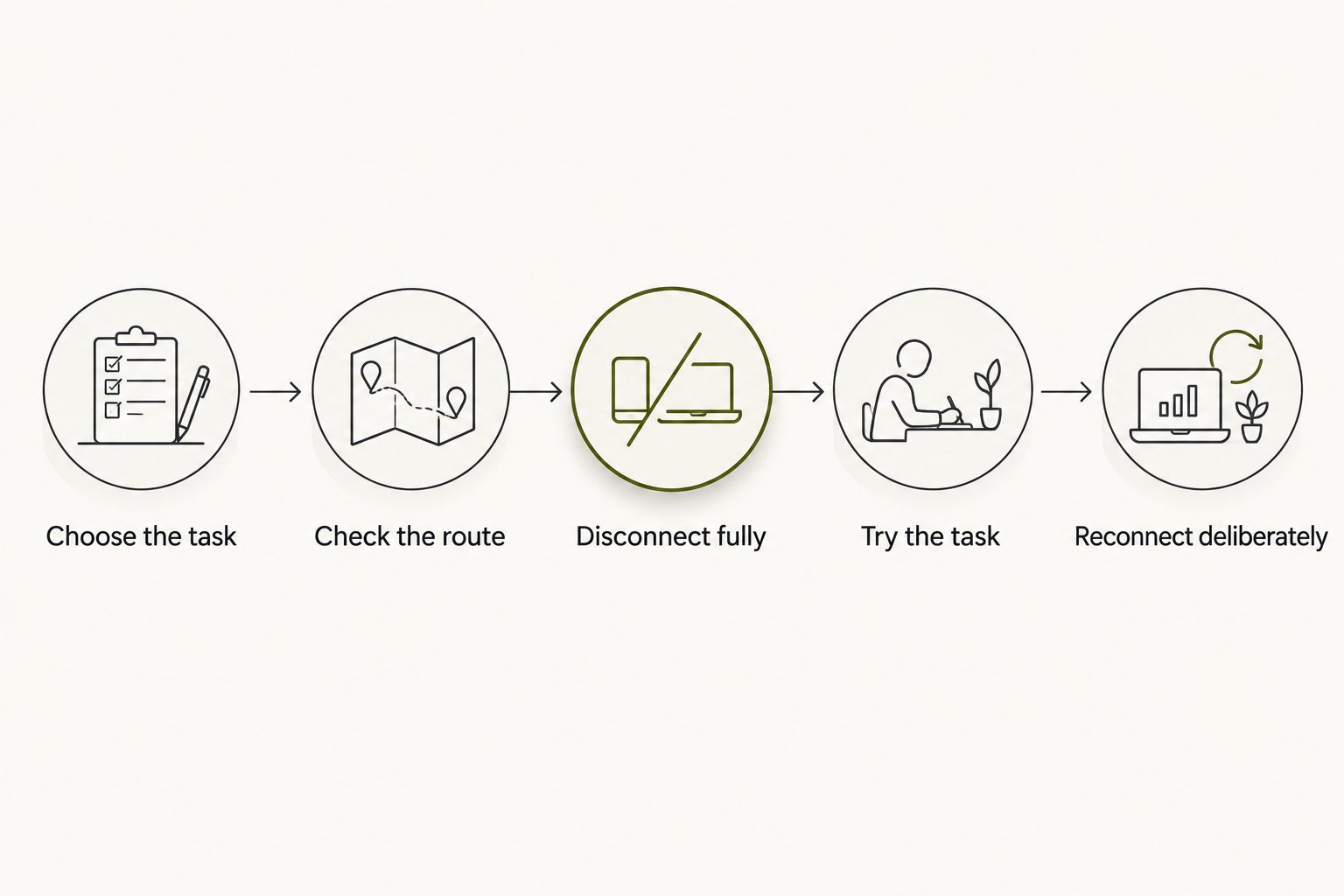
- Choose the task. Name the outcome in plain language: save a thought, read an earlier entry, or receive a response. Avoid testing several outcomes at once.
- Check the route. Identify whether the device uses Wi-Fi, a connected phone, or its own supported cellular service. Include the phone's mobile data connection in this check.
- Disconnect fully. Remove internet access through every supported route while preserving any local connection needed for the test. Turning off Wi-Fi alone does not establish an offline state.
- Try the task. Perform the chosen action and check the result. Distinguish an input acknowledgment from a saved item or completed response.
- Reconnect deliberately. Watch what becomes available afterward. Check whether anything needs a retry, review, or separate approval before it goes elsewhere.
Record the outcome in ordinary words: saved while offline, available only after reconnecting, or unavailable without internet. That description is more useful than a single pass or fail.
Repeat the check after a relevant software change before depending on the result. A 2026 demonstration establishes what worked under those conditions; it is not a promise about every later version or connection setup.
Does Bluetooth mean a wearable works offline?
Bluetooth alone does not establish offline functionality. It provides a local wireless connection between compatible devices. A wearable can use that connection while still relying on the phone's internet access for part of its work.
Think of Bluetooth as one part of the route. If information travels from the wearable to a phone and then to an online service, removing the phone's internet connection breaks the online part of that route.
Check what remains available when the local connection stays active but internet access is removed. That separates phone-connected behavior from genuinely offline behavior.
Can a wearable use mobile data instead of Wi-Fi?
Mobile data can replace Wi-Fi when the wearable supports an appropriate connection route. That might mean using a connected phone's internet access or using cellular service built into the wearable.
Neither route follows automatically from the word wearable. Confirm whether the phone needs to be nearby, whether a particular function depends on it, and what happens when coverage drops.
For travel in 2026, also separate a connection requirement from a network-access requirement. A device that works on one accessible network is not thereby proven to work on every network you encounter.
Does offline operation mean information stays on the device?
Offline operation does not establish what happens after reconnection. A device can perform a local task while disconnected and transfer information later, depending on its design and settings.
Review the data-handling terms separately from the connectivity description. Check what is retained, what is transferred, and which sources you separately authorize.
Keep the source distinction clear as well. A captured conversation records what was said; it does not independently verify the statement. A public source is separate evidence, and an inference drawn from either should not be presented as a directly observed fact.
Moonshot and your next step
Moonshot is best for people who want to talk it through and choose the next step themselves. It is a wearable that hears you out, asks a good question back, and helps you notice what your days keep saying.
The useful scene is small: the friend you keep meaning to call comes up again. You decide whether that matters today. The point is to learn from your own life, not to hand over your priorities.
Moonshot turns one thing into a next step, with your yes on each one. It makes no calls and moves no money. You still choose how to show up and handle the follow-through.
For a preorder decision in 2026, check the current product information for the exact connection requirements. Separate a planned capability from a shipped one, and ask which part of your intended task works without internet access. A description of the intended benefit is not an offline specification.
FAQ
Can an AI wearable work without wifi or mobile data?
An AI wearable can work without Wi-Fi or mobile data only for functions designed to run without internet access. Check offline capture, local processing, and access to saved information separately.
Does turning off Wi-Fi prove that my wearable works offline?
Turning off Wi-Fi does not prove offline operation because a connected phone or supported wearable cellular connection can still provide internet access. Remove every internet route before testing a function's offline behavior.
Will Bluetooth give my wearable internet access?
Bluetooth alone does not provide internet access. A compatible wearable can use a supported Bluetooth connection to a phone as part of a route to online services.
Can I save something offline and use it later?
You can save something offline and use it later only if the device supports offline storage and the later function you need. Confirm that the input was saved and check what happens when you reconnect.
Does offline mean my information never leaves the wearable?
Offline does not mean information never leaves the wearable. A device can retain information while disconnected and transfer it later according to its design, settings, and permissions.
Does Moonshot need Wi-Fi for every function?
Check Moonshot's current product information for function-specific connection requirements. Do not treat its description as a wearable that hears you out as confirmation of offline capture, processing, or syncing.
What should I check before buying a wearable for use without internet?
Check whether your exact task works with every internet route disconnected. Then check what remains saved, what waits for reconnection, and what requires your approval before anything is sent.
One last thing
The strongest offline test starts with the result you need, not the connection you switch off. A wearable that saves your thought but cannot yet return a response has done something useful, but it has not completed the same job as a fully local function.
Before you depend on it, finish this sentence: without internet, I need it to do this. Make the answer concrete enough to test. That is the requirement to carry into your purchase decision.