 moonshot

No—an AI wearable does not require a monthly subscription simply because it is a wearable. A subscription is required only when the product’s terms make an ongoing plan necessary for the function you want. Before you commit, check what the device purchase includes, what requires a separate membership, and what remains usable after that membership ends.
- Does an AI wearable require a monthly subscription? The purchase terms, not the category name, determine the answer.
- Separate the device purchase from any required service agreement before you commit.
- Check what stops working when a membership ends, including access to previously captured material.
- Moonshot suits people who want to talk it through and choose the next step themselves.
Why this matters
You remember a conversation because of one small thing: you said you wanted to call a friend. Later, you want to return to that thought. The useful buying question is whether the product’s terms include that return visit—or place it behind an ongoing membership.
A device purchase and a continuing service agreement are different commitments. Judge the purchase by the function you want to keep using, not by the hardware alone. An optional membership is not truly optional for your purposes if it contains the only function you wanted.
For Moonshot, read the current preorder terms before committing. Use the same check for any wearable you consider in 2026: identify the intended benefit, then find the terms that govern continued access to it.
Does an AI wearable require a monthly subscription?
The answer depends on the agreement attached to the device. Look for an explicit statement that a membership is required, optional, included for a defined period, or unnecessary for the function you want. Do not treat silence about subscriptions as a promise that none exists.
The table below is a reading guide, not a list of plans offered by a particular product. Each row describes wording to look for and the question it should trigger.
| Wording in the terms | What it establishes | Best for | Limitation to check |
|---|---|---|---|
| No membership required for a named function | That function does not depend on a membership under those terms | Buyers who want that specific function without a recurring agreement | Other functions can have separate conditions |
| Optional membership | You can decline the membership | Buyers satisfied with the explicitly included functions | Your intended use might depend on the optional features |
| Required membership | Continued service depends on maintaining the agreement | Buyers comfortable with an ongoing commitment | What remains usable after cancellation |
| Membership included for a stated period | Access is covered during that period | Buyers evaluating the included service | What happens when the included period ends |
“Included” needs an object and a duration. Included hardware, included service, and included introductory access are not interchangeable promises.
Required membership: check the cancellation boundary
If the terms require a membership, start with what happens when it ends. That boundary tells you more about the commitment than a feature list does. Ask which functions stop, which remain, and whether you can still retrieve material you deliberately captured.
A useful answer names the function. “Limited access after cancellation” leaves too much unresolved. You need to know whether limited access means you can read existing material, create new entries, retrieve earlier conversations, or do none of those things.
Also separate cancellation from deletion. Ending a recurring agreement does not, by itself, explain the treatment of your account or stored material. Read the relevant terms rather than assuming these actions are equivalent.
For a 2026 purchase, save the version of the agreement you accepted. Keep the purchase confirmation alongside it. This gives you a concrete reference if you later need to establish what was included when you committed.
The advantage of explicit required-membership terms is clarity about the continuing commitment. The drawback is equally clear: you must maintain that agreement to retain the functions it covers. Decide whether those are functions you expect to use.
Optional membership: check the function you actually want
“Optional” describes your ability to decline a membership. It does not tell you whether the remaining product meets your needs. Start with a concrete use rather than the broad promise of a wearable.
Suppose you want to return to something you intentionally captured earlier. Break that into the actions that matter: recording it with permission, finding it later, and deciding what to do next. These are questions to verify, not capabilities to assume.
Then check each action against the included-function description. If the first action is included but the later action requires membership, the service boundary cuts through your intended use. You should know that before buying.
The benefit of an optional arrangement is that you can decline the additional agreement. Its limitation is that the included functions might not deliver your particular payoff. Evaluate the whole use you care about, not an isolated feature that happens to be included.
If the wording remains unclear, ask a narrow question: can I complete this specific task without maintaining a membership? A direct answer is more useful than another general description of the product.
Why the subscription answer varies
Subscription wording addresses several different questions. Keep them separate when reading a 2026 offer:
- Requirement: Does the agreement explicitly require an ongoing membership, or merely offer one?
- Scope: Which named functions belong to the device purchase, and which belong to the service agreement?
- Duration: Is service included indefinitely under the stated terms, or only for a defined period?
- Renewal: Does access end, require a new decision, or renew under the agreement?
- Cancellation: Which functions and account access remain after you end the membership?
- Purchase status: Does the description identify something currently offered or something planned for later?
These distinctions explain the buying decision without guessing how a manufacturer operates. A description of what a product is intended to do is not a substitute for the terms that govern your access to it.
Keep the wording attached to its source. A product description explains the intended experience; an agreement establishes the commitment you are accepting. Neither should silently stand in for the other.
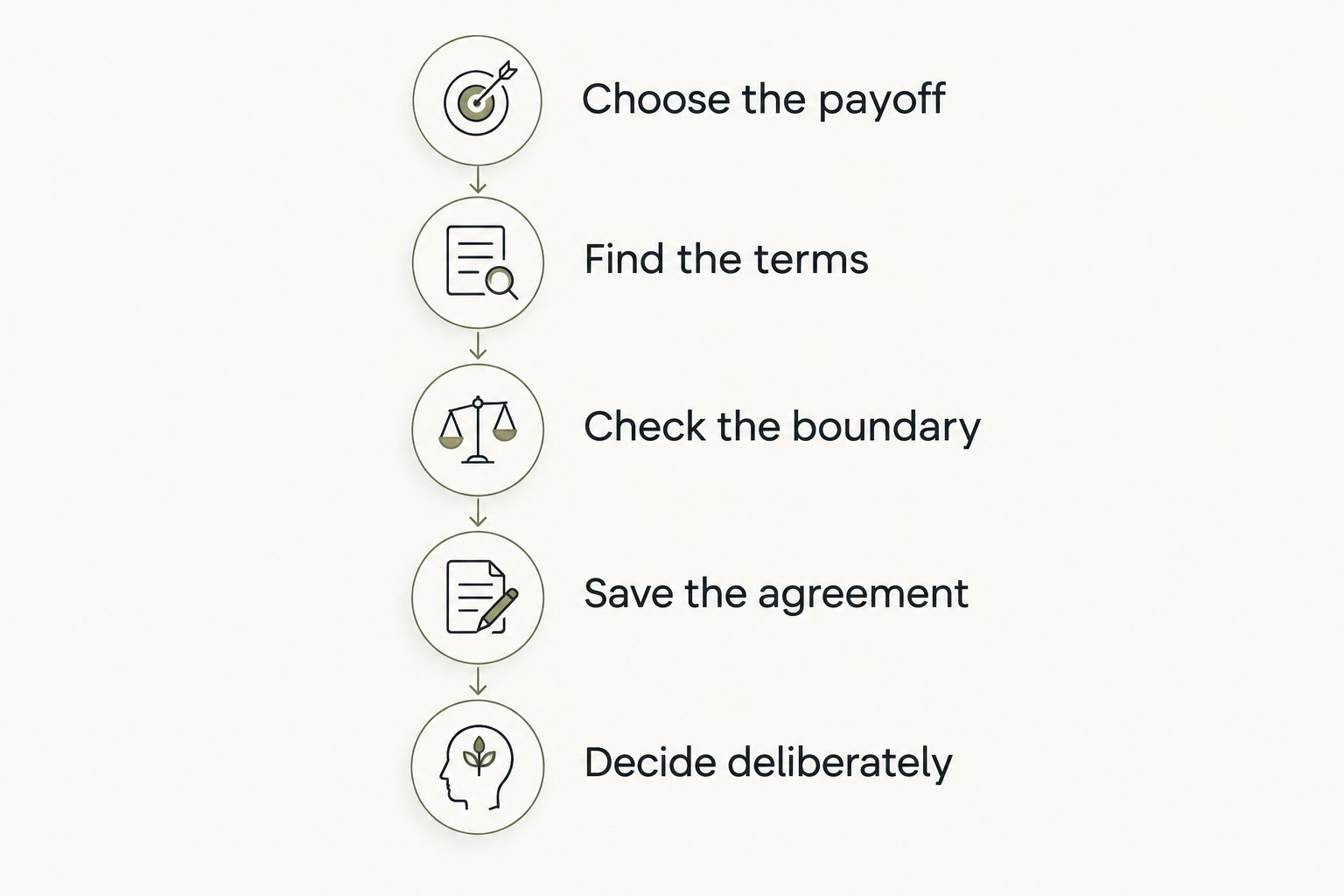
A subscription check before you commit
Use this sequence to turn a broad product promise into a decision you can explain in plain language. You do not need to understand the underlying technology to ask these questions.
- Choose the payoff. Write down the moment you want help with. For example, you want to return to an idea you deliberately captured and decide whether it deserves attention. Keep the goal small enough to verify.
- Find the terms. Locate the current purchase and service conditions. Read the description of included access, required membership, renewal, and cancellation together rather than treating any isolated phrase as the full answer.
- Check the boundary. Match your intended use to the included functions. Ask what changes without membership and what happens to existing material when service ends. Do not fill an unclear answer with an assumption.
- Save the agreement. Keep the accepted terms and your purchase confirmation. For a preorder, distinguish the commitment you are making now from descriptions of future functions.
- Decide deliberately. Accept only the arrangement that fits your intended use. A clear answer that does not suit you is still useful: it lets you decline without guessing.
The sequence works because each step resolves a different question. You choose the purpose first, then assess the agreement against it. A long feature list cannot make that choice for you.
Permissions are separate from subscriptions
A membership answers a question about service access. It does not answer which sources a product can use, who agreed to a captured conversation, or whether an action can happen in your name. Check those boundaries separately.
Treat a conversation you deliberately captured differently from a public source. Treat a recorded fact differently from an interpretation of it. If a product suggests that a passing remark reflects a priority, you still decide whether that interpretation is right.
The same distinction applies to follow-through. A suggested next step is not permission to carry it out. Decide what can be accessed, grant each source separately, and look for a clear approval boundary before anything goes out in your name.
This matters even when no recurring membership is involved. A payment agreement is not a blanket permission agreement. Evaluate both before deciding whether a wearable belongs in your day.
For your 2026 checklist, keep these as separate questions rather than combining them into a vague judgment about trust.
Moonshot: a question, then your choice
Moonshot is a wearable that hears you out, asks a good question back, and helps you notice what your days keep saying. Its purpose is to help you learn from your own life. You choose what to do with what you notice.
Moonshot is for people who want to talk it through and choose the next step themselves. The intended payoff is specific: an idea you keep returning to becomes something you decide to act on, with your yes on each next step.
That boundary matters. It makes no calls and moves no money. If you want a device to make the call for you, that is not the role described here; you still show up for the conversation yourself.
Use that intended experience as your buying test, then check the current agreement separately. Product purpose tells you whether the approach fits. Subscription terms tell you what commitment you are accepting.
Can I keep using a wearable after canceling its subscription?
You can keep using only the functions the agreement leaves available after cancellation. Ownership of the physical device does not, by itself, establish continued access to a separate service.
Ask about existing material as well as new activity. Reading something already captured and creating something new are different uses; the cancellation terms need to address the one you care about.
Does an included membership mean it will never renew?
An included membership does not establish what happens at the end of the included period. Read the renewal language and identify whether continued access requires another decision or follows the agreement’s renewal conditions.
For a 2026 preorder, check this before committing rather than leaving it until delivery. An included period and a continuing entitlement are different promises, even when both appear under the word “included.”
FAQ
Does an AI wearable always need a monthly subscription?
No. A monthly subscription is required only when the product’s terms make it necessary for the function you want. Check the purchase and service agreements rather than relying on the category name.
How can I tell whether a wearable subscription is really optional?
Match your intended use to the functions explicitly available without membership. A membership can be optional to purchase while still containing the only function you want.
What should I check before canceling a wearable membership?
Check which functions stop and whether you can still access previously captured material. Read account-deletion and data-handling terms separately from cancellation terms.
Does buying the device include ongoing service?
Buying the device includes only the service access specified in the purchase agreement. Do not assume that ownership of the hardware establishes an ongoing service entitlement.
Is an included membership the same as permanent access?
No. An included membership establishes access only for the scope and duration stated in the agreement. Check the renewal conditions before committing.
Does paying for a subscription give a wearable permission to use every source?
No. Service access and source permission are separate decisions. Grant each source deliberately and check the approval boundary for actions taken in your name.
Does Moonshot make calls for me?
Moonshot makes no calls and moves no money. It hears you out, asks a good question back, and leaves the choice of the next step with you.
One last thing
The most revealing subscription question is not whether a membership exists. It is whether you still get the benefit you bought the device for when that membership ends. Ask it using your own intended use, not the product’s broadest promise.
Before you commit, finish this sentence: without an ongoing membership, I can still use the device to do this specific thing. Then find the wording that supports your answer. If you cannot complete the sentence confidently, keep the purchase undecided until you have a clear answer.
A clear boundary makes the choice simpler. You know what you are agreeing to, what remains your responsibility, and whether the device fits the way you want to spend your attention.