 moonshot

Not automatically: an AI wearable supports multiple languages only if its documented language support covers what you want to do, from capturing speech to returning a useful response. Before you choose in 2026, check your exact languages, whether you switch between them, and which language you want back.
- Does an AI wearable support multiple languages? Check speech recognition, translation, and response language separately.
- Moonshot is for people who want to talk it through and choose their own next step.
- A translated summary is not the same as a transcript in the original language.
- Ask for a mixed-language example before relying on a wearable for bilingual conversations.
Does an AI wearable support multiple languages?
A multilingual claim needs a task attached to it. Recognizing spoken words, translating them, and asking a useful question back are different requirements. Support for one does not establish support for the others.
Start with the moment you want help with. Suppose you captured a thought in Spanish earlier and now want to revisit it in English before calling a friend. Your requirement includes understanding the original thought and returning something useful in another language—not merely displaying an English menu.
Use this table to separate the requirements when you compare wearable descriptions in 2026. These are evaluation categories, not claims about any particular device.
| Requirement | Best for | What to request | Limitation to check |
|---|---|---|---|
| Speech recognition | Keeping spoken words in their original language | A transcript of your chosen language | Translation is a separate requirement |
| Translation | Reading captured speech in another language | Original text beside translated text | A translation is not the original wording |
| Mixed-language capture | Conversations that switch languages | An example containing both languages | Separate language support does not establish switching support |
| Response language | Reflecting in the language you prefer | A written response in that language | Menu language does not establish response language |
Language fit
Language fit matters because you need to recognize your own meaning in what comes back. A tidy sentence is not enough if it changes who you meant, turns a question into a decision, or loses the word that made the thought specific.
The Moonshot reservation page describes a wearable that hears you out and asks a good question back. For a multilingual buyer, the useful question is whether that exchange works in the language you actually use—not just the language you use while shopping.
Keep the intended benefit small and concrete. Perhaps you want to return to something you said about a friend and decide whether to call. Evaluate that exchange before imagining a device handling every conversation in your day.
Original-language capture
Best for: keeping the wording you actually used. If you want a record of spoken Spanish, request a Spanish transcript rather than accepting an English summary as evidence of Spanish transcription.
A transcript and a summary serve different purposes. The transcript represents spoken wording; the summary selects and condenses meaning. Neither should be presented as a public source when it came from a captured conversation.
Try a short passage with a person's name and a phrase you use naturally. Include an unfinished sentence if that reflects how you speak. The point is not to trick the device; it is to check an ordinary moment rather than a rehearsed demonstration.
Original-language capture lets you inspect the wording directly if you read that language. Its limitation is equally clear: it does not answer whether you can receive a response in another language or translate the capture later.
Translation
Best for: revisiting a thought in another language. Ask to see the original wording beside the translation so you can compare what changed.
For example, imagine saying that you might call a friend after work. A useful translation must preserve the difference between considering the call and committing to it. Your uncertainty is part of what you said, not something to tidy away.
Check names, relationship terms, and phrases whose meaning depends on context. If you cannot read the original language, ask someone who can to review the example with you rather than judging accuracy from fluent wording alone.
Translation gives you another way to read the capture. The trade-off is that the translated wording is an interpretation of the original, not a replacement for it. Keep that distinction visible when deciding what to do next.
Mixed-language conversations
Best for: people who naturally switch languages while speaking. Ask for an example containing both of your languages within the same conversation, not separate demonstrations of each.
You might describe your day in English but use a Spanish phrase because it says exactly what you mean. Or you might speak one language with a relative and another when adding your own reflection. Those are different tests from reading a prepared passage in a single language.
For a practical check, prepare 1 conversation containing 2 languages. Put a language switch in the middle of a sentence as well as between speakers if both reflect your actual use.
Check whether the output preserves the switch, translates everything, or leaves part of the conversation unresolved. Each result calls for a different decision. Do not treat the presence of both language names on a list as proof of how a mixed conversation will be handled.
Response language
Best for: thinking through a captured moment in your preferred language. Specify the language you want back, independently of the language you spoke.
A useful evaluation might start with a thought captured in one language and a written question returned in another. Check whether the question follows what you meant and leaves room for your answer. Do not assume the response is spoken aloud.
The advantage is practical: you can evaluate the exchange in the language in which you want to reflect. The limitation is that response language alone tells you nothing about the accuracy of the original capture.
Keep action separate, too. A question about calling a friend is not permission to place the call. Understanding what you said, suggesting the next step, and receiving your yes are distinct events.
Reasons language support varies
When checking a wearable in 2026, replace the broad question of language count with these specific questions. Each factor describes a requirement to verify, not a feature to assume.
- Task: Do you need a transcript, a translation, or a question back? Request an example of that exact task.
- Language variety: Does the documentation address the regional variety you speak? Use your own phrasing in the demonstration.
- Switching: Do you stay in one language or change within a sentence? Test the pattern you actually use.
- Conversation format: Are you capturing your own reflection or an exchange with someone else? Keep those examples separate.
- Output: Do you want the original language preserved or a different language returned? State that choice before evaluating the result.
- Release status: Is the demonstrated function available now or described as planned? Do not treat a future description as present support.
These questions make a language claim inspectable. A long list of languages is less useful to your decision than a clear example matching the exchange you need.
A language check before choosing
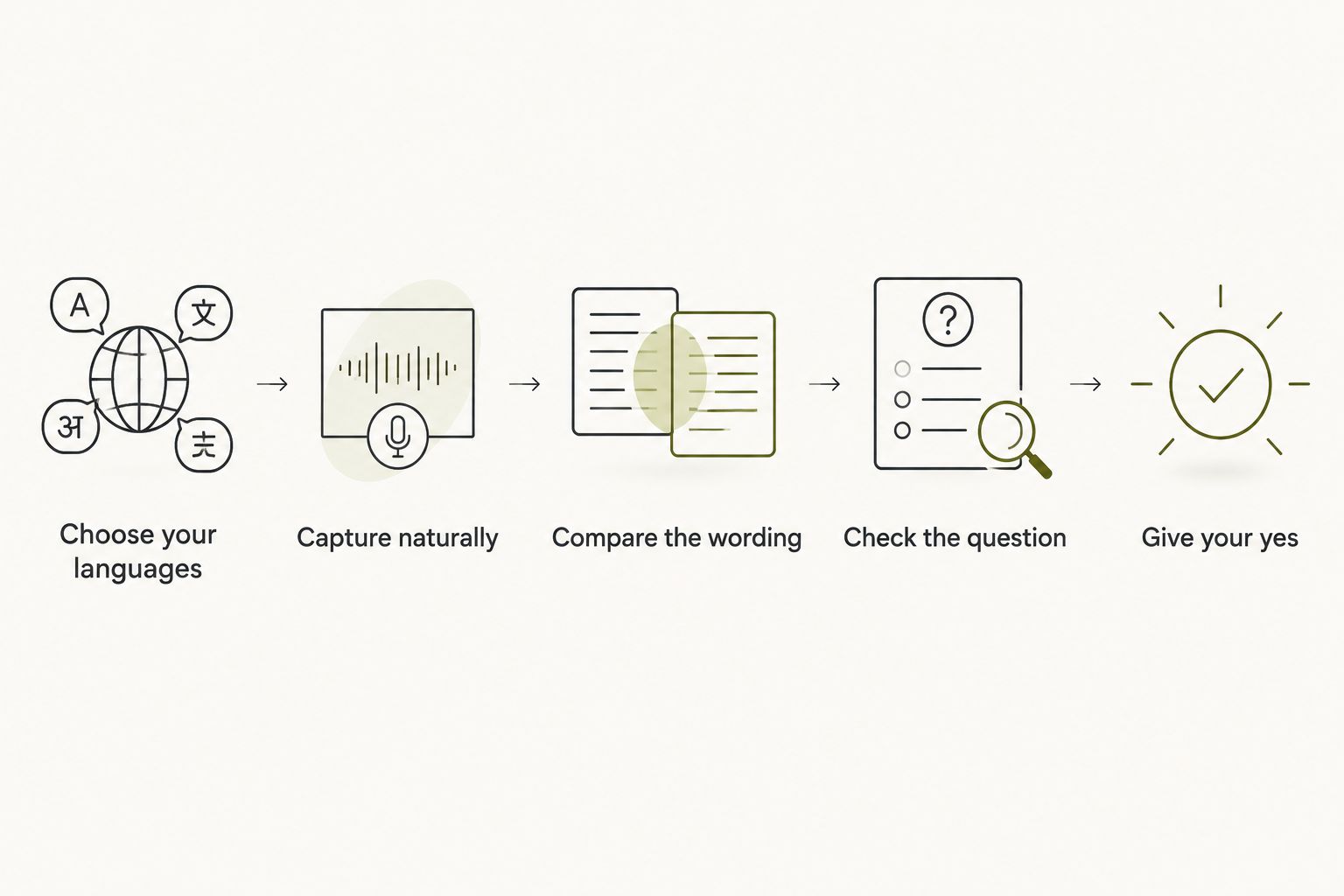
Use this sequence when reviewing a wearable in 2026. It produces a clear question for the seller and a practical way to judge the answer.
- Choose your languages. Write down what you speak and what you want returned. Include the regional variety when it matters to your example.
- Capture naturally. Prepare a brief passage using ordinary phrasing. Ask permission before including another person's speech.
- Compare the wording. Review the original capture separately from any translation or summary. Mark where the meaning changes.
- Check the question. Decide whether the response follows your meaning without presenting an inference as a fact.
- Give your yes. Choose whether to take the next step. An understood sentence is not approval to act in your name.
Keep a short record of the example you used and the result you received. That gives you something specific to ask about if a product description remains broad or changes later.
For Moonshot, focus the evaluation on its stated purpose: hears you out, asks a good question back, and helps you learn from your own life. That purpose fits someone who wants to talk it through; it does not, by itself, establish support for a particular language.
Use the contact page to ask about your exact language combination and intended exchange. Ask for a current example rather than confirmation of a broad label.
Can I speak one language and get another back?
Speaking one language and receiving another back requires support for that specific exchange. Ask for the original capture and the returned response together so you can check both.
Keep your request precise: name the spoken language, the desired response language, and whether you need a transcript or a summary. A demonstration of translation alone does not answer every part of that request.
Will a wearable understand my accent?
An accent needs an example, not an assumption. Use your own speech and ordinary phrasing when evaluating recognition.
Check the actual wording, especially names and the words that carry your intent. A polished summary does not show you whether those details were captured correctly.
Does multilingual support mean live interpreting?
Multilingual support does not establish live interpreting. Capturing a conversation for later review and returning a translation during an exchange are different requirements.
If you need live interpreting, ask specifically whether that function is available and how the exchange works. Do not infer it from a language list or a translated example shown after a conversation ends.
FAQ
Does an AI wearable support multiple languages automatically?
Do not assume automatic multilingual support. Verify your spoken languages, the task you need, and the language you want returned as separate requirements.
Can I switch between two languages in the same sentence?
Check mixed-language capture with an example that switches within a sentence. Separate demonstrations of each language do not establish how a mixed sentence will be handled.
Does an English menu mean the wearable understands English speech?
An English menu does not establish English speech recognition. Ask for a spoken example and inspect the resulting transcript or response.
Can a wearable translate a conversation without keeping the original wording?
Ask whether the original wording remains available alongside the translation. A translated summary and an original-language transcript are different outputs.
How do I check whether a language feature is available in 2026?
Check current documentation and request a demonstration of the exact language task. Keep planned capabilities separate from functions you can use now.
Is Moonshot a fit if I want to talk through my day?
Moonshot is for people who want to talk it through and choose their own next step. Verify your language requirements separately before deciding whether it fits your use.
Does understanding my words give a wearable permission to act?
Understanding your words is not permission to act in your name. Choose priorities yourself, grant each source separately, and require your yes before anything goes out.
One last thing
Test the word that changes the decision. Use a sentence such as: I might call her, but I have not decided. Then check whether the output preserves both the possibility and the lack of commitment.
That small distinction matters more to this example than polished wording. A useful question leaves the decision with you. Choose the call yourself, then decide what follow-through looks like.