 moonshot

AI wearable transcription has no single accuracy rate: results depend on the recording conditions, the speakers, and how accuracy is measured. A readable transcript can still get a name, a number, or a refusal wrong, so check consequential details against the recording before acting on them.
- How accurate is AI wearable transcription? Judge the recording and test method, not an unexplained percentage.
- Word error rate measures transcription mistakes; it does not establish correct speaker labels or reliable summaries.
- Check names, numbers, and negation against the recording before using a transcript for follow-through.
- Moonshot is best for people who want to talk it through and choose the next step themselves.
How accurate is AI wearable transcription?
A transcription accuracy claim is useful only when you know what was measured and under what conditions. For a 2026 buying decision, look for the language tested, recording environment, microphone placement, and scoring method. A result from a quiet room does not describe every conversation you will have.
Consider a conversation you captured with permission earlier in the day. You return to it before calling a friend and find the sentence about when they are free. The transcript helps only if it preserves the day, the time, and whether they said they could or could not make it.
That distinction also matters when comparing wearables for meeting notes. Capturing words, identifying speakers, and summarizing decisions are separate jobs. Success at one does not establish success at the others.
| Recording condition | Best for evaluating | Useful evidence | Limitation |
|---|---|---|---|
| Quiet room, one speaker | Basic word recognition | Comparison with a checked reference transcript | Does not test interruptions or competing voices |
| Conversation with alternating speakers | Turn-taking and attribution | Correct words assigned to the correct speaker | Clear words can still receive the wrong speaker label |
| Conversation with overlapping speech | Handling interruptions | Preservation of each speaker’s contribution | Overlap makes individual voices harder to separate |
| Speech with background noise | Performance in your intended setting | Results from a comparable environment | A quiet-room score does not describe this condition |
These are test conditions, not product rankings. The best evidence resembles the situation where you intend to use the wearable.
Why transcription accuracy matters
A transcript often becomes the starting point for something else: a note you revisit or a message you consider sending. An error at that starting point can change the meaning of the next step. Smooth wording does not make the underlying record correct.
Suppose someone says they have not agreed to a proposal. Dropping the word not changes the decision, even if every other word is right. A low overall error rate can therefore coexist with a consequential mistake.
For your 2026 evaluation, separate convenience from dependence. A rough transcript can help you locate a conversation worth replaying. A transcript used to confirm an agreement needs closer checking.
Word error rate
Word error rate, usually shortened to WER, is a standard speech-recognition measure. It compares a generated transcript with a reference transcript and counts substitutions, deletions, and insertions.
The calculation is:
WER = (substitutions + deletions + insertions) ÷ reference words × 100%.
A substitution replaces a word. A deletion leaves a word out. An insertion adds a word that was not in the reference.
WER expresses errors relative to the reference length: a 100-word reference supplies the denominator for that comparison. A result of 0% WER means there were no word errors under the scoring rules. WER can exceed 100% when insertions push the error count above the number of reference words.
Those figures describe the metric, not a measured result for a particular wearable. Treat an advertised accuracy percentage as incomplete until its calculation and test conditions are clear.
Word accuracy is not meaning accuracy
WER counts word edits, not their consequences. A missing filler word and a missing negation each contribute an error, but they do not carry the same practical risk.
Check the details that control meaning separately. Names, dates, quantities, and explicit decisions deserve attention even when the rest of the transcript reads well.
Speaker accuracy is a separate question
A transcript can contain the right sentence and assign it to the wrong person. That matters when the sentence describes a promise or an objection.
Ask how speaker attribution was evaluated. A word-recognition score alone does not answer whether the correct person received credit for each statement.
Why wearable transcription accuracy varies
Speech recognition starts with the sound the microphone receives. The conditions below change that sound or make the language harder to distinguish; they are not evidence that any particular device performs well or poorly.
- Microphone position. Distance, orientation, and clothing between a microphone and a speaker affect the captured speech. Test the intended wearing position rather than treating a nearby recording as equivalent.
- Background sound. Music, traffic, and nearby conversations can mask speech. Use a setting that resembles your actual use, with everyone’s permission.
- Overlapping voices. Simultaneous speech makes words and speaker boundaries harder to separate. A test with orderly turns leaves that challenge untested.
- Pronunciation and language. Accents, dialects, and switching languages change the recognition task. Check evidence for the language you use rather than assuming coverage means equal performance.
- Names and specialist vocabulary. Unfamiliar names, abbreviations, and technical terms need particular scrutiny. A plausible replacement can look correct until you compare it with the recording.
- Scoring rules. Reference preparation and treatment of punctuation, capitalization, and written numbers affect comparisons. Compare results produced under the same rules.
Do not use a favorable result from one condition as proof of performance in another. For a 2026 comparison, keep the recording task consistent before comparing percentages.
A practical transcription check
Test the transcript against the recording, then test whether it preserves the detail you need. Reading for fluency alone misses errors that sound natural on the page.
Use an ordinary conversation that everyone involved agrees to capture. Choose a setting you actually expect to use, rather than constructing a test that removes every difficulty.
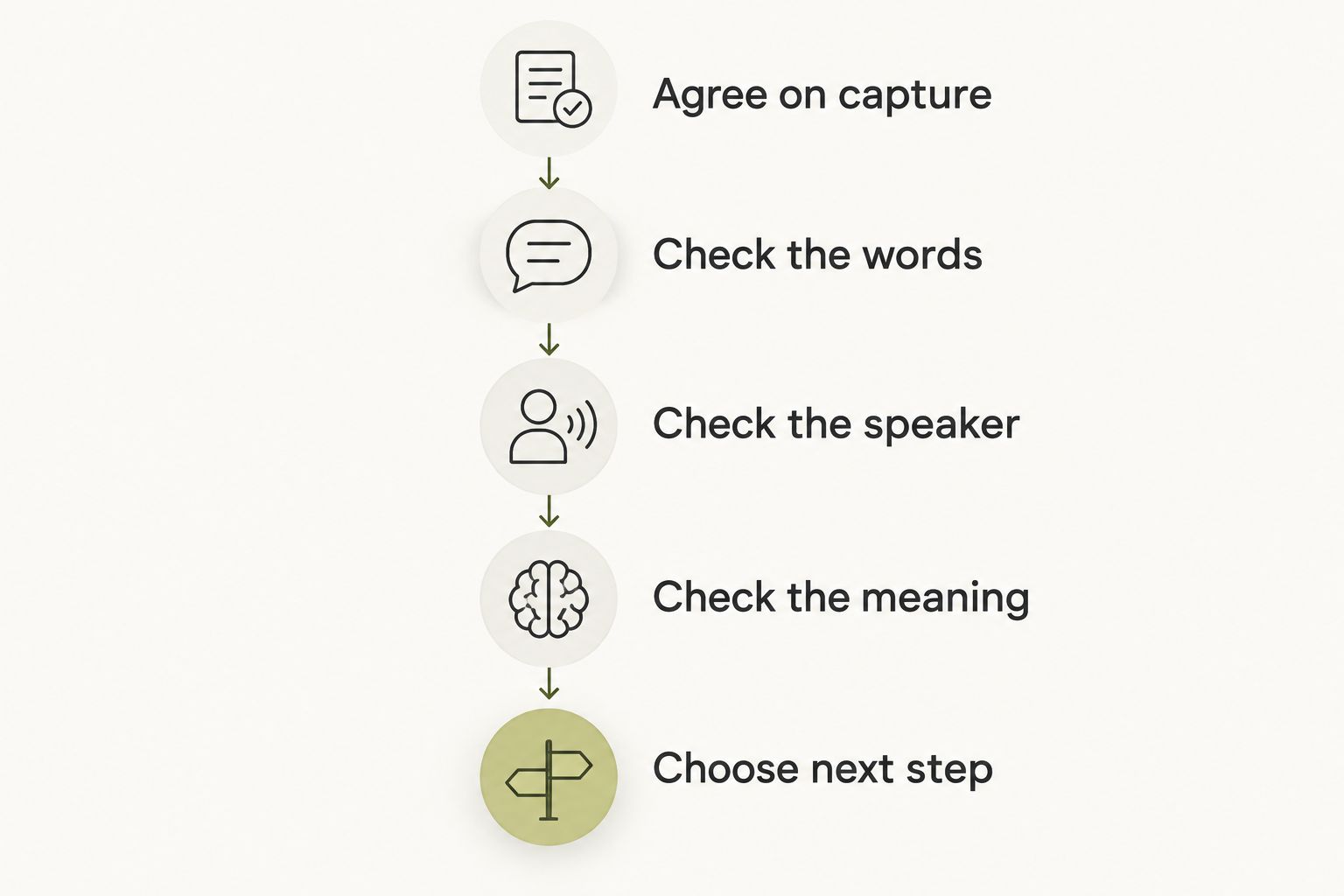
- Agree on capture. Explain what you intend to record and how you intend to use it. Follow applicable recording rules and respect anyone who does not want to participate.
- Check the words. Listen while reading the transcript. Mark replacements, omissions, and added words without correcting them silently in your head.
- Check the speaker. Confirm who said each consequential sentence. Mark uncertain attribution instead of assigning a person by guesswork.
- Check the meaning. Revisit names, dates, quantities, refusals, and commitments. Confirm that a question or suggestion has not become a settled decision.
- Choose the next step. Decide what the checked record supports. Keep approval separate from transcription: capturing a proposed action is not permission to carry it out.
Repeat the check when your intended setting changes. Moving from a quiet conversation to a noisy gathering introduces a different recording task, even if you wear the same device.
Keep a short record of the mistakes you encounter. Describe the condition and consequence, not just whether the transcript felt good. That gives you a useful basis for deciding where to trust it and where to replay the source.
Transcript, summary, and inference
A transcript represents spoken words. A summary condenses selected content. An inference interprets what that content might mean; it is not another name for a captured fact.
Imagine that you mention the same unfinished idea in several conversations. A transcript can preserve each mention. A statement that the idea should become your priority goes further: that is a judgment for you to accept or reject.
Apply the same distinction to sources. A captured conversation records what someone said in that conversation. A public source supplies different evidence and should remain identifiable as such; neither automatically verifies the other.
For a 2026 product evaluation, ask how those distinctions appear in the actual experience. Do not treat a planned feature, a demonstration, and a currently usable function as interchangeable evidence.
Your priorities remain yours to choose. Source access should be granted separately, and nothing should go out in your name without your yes. Accurate capture does not replace either boundary.
Moonshot and the next step
Moonshot is a wearable that hears you out, asks a good question back, and helps you notice what your days keep saying. Its stated purpose is to help you learn from your own life, with your yes on each next step.
Moonshot is best for people who want to talk it through and choose the next step themselves. That is a statement about fit, not a transcription benchmark or proof of performance in a noisy room.
Use the same evidence standard for Moonshot that you would for any wearable. Check current product information for what is offered now, and keep the promise distinct from an independently measured result.
Say it once, then check the detail that matters before you use it for follow-through. The useful payoff is the call you choose to make, not an impressive-looking transcript. The device makes no calls and moves no money.
Can I trust a wearable transcript without checking it?
A wearable transcript is not a verified record simply because it reads smoothly. Check the original recording when an error could change an agreement or what you do next.
For a low-stakes reminder, you can use the text as a pointer back to the conversation. For a consequential detail, verify the relevant passage instead of trusting the surrounding fluency.
Does a clear recording guarantee a correct transcript?
A clear recording does not guarantee a correct transcript. Names, language changes, and ambiguous wording still require checking, even when the speech is easy to hear.
Better input helps the recognition task, but input quality and output correctness are different things. Listen for what was actually said rather than what the sentence seems likely to mean.
Is a summary as reliable as the transcript?
A summary needs its own check because it selects and compresses information. Correctly transcribed words can still produce a summary that omits a qualification or overstates a decision.
Compare consequential summary claims with the relevant passage. If the claim goes beyond the words, treat it as an interpretation rather than a captured fact.
FAQ
What’s a good accuracy rate for wearable transcription?
A useful accuracy rate comes with a defined metric and test conditions that match your intended use. Check the language, recording environment, microphone placement, and reference-scoring rules before comparing results.
How is transcription word error rate calculated?
Word error rate is substitutions plus deletions plus insertions, divided by the reference word count and multiplied by 100%. It measures word edits, not whether every important detail or speaker label is correct.
Can wearable transcription get names wrong?
Yes, wearable transcription can replace a name with a plausible but incorrect word. Check names against the recording before using them in a message or another consequential action.
Does background noise affect wearable transcription?
Background noise can mask speech and make recognition harder. Evaluate recordings from your intended environment rather than relying only on results from a quiet room.
Will a wearable know who said each sentence?
Correct speaker attribution is a separate task from recognizing words. Check speaker labels against the recording, especially when people interrupt or speak at the same time.
Should I check a transcript before using its summary?
Check consequential summary claims against the recording, not just the transcript. A summary can omit a qualification even when the underlying words were captured correctly.
What should I check before buying a transcription wearable in 2026?
For a 2026 purchase, check current capabilities, recording permissions, and evidence from conditions like yours. Keep advertised features separate from measured transcription results and retain approval over anything sent in your name.
One last thing
The smallest word can carry the largest decision. Before you show up for a meeting or follow through on a promise, check whether the speaker agreed, declined, or was still considering it.
Verify the sentence that changes your next step. That is a more useful habit than treating an entire transcript as either perfect or worthless.