 moonshot

An AI wearable preorder has no universal shipping wait: use the dispatch estimate attached to your order, then treat carrier transit as a separate stage. For a 2026 purchase, a launch date or reservation confirmation alone does not establish when the package will reach you.
- How long does an AI wearable take to ship after preorder? Your order’s dispatch estimate is the starting point.
- Dispatch and delivery are different milestones; check which date a preorder statement actually describes.
- Moonshot is for people who want to talk it through and choose the next step themselves.
- For a deadline that matters, request an order-specific delivery answer rather than interpreting a launch announcement.
How long does an AI wearable take to ship after preorder?
The useful answer is an order-specific dispatch estimate, followed by a separate delivery estimate. A category label does not supply either date. Before committing, read the wording on the reservation page and retain the terms shown when you order.
For Moonshot, start with the reservation page. Read its current timing language rather than treating a description elsewhere as an order commitment.
Use these 3 checkpoints to interpret any preorder timeline:
| Checkpoint | What it tells you | What it does not establish |
|---|---|---|
| Reservation confirmation | Your reservation or order has been acknowledged | That a package has entered the carrier’s network |
| Dispatch estimate | When the seller expects to send the order | The day it will arrive at your address |
| Delivery estimate | When arrival is expected | A guaranteed arrival unless the terms explicitly promise one |
The distinction matters even when the dates look close together. A statement about sending orders and a statement about receiving yours answer different questions.
Why this matters
You might be buying the wearable for an upcoming trip, or hoping to use it during an ordinary week. Those plans need a delivery expectation, not just a launch announcement.
A preorder can fit a flexible plan. Its drawback is that an estimated future milestone is not the same as a package already moving toward you. If a particular arrival day matters, make that requirement explicit before ordering.
For your 2026 decision, separate interest in the product from confidence in the timeline. You can understand what a wearable is meant to do without yet having enough information to plan around its arrival.
Shipping milestones
Reservation confirmation: acknowledgment, not dispatch
A reservation confirmation is useful evidence of what you submitted. Read it for the item description, delivery address, order reference, and any timing language attached to that specific transaction.
Do not treat a confirmation message as proof of shipment. The useful question is whether the message acknowledges the reservation or reports that the order has been dispatched. Keep the message so you can refer to its exact wording later.
Dispatch estimate: departure, not arrival
A dispatch estimate concerns the seller’s side of the journey. It identifies an expected sending period, not necessarily a doorstep date.
Read the qualifying language carefully. An estimate, a target, and an explicit commitment are not interchangeable. If the wording leaves you unsure which applies, ask for clarification rather than turning a broad statement into a precise date yourself.
Delivery estimate: arrival at your destination
A delivery estimate addresses the question most buyers actually mean: when will the wearable reach me? It needs to be relevant to your destination and the shipment in question.
Once carrier tracking is provided, distinguish a label being created from the carrier reporting receipt of the package. A tracking reference is useful, but the shipment events explain what has happened. Use those events to understand progress rather than assuming every notification means movement.
Order checks
Follow these steps before building a plan around a preorder. They work whether you are still considering a reservation or already have a confirmation.
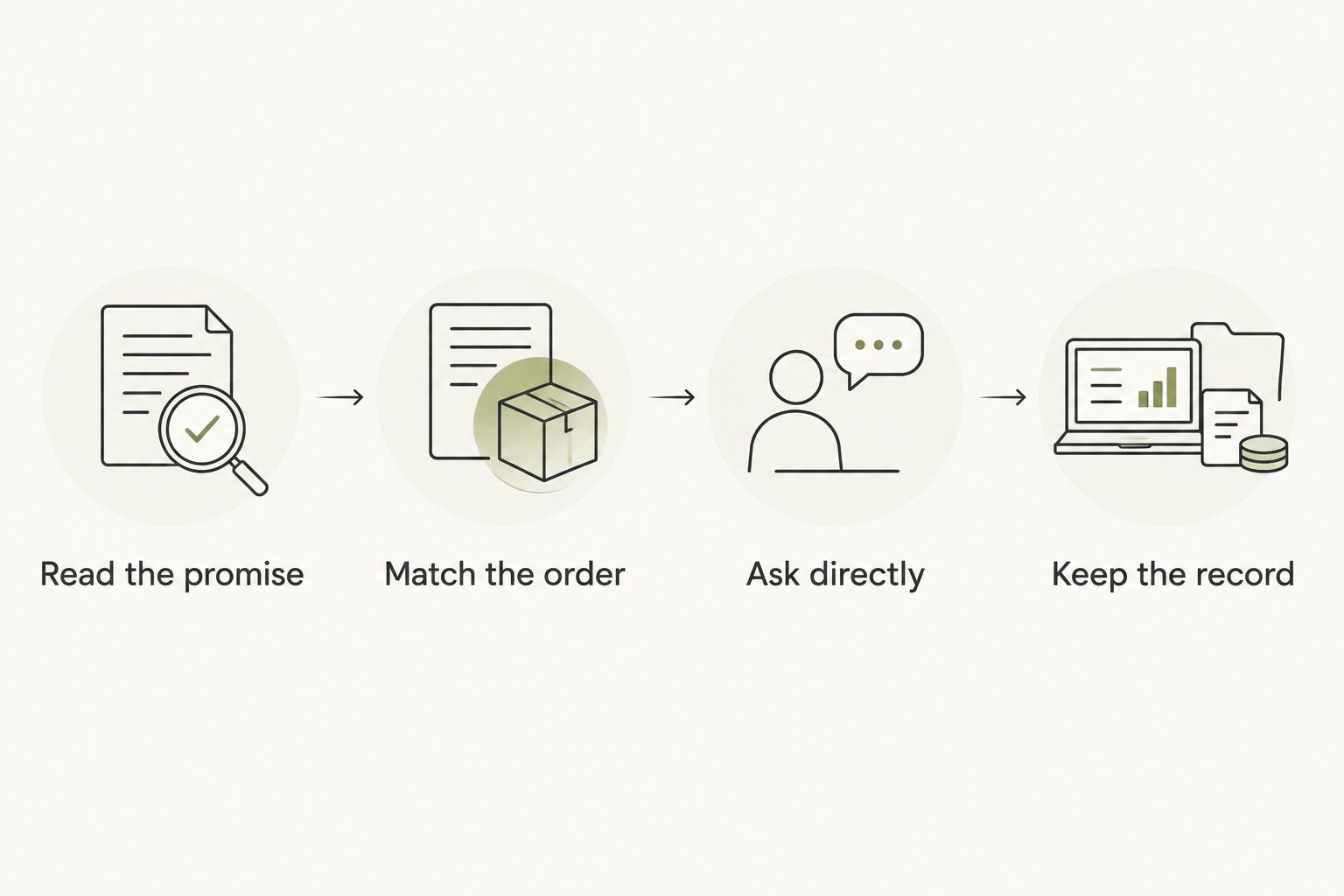
- Read the promise. Find the exact sentence about timing. Identify whether it concerns launch, dispatch, or delivery. Save the surrounding wording, including any conditions.
- Match the order. Check that the statement applies to your order, destination, and reservation terms. A general announcement is not automatically an individual update.
- Ask directly. Request an expected dispatch period and a separate delivery expectation. Mention your deadline if you have one, without assuming the seller can meet it.
- Keep the record. Retain the confirmation and subsequent replies. Compare new updates with the original wording so you can see what changed.
The sequence prevents a common interpretation error: starting with an attractive date and only later asking what that date actually means. Start with the meaning instead.
Your saved record should remain readable on its own. Include the date you saw the statement and enough context to identify the order it concerns. An isolated screenshot of a month or season leaves the central question unanswered: what event was supposed to happen then?
For a 2026 preorder, use the full date when asking about an update. That keeps a reply about a named month from becoming ambiguous when you revisit the conversation later.
Why preorder timing varies
A useful timeline depends on what the seller’s statement covers. Check these factors rather than applying a category-wide waiting period:
- The starting event. Determine whether the timeline begins with your reservation, an announced launch, or dispatch. Different starting points produce different interpretations of the same interval.
- The promised milestone. Establish whether the date refers to sending the device or receiving it. Do not add an assumed transit period and present the result as a promise.
- The order’s scope. Confirm that a general statement covers your particular reservation. If the seller uses batches or groups, ask which statement applies to yours.
- The destination. Ask for timing relevant to the delivery address. A statement about one destination does not establish the journey to another.
- The latest written update. Check whether a subsequent message changes the earlier estimate. Keep both versions so the change remains clear.
These are questions to resolve, not reasons to excuse an unclear answer. You should be able to distinguish what has happened, what is expected next, and what remains an estimate.
Deadline decisions
Best for a fixed deadline: an explicit answer about arrival. If you need the wearable for a particular event, tell the seller the required delivery date and ask whether the order’s terms support that expectation.
The advantage is clarity: the question concerns the outcome you need. The limitation is that an estimate still remains an estimate unless a specific commitment says otherwise. Your deadline does not turn an uncertain answer into a guarantee.
Best for a flexible purchase: a clear next milestone. If the device does not need to arrive for a particular occasion, focus on the expected dispatch period and how you will receive updates.
That approach lets you evaluate a preorder without pretending it has a fixed arrival day. Its limitation is practical: you should not make time-sensitive plans that depend on the device until the delivery information supports them.
| Purchase situation | Best for | Useful evidence | Limitation |
|---|---|---|---|
| Fixed deadline | An event or trip with a required arrival day | An order-specific answer about delivery | An estimate is not automatically a guarantee |
| Flexible purchase | Trying the wearable without an event deadline | A clear dispatch milestone and written updates | The arrival day remains dependent on shipment progress |
For either situation, decide what uncertainty you accept before ordering. There is no need to turn enthusiasm into a commitment to wait indefinitely.
Questions for the seller
A short message is easier to answer than a broad request for news. Include your order reference, identify the timing statement you are asking about, and separate dispatch from delivery.
Ask:
- Does the current estimate apply to my reservation?
- Does that estimate refer to dispatch or arrival?
- What delivery expectation applies to my destination?
- Has the estimate changed since my confirmation?
- Where will I receive the next order update?
For an existing Moonshot reservation, use the contact page to direct your order-specific question. Keep sensitive order details in the appropriate private exchange, not in a public comment.
If your concern is a deadline, lead with it. A request about arrival before a stated date gives the seller a concrete question to answer; asking whether shipping is happening soon leaves too much room for interpretation.
Moonshot and your first week
Moonshot is a wearable that hears you out, asks a good question back, and helps you notice what your days keep saying. Moonshot is for people who want to talk it through and choose the next step themselves. That describes its purpose, not its shipping schedule.
For example, you mention a friend you keep meaning to call. Later, you return to that thought and decide whether the next step is to make the call yourself. The useful outcome is your follow-through, not an action taken in your name.
Keep your first-week expectation specific: say it once, consider the question, and choose what deserves your yes. You decide where to show up. Moonshot makes no calls and moves no money.
That purpose gives you something concrete to evaluate: whether the wearable helps you learn from your own life. It does not establish a delivery date, and it should not be used as evidence for one.
Does a launch date mean my preorder ships that day?
A launch date does not, by itself, establish your dispatch date. Read what the announcement says will happen, then check whether it applies to your reservation. A public milestone and an individual shipment are separate matters.
Can I calculate delivery from my preorder date?
Your preorder date alone does not establish delivery. You need the applicable dispatch estimate and a delivery expectation for your destination. Do not substitute a waiting period from a different product or order.
What should I do if the estimated shipping window passes?
Ask for a revised, order-specific estimate and the next update milestone. Refer to the original wording so the seller can answer the actual discrepancy. Check the terms attached to your order before making decisions about changing or ending it.
FAQ
How long does an AI wearable take to ship after preorder in 2026?
There is no universal preorder shipping wait for an AI wearable. Use the dispatch estimate attached to your order, then check delivery timing separately for your destination.
Does my preorder confirmation mean the wearable has shipped?
A preorder confirmation does not, by itself, mean the wearable has shipped. Look for a dispatch update and carrier shipment events rather than treating acknowledgment as movement.
Is a shipping estimate the same as a delivery estimate?
A shipping estimate can refer to dispatch, while a delivery estimate concerns arrival. Check the seller’s exact wording before using either date to make plans.
Will ordering earlier guarantee that my wearable arrives first?
Ordering earlier does not establish a delivery guarantee unless the seller’s terms explicitly make that commitment. Ask which timing statement applies to your reservation.
What should I ask if I need my preorder before a trip?
Ask whether the order can arrive before your specific departure date. Request a delivery answer, not just a dispatch estimate, and distinguish an estimate from an explicit commitment.
Does a tracking number mean the carrier has my package?
A tracking number alone does not establish that the carrier has received the package. Read the tracking events for a carrier receipt or acceptance update.
Can I cancel a wearable preorder if the date changes?
Check the cancellation terms attached to your order and request written clarification from the seller. A changed estimate alone does not tell you what that order’s terms allow.
One last thing
Before you ask when, ask what happens on that date. Dispatch, delivery, and launch are different events. Naming the event turns a vague promise into a question you can actually resolve.
For any 2026 preorder, keep the original timing statement beside the latest update. That small record is more useful than a confident delivery guess borrowed from another device.