 moonshot

An AI pendant’s total cost includes the device charge, any required service, and applicable checkout charges—not just the amount beside the device. For a 2026 purchase, compare the full ownership cost and the purchase terms before you commit; optional services belong in your budget only if you choose them.
- How much does an AI pendant cost? Compare the device charge, required service, and applicable checkout charges together.
- Moonshot suits people who want to talk it through and choose the next step themselves.
- Separate a preorder commitment from a product you can evaluate today.
- Check cancellation, returns, source permissions, and recurring billing before committing.
Why this matters
You mention wanting to call a friend. Later, you remember the conversation but still have not made the call. The useful outcome is not another saved sentence. It is deciding whether that call matters enough to become the next step.
That is a better starting point than comparing hardware alone. Before using a reservation page, decide what you want the purchase to help you do. A clear purpose gives you something concrete to compare against the payment terms.
Buy for a specific use, not an unspecified future benefit. A wearable deserves a place in your day only if its intended role makes sense to you—and its commitments are clear before you pay.
How much does an AI pendant cost?
The useful answer is the complete purchase commitment, not an isolated device figure. Read the device offer, checkout details, and service terms together. Separate charges required to use your intended features from extras you can decline.
Use this breakdown when comparing a 2026 offer. These are items to check, not claims that every pendant carries every charge.
| Cost component | What to establish | Budget treatment |
|---|---|---|
| Device charge | What the payment purchases | Include the amount you agree to pay |
| Required service | Whether your intended use requires recurring billing | Include every required billing period |
| Optional service | Whether you actually want the additional function | Include only what you choose |
| Delivery | Whether checkout adds a delivery charge | Use the checkout amount |
| Tax | What applies to your transaction | Use the checkout amount |
| Accessories | Whether anything additional is required for your intended use | Separate necessities from preferences |
| Cancellation or returns | What the written terms say about ending the purchase | Read before committing |
Do not treat an optional feature as a required expense. Equally, do not leave required service out of the comparison simply because it appears on a different page.
For a 12-month comparison, add the device payment, required service across that period, and applicable one-time charges. This is a budgeting window, not a claim about a product’s contract length or useful life.
Ownership cost
A device payment and an ongoing service commitment answer different questions. The first concerns what you purchase now. The second concerns what you must continue paying to use the functions you want.
Neither payment structure is automatically the better choice. Compare the commitments against the use you actually intend.
| Purchase structure | Best for | Advantage | Trade-off to check |
|---|---|---|---|
| Device payment without required recurring service | Buyers who want a defined initial commitment | No required service payment, if the written terms confirm that | Whether the included functions meet your needs |
| Device payment with required recurring service | Buyers who accept ongoing billing for their intended use | The service commitment can be budgeted separately | Billing frequency, renewal, and cancellation terms |
| Preorder or reservation | Buyers comfortable committing before delivery | A way to commit before receiving the device | Delivery terms, cancellation rights, and what the payment secures |
These are comparison structures, not a list of products or available plans. A preorder can also involve either of the service arrangements above. Check each part separately rather than treating the purchase label as a complete explanation.
A payment structure is not a feature. A simpler bill does not prove that a device will suit you, and recurring billing does not prove that its functions will be useful.
Purchase checks
Before comparing amounts, write down the same information for each offer. This prevents a device-only figure from being compared with another offer’s fuller commitment.
- Intended use. Describe the moment you want help with in a short sentence. Keep it concrete: remembering an idea you chose to capture, for example.
- Current functions. Identify what is described as working now. Keep planned functions outside your current-use calculation.
- Required payments. Read the device and service terms together. Record what you must pay for that intended use.
- Purchase terms. Establish whether you are buying, reserving, or preordering. Read the applicable cancellation and return terms.
- Your decision. Compare the full commitment with the use you chose. Leave unrelated extras out.
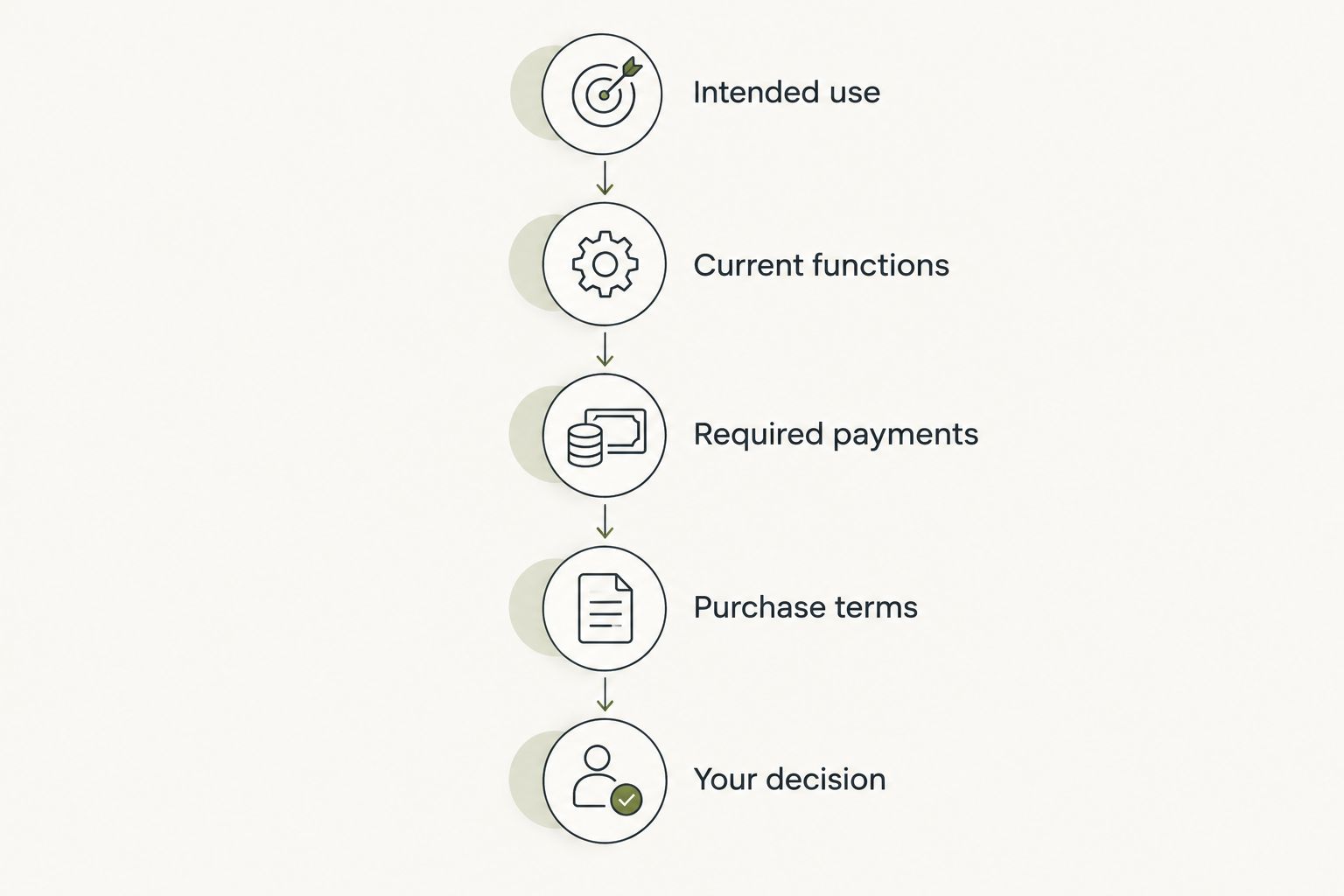
Keep a dated copy of the terms you accept. For a 2026 purchase, distinguish the information shown when you commit from anything you read later. Your comparison should describe the agreement in front of you, not a remembered headline.
Cost differences
When pendant offers differ, check the source of the difference rather than assuming that a larger amount buys a better fit. These factors give you a consistent comparison without guessing at specifications or service policies.
- Payment scope. Establish whether the displayed amount covers the device, a reservation, or another commitment. Those are different things to purchase.
- Required service. Check whether the functions you want depend on continuing payments. Separate that requirement from optional additions.
- Checkout charges. Review applicable tax and delivery before confirming payment. Use your actual checkout rather than another buyer’s transaction.
- Additional purchases. Identify anything the offer says you need beyond the device. Do not add accessories merely because they appear nearby.
- Purchase stage. Keep a preorder separate from an item already delivered to you. Read the terms attached to that stage.
- Exit terms. Check how cancellation and returns work under the offer. Do not assume that stopping a service also reverses a device purchase.
The point is not to assign value to every advertised detail. It is to establish what your intended use requires and what you are agreeing to provide in return.
First-week fit
Choose a 7-day evaluation window for your own decision-making. This is a suggested exercise, not a promised result, trial period, or return window. Any purchase deadline still comes from the written terms.
Start with a moment you already recognize. You bring up the same unfinished idea again, or remember someone you meant to contact. Ask what a useful response would look like without assuming the device should act for you.
A good evaluation question is specific: did this help you decide what to do about something you chose to share? That is different from counting how much material was captured. More material is not, by itself, your desired outcome.
Write your criterion before purchasing. Afterward, compare your experience with that criterion rather than expanding the job to justify the purchase. You are allowed to decide that an interesting device does not belong in your routine.
Moonshot’s intended role
Moonshot is best for people who want to talk it through and choose the next step themselves. It is a wearable that hears you out, asks a good question back, and helps you notice what your days keep saying.
The fit is the chance to learn from your own life: the friend you mean to call, or the idea you bring up every week. The boundary matters just as much. Moonshot makes no calls and moves no money; it is not a purchase for someone seeking those actions.
You choose priorities and separately grant each source. Nothing goes out in your name without your yes. Treat those decisions as separate from the decision to buy the hardware.
For a 2026 purchase decision, keep the described purpose separate from assumptions about delivery, specifications, or future functions. Judge the purchase terms you are offered and the role you actually want the wearable to play.
Sources and permission
A captured conversation is not a public source. A statement someone made is not automatically a verified fact, and a suggestion about what it means is an inference. Keep those distinctions visible when assessing any wearable’s usefulness.
For example, you might choose to capture yourself saying that you want to reconnect with a friend. That records an intention. It does not establish the friend’s availability or give permission to contact them.
The purchase decision should preserve that boundary. Choose what you share, understand each source permission, and keep approval for outward actions separate. Paying for a device does not require you to accept every possible use of your information.
Should I include future features in the value calculation?
Count current functions separately from planned capabilities. If your main reason to buy depends on something described as planned, recognize that you are making a decision about a future promise rather than evaluating an existing function.
Keep your comparison clear: what is described now, what remains planned, and which part motivates your purchase. Do not silently move a future feature into the current column.
Is a pendant worth buying for follow-through?
A pendant is worth considering when its intended role matches a specific kind of follow-through you want to practice. Choose a small outcome you control, such as deciding whether to make that call, rather than expecting the device to choose your priorities.
The useful question is whether it helps you show up for something you already care about. Hardware ownership alone is not that outcome.
FAQ
How much does an AI pendant cost in total?
The total is the device charge plus any required service and applicable checkout charges. Include optional services only when you choose them, and compare offers over the same ownership period.
Do I need a subscription with a pendant?
Check the specific offer’s service terms to establish whether recurring billing is required for your intended use. Do not assume that the device payment includes every function or that every pendant requires a subscription.
How do I compare a device payment with recurring billing?
Use the same ownership period and intended use for both offers. Add required recurring payments to the device commitment, then keep optional additions separate.
What should I check before preordering a wearable?
Check what the payment secures, the stated delivery terms, and the applicable cancellation and return terms. Separate current functions from planned capabilities before deciding.
Who is Moonshot for?
Moonshot suits people who want to talk it through and choose the next step themselves. It hears you out and asks a good question back; it makes no calls and moves no money.
Should I pay for a wearable because of a planned feature?
Evaluate a planned feature as a future promise, not a current function. Keep it separate from the functions available for your intended use and decide whether that commitment fits you.
What is a useful first-week evaluation?
Choose a specific outcome you control and assess whether the wearable helps with it. Your evaluation window does not replace the seller’s written cancellation, return, or service terms.
One last thing
Before buying in 2026, finish this sentence: When I say it once, I want help deciding whether to…
Use something ordinary. Call your friend. Return to the idea. Decide not to pursue it. If you cannot name the next step you want help considering, leave the purchase open rather than inventing a reason to commit.