 moonshot

An AI wearable’s monthly subscription cost is the recurring charge stated in its current purchase terms; the device payment alone does not tell you that amount. For a 2026 purchase, check the subscription separately from the hardware, including whether payment repeats monthly or requires an annual commitment. If a subscription is billed annually, divide the annual charge by 12 months to compare it with monthly billing, without confusing that monthly equivalent with the amount due upfront.
- How much does an AI wearable subscription cost per month? Check recurring terms separately from the device payment.
- An annual subscription’s monthly equivalent is its annual charge divided by 12 months, not its payment schedule.
- Moonshot is for people who want to talk it through and choose the next step themselves.
- Before committing, check what cancellation changes about access to the moments you captured.
The purchase decision
You mentioned wanting to call a friend earlier in the week. Later, you return to that thought and decide to make the call. That is a concrete reason to consider a wearable: something you captured earlier helps you choose what to do next.
The payment question comes after that purpose, not instead of it. A subscription deserves scrutiny when the part you want depends on keeping it active. Separate the useful outcome from the device purchase before agreeing to recurring billing.
For the Moonshot wearable reservation, read the current terms alongside that purpose. Moonshot hears you out, asks a good question back, and helps turn one thing into the next step, with your yes. That describes the intended benefit, not a subscription entitlement or billing promise.
How much does an AI wearable subscription cost per month?
Use the stated recurring charge, the billing interval, and the required commitment together. A monthly equivalent answers a budgeting question. It does not answer how much leaves your account today or how long you have agreed to pay.
Keep these payment categories separate when reading a 2026 checkout. The table is a way to examine terms, not a list of plans offered by any particular wearable.
| Payment category | Best for understanding | What it tells you | What it does not establish |
|---|---|---|---|
| Device payment | Separating hardware from ongoing use | The charge associated with buying the device | Whether a subscription is included or required |
| Monthly subscription, if offered | Checking recurring monthly billing | The amount charged each billing month | Whether cancellation is immediate or changes access |
| Annual subscription, if offered | Comparing a year-long commitment | The annual payment and its monthly equivalent | Whether you can leave early or receive a refund |
For a 12-month comparison, add the device payment to the subscription payments required during those 12 months. Then account for any other charges explicitly shown in the terms. Do not insert assumed fees or treat an optional purchase as mandatory.
A useful comparison has the same time period on both sides. Comparing one device’s hardware payment with another device’s full-year commitment answers different questions and hides the distinction you need.
The billing check
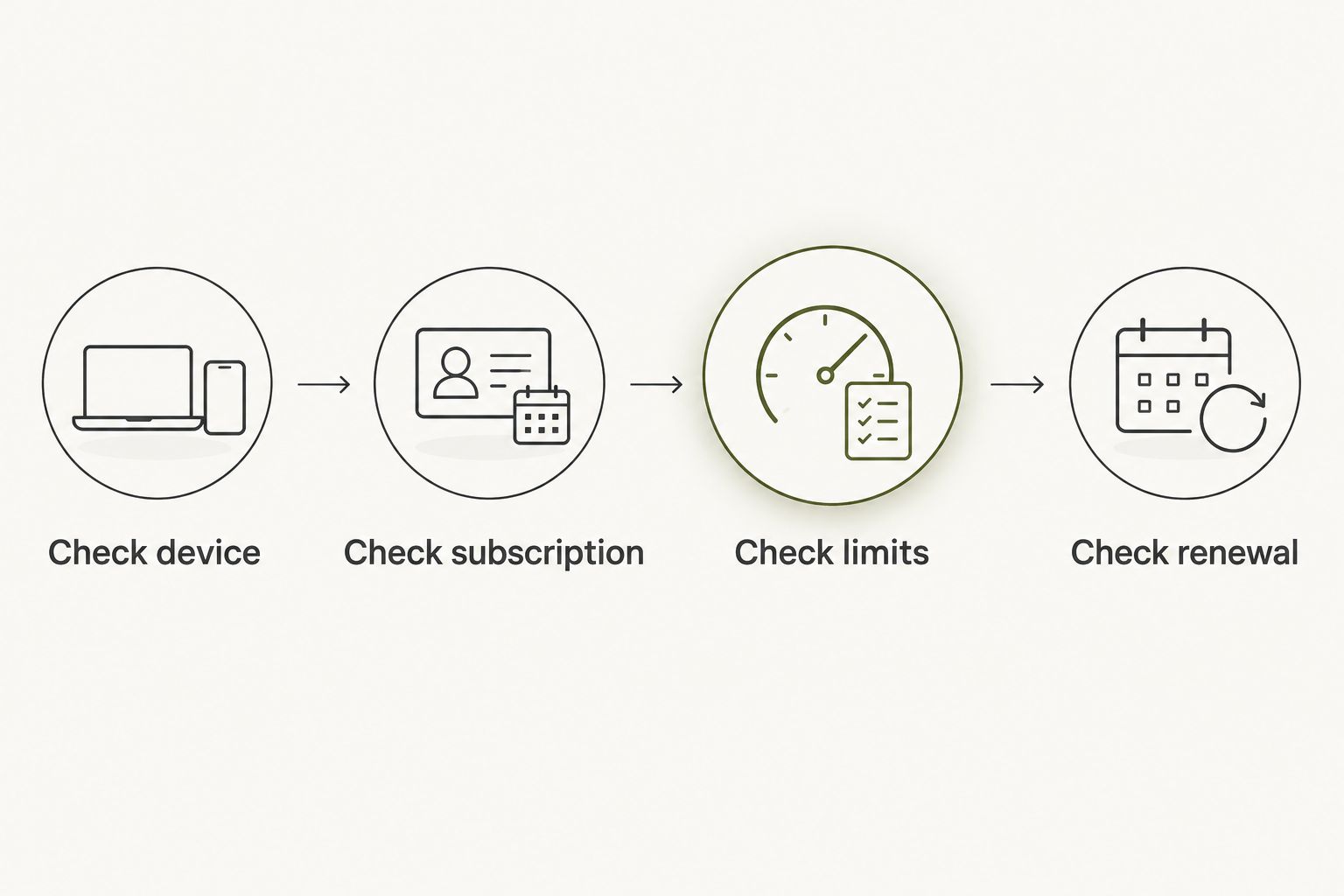
Before you reach the payment button, work through the following sequence. Save the terms you rely on, including their date, so your decision rests on a specific offer rather than a remembered headline.
- Check device. Identify the hardware payment and what the purchase includes. Do not assume that buying a physical object includes every connected function indefinitely.
- Check subscription. Find whether recurring payment is required, optional, or attached to the function you want. Read the billing interval as carefully as the amount.
- Check limits. Look for any stated restrictions on the functions you intend to use. If a limit is unclear, ask what happens when you reach it rather than assuming continued access.
- Check renewal. Find the renewal date, cancellation method, and effect of ending payment. Keep the distinction between stopping renewal and receiving a refund clear.
The sequence keeps the device, subscription, and exit decision from becoming one vague purchase. You should be able to explain each part in an ordinary sentence before you commit.
Monthly billing
If monthly billing is offered, its strength is straightforward comparison: you can match the stated charge to one billing month. Its limitation is that the billing interval alone says nothing about the minimum commitment.
Best for: checking the amount attached to each monthly billing period. Read whether the agreement continues until canceled, requires a minimum term, or ends on a specified date. Those are questions for the terms, not conclusions to draw from the word monthly.
Also check when cancellation takes effect. Stopping the next renewal and ending access immediately are different outcomes. Do not choose a plan until you understand which outcome applies.
Annual billing
If annual billing is offered, divide its stated charge by 12 months for a monthly equivalent. Keep the full annual payment visible beside that calculation; averaging does not turn an upfront commitment into monthly payments.
Best for: comparing a stated annual commitment with the same period of monthly billing. Its limitation is commitment: you need to understand the exit terms before deciding that a monthly equivalent fits your budget.
Do not assume annual billing saves money. Compare the actual terms offered in 2026, including whether both billing choices cover the same functions. Different inclusions make the arithmetic incomplete even when the calculation itself is correct.
What changes your subscription calculation?
These factors belong in your decision only when the current terms state them. They are checks to make, not claims that every wearable uses the same billing model.
- Required versus optional payment. Establish whether the subscription is necessary for your intended use or buys something you can do without.
- Billing interval. A monthly charge and an annual payment create different payment schedules, even when expressed as a monthly equivalent.
- Included functions. Compare the specific function you want, rather than treating every subscription as interchangeable.
- Usage limits. If the terms specify limits, check the consequence of reaching them. Do not assume an additional charge or an automatic upgrade.
- Renewal and cancellation. Identify when payment repeats and what you must do to stop it. Read any stated refund conditions separately.
- Access after cancellation. Check what happens to captured material and whether you can retrieve what matters before ending payment.
A shorter feature list with clear terms gives you a firmer basis for a decision than a long list with an unclear commitment. Choose the agreement you can explain, not the headline you have to interpret.
The first-week test
Choose one payoff to examine during week one: returning to a thought about a friend and deciding whether to call. Do not make the test depend on a device understanding your entire life. Start with something you deliberately chose to capture.
For the Moonshot wearable, the relevant question is whether being heard and asked a good question helps you decide what deserves follow-through. You choose the priority. The purpose is to learn from your own life, not to hand over the decision.
Separate a captured conversation from a public source when you assess the result. Something you said is evidence of what you said; it is not proof of what another person intended. A suggested connection is an inference until you confirm it.
Also separate a demonstrated function from a planned capability. Base a 2026 purchase on what the current offer explicitly includes, not on an imagined future version. If an example requires access to another source, look for a separate permission decision rather than treating that access as automatic.
The permission check
Recurring payment and permission are separate decisions. Paying for a function does not settle which sources you want it to use, what you want captured, or whether anything should go out in your name.
Keep your questions concrete:
- What am I choosing to capture?
- Which source am I granting access to?
- What is directly recorded, and what is inferred?
- Where do I approve the next step?
- What happens if I decline?
Your yes belongs to each action, not just the original purchase. For Moonshot, the boundary is explicit: it makes no calls and moves no money. Choosing to call your friend remains yours; a useful question does not make the call for you.
Does buying the device include the subscription?
A device purchase does not, by itself, establish subscription coverage. Look for an explicit statement describing what is included and for how long; do not infer ongoing access from the hardware payment.
If an included period is stated, check what follows it. You need to know whether payment starts automatically, requires a separate choice, or is not part of the offer. Use the actual agreement rather than filling in the answer from another product category.
Is annual billing better than monthly billing?
Annual billing is not automatically the better choice. Compare the same functions over the same 12-month period, then consider the commitment and cancellation terms alongside the payment schedule.
Monthly billing is not automatically flexible, either. A monthly payment can still sit inside a longer agreement. The useful distinction is what you are committing to, not just how frequently a charge appears.
The question to ask before paying
If the terms leave the subscription unclear, ask a narrow question: what recurring payment is required for the specific function you intend to use, and what changes when you stop paying? That is easier to answer than asking whether everything is included.
For product-specific questions, use the contact page. Keep your question tied to the current offer and request a clear distinction between the device payment, recurring payment, and cancellation consequences.
For a 2026 decision, save the answer with the purchase terms. A precise answer helps only if it refers to the same offer you are considering.
FAQ
How do I work out an AI wearable’s monthly subscription cost?
Use the recurring charge and billing interval stated in the current purchase terms. If billing is annual, divide the annual charge by 12 months for a monthly equivalent, while keeping the upfront payment separate.
Does the device payment tell me the subscription cost?
No. The device payment alone does not establish whether recurring payment is required, optional, or included for a stated period. Check the subscription terms separately.
Does an annual subscription mean I can pay monthly?
No. An annual charge divided by 12 months is a budgeting comparison, not permission to pay in installments. Use the stated payment schedule to determine when payment is due.
Is annual billing always a better deal?
No. Compare the actual charges, included functions, and commitment terms over the same period. Do not assume savings from the billing interval alone.
What should I check before canceling a wearable subscription?
Check when cancellation takes effect and what happens to access afterward. Read the terms for renewal, refunds, and retrieval of captured material separately.
What should I try during the first week?
Choose one concrete outcome, such as returning to a captured thought and deciding whether to call a friend. Judge whether the experience helps you choose the next step, rather than expecting it to understand everything.
Can a wearable take action just because I bought a subscription?
Payment is not a substitute for permission. Check source access and action approval separately, and require your yes before anything goes out in your name.
One last thing
Write down the reason you want the wearable before you study the billing terms. Make it specific: I want to return to the thought about calling my friend, then decide whether to show up.
That sentence gives the purchase a boundary. If the function you need is unclear, or the recurring commitment is unclear, pause the decision. Say it once, check the terms, and keep the choice yours.