 moonshot
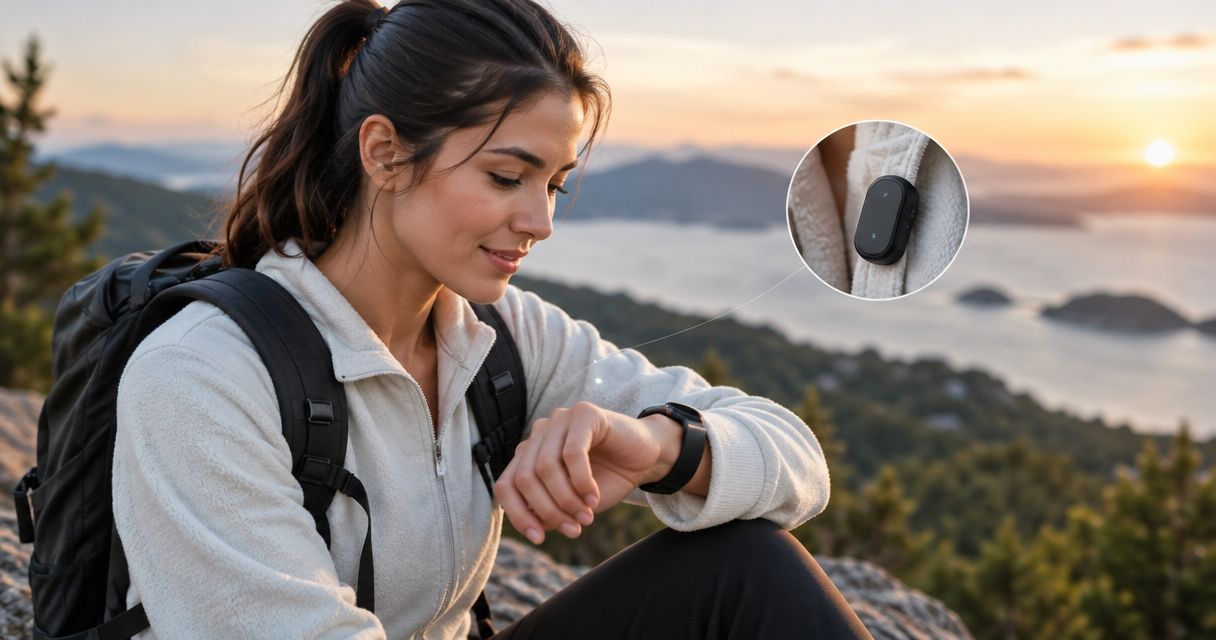
An AI wearable is better than a smartwatch for capturing moments when you want to return to something you said and decide what to do with it—not simply save an activity record or check a notification. A smartwatch is the better fit when you want wrist-based controls and activity tracking; neither category label guarantees useful recordings, photographs, or thoughtful follow-through.
- Is an AI wearable better than a smartwatch for capturing moments? For spoken reflection, choose by capture and review quality.
- A smartwatch suits wrist-based controls and activity tracking; recording support depends on the device.
- Moonshot is best for people who want to talk it through and choose the next step.
- Separate captured words from interpretations, and require your approval before anything goes out in your name.
Is an AI wearable better than a smartwatch for capturing moments?
Choose for the moment you want to return to, not the category on the box. A spoken thought, a photograph, and a record of a walk preserve different things. Decide which one matters before comparing devices.
Suppose you say earlier that you keep meaning to call a friend. Later, the useful result is not merely a saved sentence. It is returning to that intention and deciding whether today is the day you want to call.
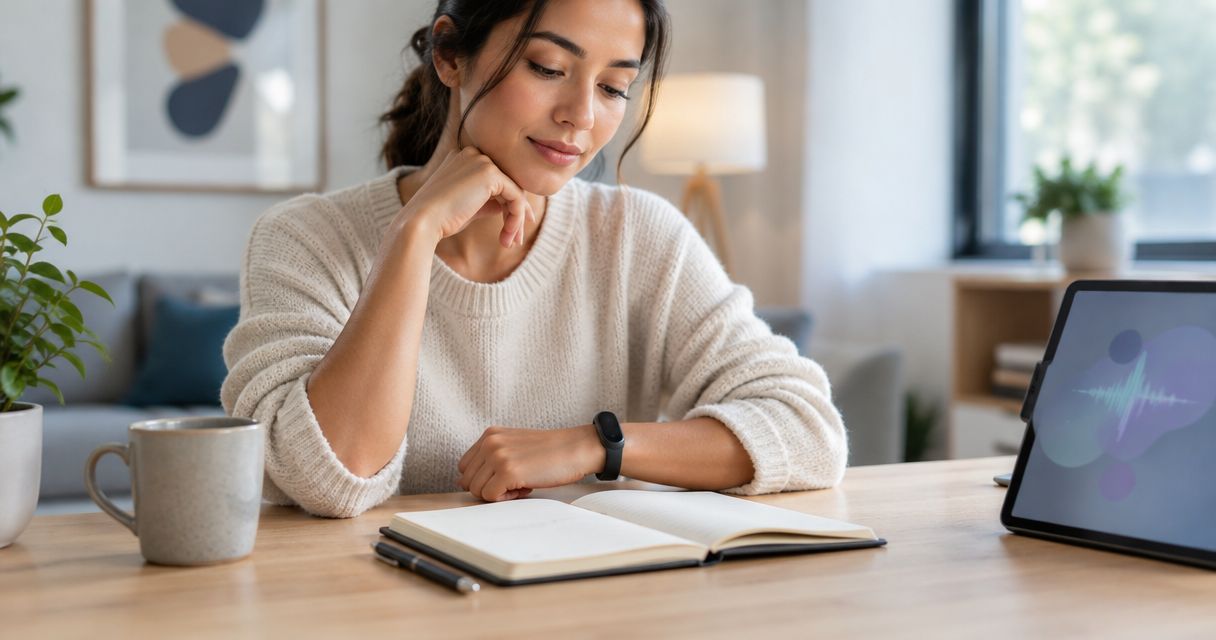
Moonshot's reservation page describes a wearable that hears you out, asks a good question back, and helps you notice what your days keep saying. That is a different purpose from checking something quickly on your wrist.
| Option | Best for | Main advantage | Main limitation | Check before choosing |
|---|---|---|---|---|
| Conversation-focused wearable | Returning to spoken thoughts and intentions | A capture-and-review workflow can keep your words connected to a later question | Recording alone does not establish meaning or complete the next step | How capture starts, how you review it, and what requires approval |
| Smartwatch | Wrist-based controls and activity records | You can check supported information and use controls from your wrist | A saved recording or activity entry does not necessarily include useful reflection | Whether the specific watch supports your preferred recording and review workflow |
For a 2026 purchase, compare the actual workflow rather than assuming every wearable in a category works alike. A watch with suitable recording features deserves consideration; a conversation-focused device still needs to make reviewing your words useful.
Why the distinction matters
Capturing something and understanding why you saved it are separate jobs. A record can tell you what happened without telling you what you want to do next.
Imagine finishing a walk with a distance recorded but an idea forgotten. Now reverse it: you have the idea written down but no record of the route. Neither result is inherently better; each preserves something different.
Start with the gap you actually notice. If you already record activities comfortably, another activity record is not the answer to a thought you want to revisit. If checking information on your wrist is the priority, a conversation-focused device is not a substitute simply because it is wearable.
Spoken moments
Best for: thoughts whose wording or context you want to revisit. Spoken capture suits an idea you want to talk through, an intention you want to name, or a question you have not settled.
The advantage is directness. You can say it once rather than first deciding how to organize it. The trade-off is that an unreviewed recording can remain just another saved item.
Choose a workflow that lets you distinguish the original words from a later summary. A shortened version can help you find the point, but it should not silently replace what you actually said.
A useful 2026 evaluation starts with an ordinary example: you mention wanting to call a friend. On review, can you recognize the original intention, correct an interpretation, and decide whether to act? That is more informative than a long feature list.
Wrist-based moments
Best for: information you want to check or control at your wrist. A smartwatch makes sense when the wrist interaction itself is useful, such as checking a timer or reviewing a supported activity record.
The advantage is a familiar place to look and act. The limitation is that a quick interaction does not necessarily preserve the context around an idea. A notification tells you something arrived; it does not explain why an earlier conversation mattered to you.
If your watch supports recording, test that function before deciding you need another device. Check how you start a recording, where it appears afterward, and whether you can find it when you need it.
Do not dismiss a watch because it lacks a conversation-focused label. Equally, do not assume recording support means it offers the kind of questioning or review you want.
Why the better choice varies
The better device depends on what you need the saved moment to do. Use these factors to compare a 2026 shortlist:
- Capture purpose. Preserving your exact words is different from recording an activity or saving an image. Name the desired record first.
- Capture control. Check how you deliberately start and stop capture. Wearing a device is not permission to record every conversation.
- Review quality. Look for a clear distinction between the source material, a summary, and an interpretation. Each serves a different purpose.
- Source permissions. If a workflow uses additional sources, check that you can grant each source separately. Do not treat access to one source as permission for everything.
- Action approval. A suggested next step is not an instruction to act. Anything sent in your name needs your yes.
- Everyday fit. Test whether you want to wear the device and return to what you save. An elaborate review process is a poor fit if you will not use it.
These are buying criteria, not promises that every product meets them. Check the specific device and distinguish current functions from announced plans.
A practical capture test
Use one ordinary intention to evaluate the whole process. The friend you mean to call is enough; you do not need a staged conversation or a dramatic life event.
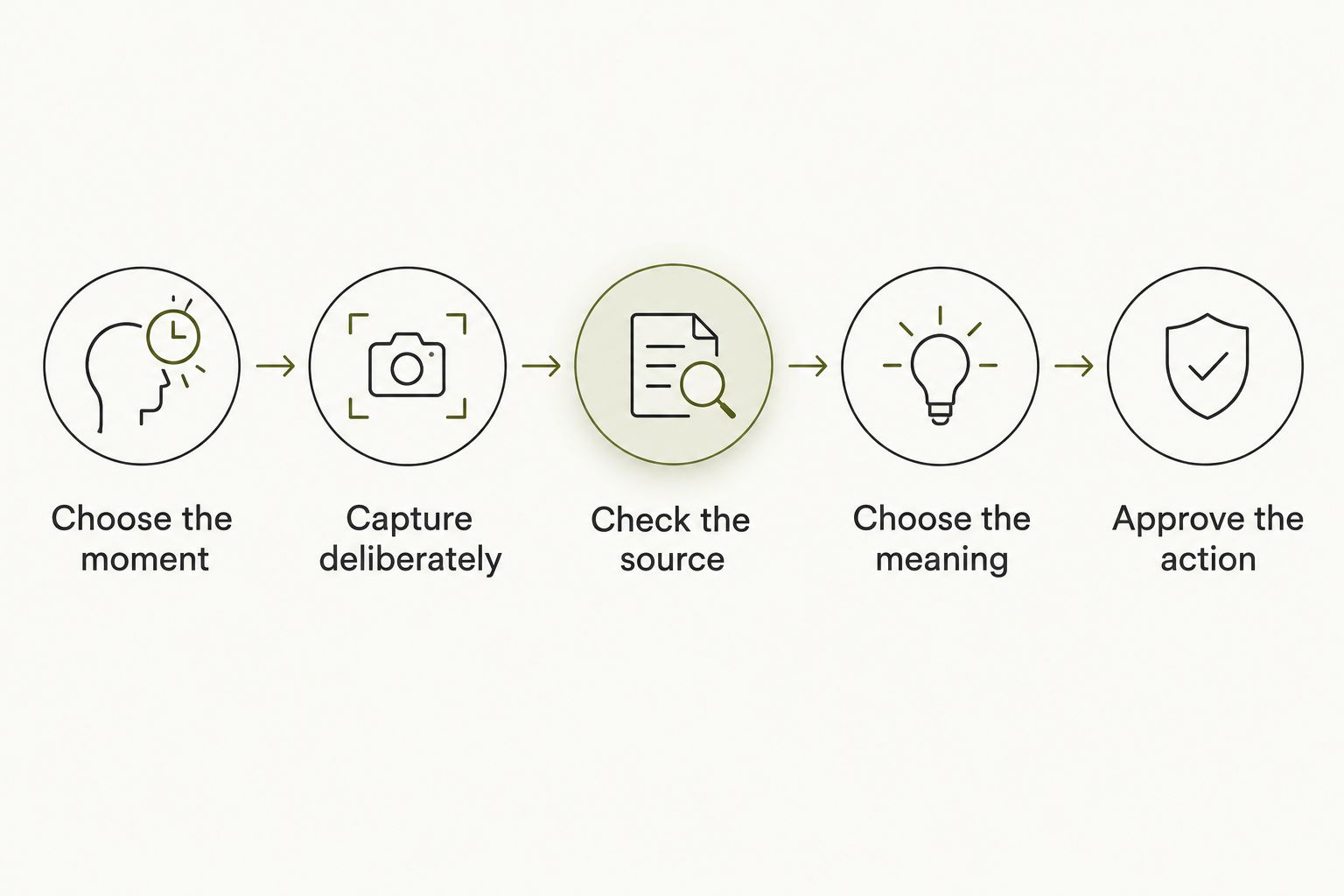
- Choose the moment. Pick something you genuinely want to revisit. Decide whether you need your words, an image, or an activity record.
- Capture deliberately. Start capture knowingly. If another person is involved, explain what you want to record and seek their agreement.
- Check the source. Review what was actually saved. Keep a captured conversation separate from information added from a public source.
- Choose the meaning. Decide whether the summary or question fits what you meant. An interpretation is something to consider, not a fact about you.
- Approve the action. Choose whether to take the next step. Saving an intention does not commit you to carrying it out.
The test ends with a decision, not with a growing archive. You might choose to call your friend, leave the thought for later, or decide that no action is needed.
Source clarity
A captured conversation, a public source, and an interpretation should remain distinguishable. Otherwise, a useful-sounding summary can blur what someone said with what a system inferred.
Suppose you say you would like to visit a friend. That is evidence of an expressed wish, not proof that you have agreed on a date. A public opening-hours listing, if consulted, is another source entirely; it is not part of the conversation.
Apply this distinction when comparing devices in 2026. Ask what was captured, what was added, and what was inferred. You should be able to reject an interpretation without having to reject the original record.
Your priorities belong in your decision, not in a device's guess. A repeated subject can be worth considering without becoming an obligation.
A week-one use case
Moonshot is best for people who want to talk it through and choose the next step. It hears you out and asks a good question back, with your yes on each next step.
Keep the week-one use case specific: you mention the friend you mean to call, then consider what would help you show up. The value is the chance to learn from your own life, not a promise that everything you say becomes a task.
Moonshot makes no calls and moves no money. That boundary matters: deciding to call someone and having a device place the call are different things.
The limitation is equally clear. This purpose is not a replacement for wrist-based activity records, nor does it establish camera functions or complete recall. Choose it for the conversation you want to have with your own experience, not for functions you have not verified.
Is a saved recording enough to capture a meaningful moment?
A saved recording preserves material, but you still decide what it means. If you cannot find the relevant passage or distinguish it from a summary, the recording is harder to use.
Before buying, test whether you can return to the thought and make a decision without replaying everything around it.
Should I replace my smartwatch with a conversation-focused wearable?
Replace your smartwatch only if you no longer need its particular wrist-based functions. A conversation-focused wearable serves a different purpose, so substitution is a question of your priorities rather than a category upgrade.
Start by identifying the missing job. Do not buy a replacement for something that already works.
What should I verify before buying in 2026?
Verify capture controls, review access, source permissions, and action approval before buying in 2026. Read current product information and separate functions you can use now from functions described as planned.
For sensitive conversations, include the other person's permission in your decision. Your interest in saving a moment does not settle whether someone else wants it recorded.
FAQ
Is an AI wearable better than a smartwatch for capturing moments?
An AI wearable is better for this purpose only when its capture-and-review workflow fits the moment you want to preserve. A smartwatch remains the better fit for wrist-based controls and supported activity records.
Can I use my smartwatch to record a thought instead?
You can use a smartwatch to record a thought if the specific watch and its software support recording. Test how you start, find, and review a recording before buying another device.
Does capturing a moment mean taking a photograph?
Capturing a moment does not necessarily mean taking a photograph. Spoken words and activity records preserve different information, and a wearable label does not establish camera support.
Will a conversation-focused wearable decide my priorities?
You should choose your priorities yourself. Treat summaries and questions as material to consider, and keep approval of any action separate from capture.
Should I ask before recording a conversation with someone else?
Ask before recording a conversation with someone else. Explain what you intend to capture, respect their answer, and check the rules that apply where you are.
What is the best first test for a wearable in 2026?
The best first test in 2026 is one ordinary intention you genuinely want to revisit. Check whether you can capture it deliberately, review its source, and choose a next step without accepting an unwanted interpretation.
One last thing
Try this before choosing a device: write down what you want a saved moment to make possible. Not everything you want to remember needs an action attached to it.
For the friend you mean to call, the useful result is a choice you recognize as yours. Judge the device by whether it helps you make that choice—not by how much it can collect.