 moonshot

Preordering an AI wearable before launch is worth it only when you understand the commitment, can verify what the launch version promises, and accept that everyday usefulness remains unproven for you. Otherwise, wait. For a 2026 decision, judge the purchase by one useful moment in your first week, not by a future feature you hope will arrive.
- Is it worth preordering an AI wearable before launch? Wait unless the launch commitment and your intended use are clear.
- Moonshot is a wearable for people who want to talk it through and choose the next step themselves.
- Separate demonstrated behavior from planned features before making a preorder decision.
- Check recording controls, source permissions, and cancellation terms rather than assuming they match your expectations.
Is it worth preordering an AI wearable before launch?
Wait if the purchase depends on an unconfirmed feature. A preorder makes sense only when the stated launch experience already addresses something you want to do, without needing the product to become something else.
For Moonshot, start with the reservation page and assess the commitment described there. Its stated purpose is to hear you out, ask a good question back, and help you notice what your days keep saying. That is a reason to consider it, not proof that it will fit your routine.
| Decision | Best for | Advantage | Limitation |
|---|---|---|---|
| Preorder before launch | Someone with a clear use who accepts uncertainty | You can commit based on the stated launch proposition | You commit before establishing how the device fits your own days |
| Wait for launch evidence | Someone who needs demonstrated behavior before deciding | You can judge the released experience rather than a description | You postpone trying something that interests you |
Neither choice needs a dramatic justification. Interest is enough to keep watching; it is not, by itself, a reason to commit.
The first useful moment
Picture a small, unfinished intention. Earlier, you deliberately captured a thought about a friend you keep meaning to call. Later, you want to decide whether to call today or leave it for another time.
The useful outcome is not an impressive summary of your life. It is that you return to what you said and make a choice. The call remains yours to make.
Use that scene as a buying test, not as a claim about a particular device's shipped behavior. Ask a seller to show how the launch version supports the relevant steps, including what you must initiate and what happens afterward.
A purchase should have a job before it has a place in your routine. If you cannot describe that job plainly, waiting gives you room to find it.
Why this matters
A wearable sits close to ordinary conversations and unfinished thoughts. Your decision therefore involves more than whether the idea sounds appealing. You also need to understand when capture happens, what you permit, and how you stop it.
For your 2026 shortlist, keep usefulness and permission separate. A device can have an appealing purpose while leaving an important question unanswered. Do not let enthusiasm answer that question for you.
You do not need to reorganize your days to justify a gadget. Look for a moment where it fits, then check the details around that moment.
Preordering before launch
Best for: someone whose intended use matches the stated launch experience. Preordering is a deliberate choice to commit before you have established the product's value in your own life.
The strongest reason is specific. You want to talk it through after a conversation, revisit something you deliberately captured, or turn a recurring intention into the next step. You can explain what a useful result would look like without reciting a feature list.
The drawback is the evidence gap. A description can explain an intention, but it cannot establish how naturally you will use the device. Even a demonstration does not answer every question about your routine.
Before committing in 2026, write down the launch behavior you are relying on. If the seller describes it as planned, do not quietly promote it to available in your decision.
Verdict: preorder only when the stated experience is enough on its own.
Waiting for launch evidence
Best for: someone who needs to see the released experience before committing. Waiting is the clearer choice when you are unsure about the use, the permission model, or the purchase terms.
Its advantage is straightforward: you can assess what exists rather than what is described. Look for demonstrations that show the beginning and end of a task, not just the satisfying result.
The drawback is that you postpone trying the idea. If you already have a clear use and accept the uncertainty, that delay has a personal trade-off. You do not need to pretend otherwise.
Waiting also works when your interest depends on a particular connection or action. Until the seller confirms that behavior for launch, treat it as outside your buying case.
Verdict: wait when a missing answer would change your decision.
Decision drivers
The right choice varies because people are buying for different moments. Use these factors to decide which uncertainty you accept and which uncertainty stops the purchase:
- Your intended use. Name the moment you want help with. A wish to remember everything is too broad to judge against a launch experience.
- The evidence behind the promise. Separate a product description, a demonstration, and a released capability. They answer different questions.
- Your permission boundaries. Decide which sources you would permit separately. Interest in a wearable does not mean agreement to every source.
- The purchase commitment. Read what you are agreeing to and how cancellation works. Do not substitute assumptions for written terms.
- Your need for follow-through. Decide whether the value is noticing something, choosing an action, or completing it yourself. Do not treat those as interchangeable.
These are decision criteria, not a score. An unanswered permission question does not become less important because you like the rest of the product.
Launch evidence
For a 2026 preorder, ask for evidence that matches the exact behavior you expect. A short, complete demonstration is more useful to your decision than a broad promise about what the device will eventually understand.
Captured conversation
A captured conversation comes from an interaction you chose to capture. Ask how capture starts, how you know it is happening, and how you stop it. Do not assume that wearing a device means it records everything around you.
If other people are involved, make their awareness part of your decision. Your permission to use a device is not a substitute for considering the people in the conversation.
Public source
A public source is different from something you said. If a demonstration uses outside information, ask where that information came from and whether the source is visible to you.
That distinction matters when checking an answer. You should not have to guess whether a statement came from your captured words or an external source.
Fact and inference
A fact and an interpretation are not the same. Saying you mentioned a friend is different from deciding why you have not called.
Look for explanations that preserve that boundary. You choose what matters; the device should not turn an inference into a decision on your behalf.
Planned behavior
A planned capability belongs in your expectations, not in your list of confirmed launch functions. Ask what is demonstrated now and what is described for later.
For the purchase decision, remove the later feature and reconsider the product. If the reason to buy disappears, wait for that feature to become verifiable.
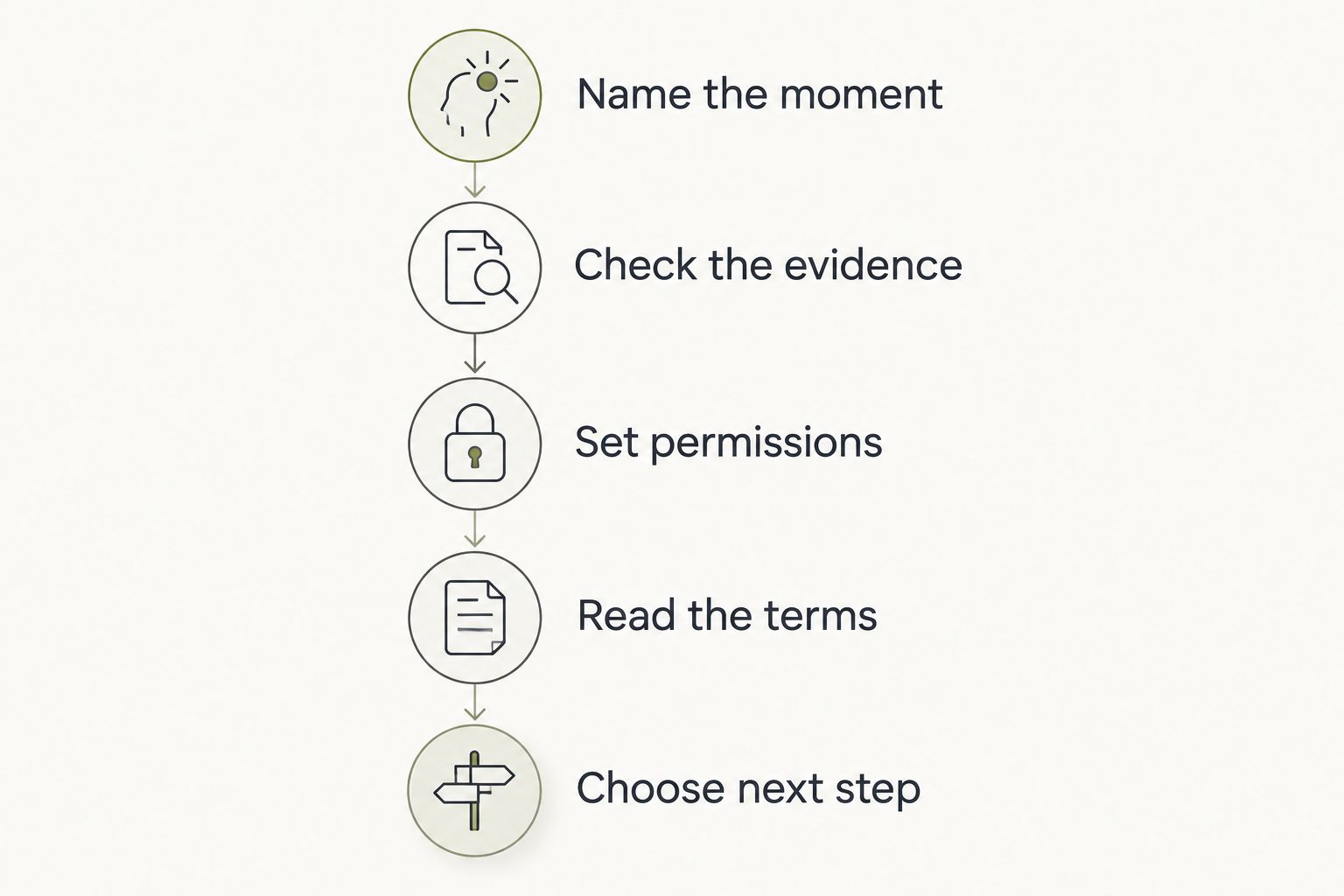
A preorder check
Use this sequence before making a commitment. It keeps the appealing scene connected to a decision you can explain.
- Name the moment. Describe something you already want to return to, such as an idea you keep mentioning. Avoid inventing a new habit just to justify the device.
- Check the evidence. Find the stated launch behavior that serves that moment. Note whether you are reading a promise or seeing a demonstration.
- Set permissions. Decide what you would deliberately capture and which sources you would separately allow. Leave anything unnecessary outside the use.
- Read the terms. Check the current commitment and cancellation language. Resolve any unclear condition before agreeing.
- Choose the next step. Preorder if the confirmed proposition is enough, or wait if your decision still depends on an unanswered question.
The sequence is not a prediction of satisfaction. It is a way to avoid purchasing for one reason while relying on a different, unconfirmed promise.
Permission boundaries
Treat recording controls and source access as separate questions. Knowing when a device captures something does not tell you what happens to that capture afterward.
Use the guide to wearable privacy features to frame your questions, then verify the answers in the product's current documentation. Do not read a category guide as a promise about a particular device.
Your checklist should ask:
- How do you start and stop capture?
- How can you tell that capture is happening?
- Which sources do you permit individually?
- What controls exist for reviewing or deleting captured material?
- What requires your approval before anything goes out in your name?
An unclear answer is a reason to ask, not a reason to fill in the blank optimistically. Your yes should apply to the specific action, not an assumed chain of actions.
Should I preorder if I mainly want help following through?
Preorder only if the stated launch experience supports the kind of follow-through you want. Noticing an intention, choosing a next step, and carrying it out are distinct outcomes.
Moonshot is a wearable for people who want to talk it through and choose the next step themselves. It hears you out and asks a good question back; it makes no calls and moves no money.
That boundary matters. If your useful moment ends with deciding to call a friend, the device's role is different from placing the call. Choose based on the role you actually want.
What should I expect during the first week?
Expect to judge fit, not to receive a verdict on your whole life. Choose a small use and notice whether returning to what you said helps you make a decision.
The aim is to learn from your own life. You can say it once, return to the thought, and decide whether it still deserves your attention. A captured intention is not an obligation to act.
For a 2026 purchase, keep the first-week test modest: does the experience help you show up for something you already care about? Do not require an imagined future version to make the current proposition worthwhile.
FAQ
Is it worth preordering an AI wearable before launch?
It is worth preordering only when the stated launch experience serves a clear use, the commitment is understood, and you accept the remaining uncertainty. Wait if the purchase depends on an unconfirmed feature.
Should I wait until a wearable launches before deciding?
Wait if you need demonstrated behavior or clearer purchase terms before committing. Preordering does not resolve uncertainty about how the device will fit your own routine.
How can I tell a planned feature from a launch feature?
Ask whether the seller identifies the behavior as part of the launch experience or describes it as planned. Do not count a future capability as a confirmed reason to buy.
Does wearing a device mean it records every conversation?
Do not assume that wearing a device means every conversation is recorded. Check the stated capture controls and how you can tell when recording starts and stops.
What should I check about permissions before preordering?
Check capture controls, separate source permissions, and approval requirements for anything sent in your name. Resolve unclear answers before making the commitment.
Is Moonshot meant to make calls for me?
Moonshot makes no calls and moves no money. Its stated role is to hear you out, ask a good question back, and help turn one thing into a next step with your yes.
What is a useful first-week test for a wearable?
Choose a specific moment you already want to return to and judge whether the experience helps you decide what to do. Keep that test separate from promises about future capabilities.
One last thing
Choose what would make you wait before choosing what would make you buy. Write down the unanswered question that would stop the preorder, then check whether the current information actually answers it.
That small reversal keeps the decision yours. A good product idea can remain interesting without becoming a commitment today.