 moonshot
Choose an AI note taker if you need a record you can check; choose an AI companion if you want an ongoing conversation that helps you decide what to do next. The right AI wearable starts with that job, not with the shape of the device.
- AI note taker vs AI companion is a workflow choice: checkable records versus ongoing conversation and follow-through.
- Luna is a planned necklace; Samantha also runs as a phone app without the necklace.
- Note taking and companionship overlap. Proactive help is not exclusive to either category.
- Choose by current capabilities, recording controls and evidence, not by the companion label.
This comparison comes from Moonshot, the company behind Luna and Samantha. Product details below reflect its November 4, 2026 information, not an independent hands-on test.
Why this matters
A transcript and a conversation solve different problems. You need a transcript when the exact wording matters. You need a conversation when you want to talk it through and settle on the next step.
Neither label guarantees the outcome. A note taker can offer proactive workflows, while a companion can capture notes. Compare the actual sequence from listening to output to approval.
For a 2026 purchase decision, separate what works now from what a company plans to ship. An appealing demonstration is not evidence that the same feature is available in the product you receive.
At a glance
These are buying priorities, not promises about every product in either category.
| Dimension | AI note taker | AI companion |
|---|---|---|
| Best for | Checking what was said | Talking through what to do next |
| Capture | Prioritize a reviewable record | Check what conversational context is retained |
| Recall | Prioritize finding source material | Prioritize continuity across conversations |
| Follow-through | Check how notes become tasks | Check how suggestions become approved next steps |
| Setup | App, wearable and cloud roles vary | App, wearable and cloud roles vary |
| Permissions | Examine recording and access controls | Examine recording, memory and action controls |
| Standout feature | Traceability back to the conversation | A continuing exchange rather than a static document |
| Pricing model | Verify hardware and service terms | Verify hardware and service terms |
A note taker fits records; a companion fits reflection
Choose the job before you choose the category. If you leave a meeting asking what someone actually agreed to, start with note taking. If you leave asking why you keep postponing a conversation, start with conversational support.
The distinction is about your desired output. A searchable record answers a retrieval question. A companion-style exchange gives you room to explain, reconsider and choose.
Moonshot positions its AI wearable around conversation and follow-through, not just collecting meeting notes. That makes it relevant to readers who want help turning something they said into something they choose to do.
The limitation matters: that positioning does not establish transcript accuracy, recall quality or completed actions. Evaluate those separately rather than treating a product description as proof.
A note taker wins when the record comes first
A note-taking workflow is the better starting point when you need to inspect the source. Think of an interview, a project handoff or a discussion where wording changes the meaning.
Look for a clear distinction between the captured conversation and the generated summary. A summary is an interpretation. It is not a substitute for checking the underlying words when accuracy matters.
Your evaluation should answer these questions:
- Can you inspect the captured material behind a summary?
- Can you correct a mistaken statement?
- Can you distinguish a speaker's words from a generated conclusion?
- Can you remove material you did not intend to keep?
A companion can also support this workflow. Do not rule it out because of its name. But if the product makes source checking awkward, conversational warmth does not fix the mismatch.
Best for source-dependent work: a note-taking workflow with an inspectable record.
A note taker wins for source lookup, not necessarily personal continuity
Recall has two meanings here. One is finding a particular statement. The other is keeping enough context to continue a conversation without starting over.
For source lookup, ask the product a question whose answer you can verify against the captured discussion. Then inspect whether its response preserves uncertainty and points you back to the relevant material.
For continuity, ask what the system remembers and how you can correct it. A remembered inference should not quietly become a fact about you.
Samantha's stated direction includes understanding context over time. Treat that as a product direction, not proof of dependable long-term recall. Luna has not shipped as of November 4, 2026, so there are no Luna customer results to establish that performance.
Choose a note-taking workflow when finding the original statement matters more than sustaining the exchange. Choose conversational continuity only after checking how memory behaves.
A companion wins when you want to talk it through
A companion-style workflow fits an unfinished thought better than a finished document. You say what happened, consider a question and decide whether anything deserves action.
For example, you mention that you keep meaning to call a friend. The useful outcome is not merely a note containing the friend's name. It is a conversation that helps you decide whether to make the call and what you want to say.
That is an example of a workflow, not a reported Luna result. The difference matters because an imagined outcome can sound like a tested capability if it is presented without context.
Moonshot's AI wearable is aimed at people who want conversation and follow-through, rather than a transcript alone. Its intended value is helping you learn from your own life.
A companion is the weaker fit when you only want a clean record and no continuing exchange. More conversation is not automatically more useful.
Both categories need a clear capture-to-action workflow
Do not award either category an automatic win for being proactive. Note-taking products can suggest tasks and initiate workflows too. The important question is what happens between a suggestion and an action.
Break the workflow into distinct jobs:
- Capture: What information enters the system?
- Recall: What information returns when you ask?
- Follow-through: What happens after you choose a next step?
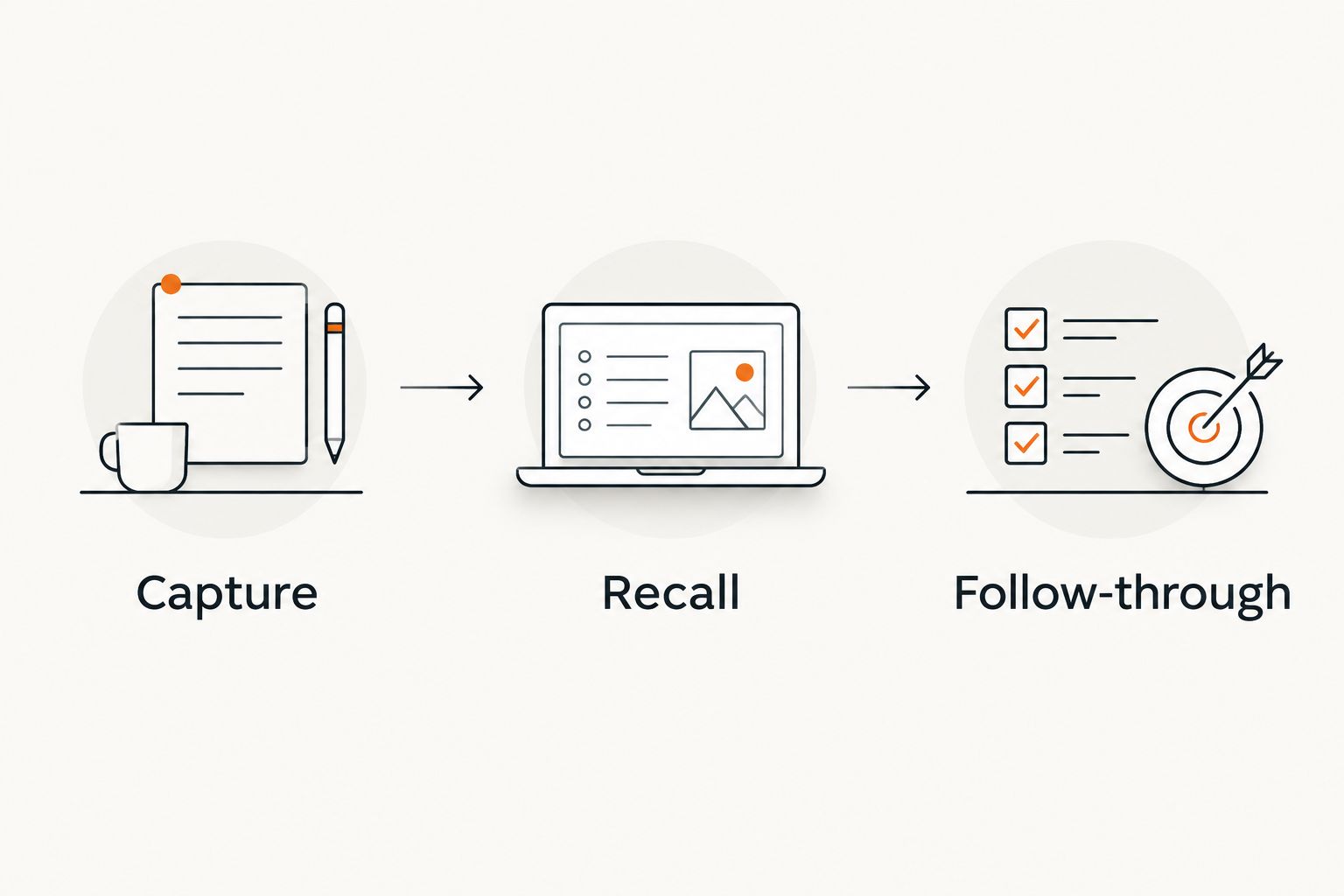
For follow-through, ask where your yes enters the process. A proposed reminder, a drafted message and a completed action are different states. The product should make the difference clear.
Samantha's direction includes speaking up first and helping with follow-through. Check which parts work in the current phone app and which depend on planned hardware. Do not count a planned interaction as a current feature.
Both require you to separate hardware, app and cloud
A necklace is not the whole system. The microphones, phone app and remote processing each have a different role. You need to understand all of them before deciding what you are comfortable using.
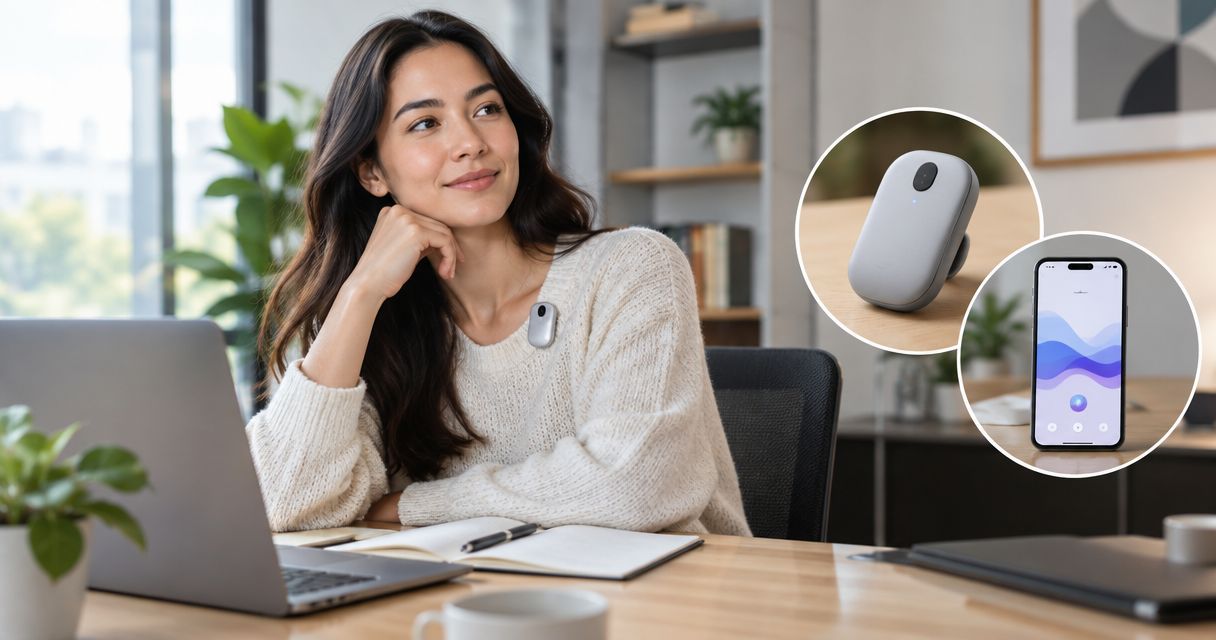
The November 4, 2026 product description lists Luna as a 27 mm necklace weighing about 7 g, with two microphones and no camera. It pairs with an iPhone or Android phone. Samantha also runs as a phone app without Luna.
Luna has not shipped. Its described interaction includes a glow and a buzz for the wearer, while Samantha speaks through earbuds or the phone. Keep that planned hardware experience separate from the app you can use today.
A phone-first option fits better if you want to assess the conversational workflow without committing to a necklace. A hardware reservation fits a different decision: whether you want the planned physical format despite the uncertainty of an unshipped product.
Neither category wins setup by default. Choose the arrangement you can understand, control and realistically use.
Both need explicit recording and memory controls
Privacy is not a category feature. A note taker is not inherently private, and calling software a companion does not tell you where conversations go.
Moonshot's privacy description says microphone audio streams through its server for processing. Neither the phone nor the server saves that audio, but the server retains a word-for-word transcript and memories until deletion. Nearby people's words can appear in that transcript.
That is the critical distinction: not saving audio does not mean not retaining the conversation. The retained transcript is stored in the cloud, not encrypted under a key held only by the user.
The described Luna control turns its microphones off with a double tap. Details about what the necklace itself sends are to be published before it ships. Do not fill that gap with an assumption about on-device processing.
Choosing AI apps with voice conversations concerns the interaction format; it does not establish how audio, transcripts or memories are handled. Apply the same storage questions whether you speak to a phone or wear a microphone.
Before using either category around others, establish what is being captured and whether the setting permits it. A product's recording control does not settle the permissions for every conversation.
A companion wins for dialogue; a note taker wins for traceability
The strongest distinction is the output you return to. A note-taking workflow gives you material to inspect. A companion-style workflow gives you an exchange to continue.
Neither is enough on its own. A polished summary can omit a qualification. A fluent response can misunderstand what you meant. Ask the system to distinguish captured words, public-source information and its own inference.
For a 2026 shortlist, use the same ordinary example with each option. Describe a task you have postponed, ask what it understood and inspect the proposed next step. Then correct a detail and see whether the correction is reflected.
This is an evaluation method, not a claim that any named product passes it. You are looking for understandable behavior, not an impressive monologue.
Pricing models need separate hardware and service checks
There is no single pricing model for either category. Compare the hardware commitment, the ongoing service terms and what happens if those terms change. Do not assume buying a necklace includes every future service.
Samantha has no subscription as of the November 4, 2026 brand update. That is a current statement, not a promise that the service will remain subscription-free. Luna's hardware terms and any future service terms are separate questions.
For either option, ask what remains usable without an ongoing plan. If that answer is unclear, do not treat continued access as included.
A reservation is also different from a shipped device. Choose it because you accept the planned product's status, not because you need hardware for an immediate task.
Your choice comes down to the output you need
Choose an AI note taker if you need a dependable reference
Best for interviewers, meeting participants and people checking specific commitments: prioritize a note-taking workflow. Make inspectable source material, corrections and retrieval your deciding criteria.
Choose this route even if a companion sounds more engaging. Your job is to recover the discussion, not extend it.
Choose an AI companion if you want a continuing exchange
Best for people who want to talk through an idea and choose a next step: prioritize a companion-style workflow. Check how it handles context, corrections and approval.
Consider Samantha's phone app separately from Luna's planned necklace. If you specifically want Luna's physical format, the next step is a reservation, not an assumption that the hardware is ready to use.
| Dimension | Winner |
|---|---|
| Best for | Note taker for records; companion for reflection |
| Capture | Note-taking workflow for inspectable records |
| Recall | Note-taking workflow for source lookup |
| Follow-through | Companion workflow for continuing dialogue; verify actions separately |
| Setup | Tie; depends on the actual system |
| Permissions | Tie; inspect each product's controls |
| Standout feature | Companion for dialogue; note taker for traceability |
| Pricing model | No category winner; compare current terms |
FAQ
What's the difference between an AI note taker and an AI companion?
An AI note taker centers the captured record; an AI companion centers the continuing exchange. Products can combine both, so compare their actual capture, recall and follow-through workflows.
Is an AI companion better for meeting notes?
Not automatically. For meeting notes, prioritize source checking, correction and retrieval over the companion label.
Can an AI note taker offer proactive help?
Yes. Proactive suggestions and workflows are not exclusive to companions. Check whether the product suggests an action, prepares it or carries it out with approval.
Do I need a necklace to use Samantha?
No. Samantha also runs as a phone app on iPhone and Android without Luna, according to the November 4, 2026 product information.
Has Luna shipped?
Luna has not shipped as of the November 4, 2026 product information. Evaluate the necklace as planned hardware, separately from Samantha's current phone app.
Does deleting audio mean no conversation data is stored?
No. Audio, transcripts and memories are different data types. Moonshot's described system does not save streamed audio on the phone or server, but retains transcripts and memories until deletion.
Should I reserve an AI wearable or try a phone app first?
Try a phone app first if your main question is whether the conversational workflow helps you. Reserve hardware only if you want its planned physical format and accept that it has not shipped.
One last thing
Ask the same follow-up after any impressive answer: What did I actually say, and what did you infer? A clear distinction helps you check notes, correct memories and decide whether the suggested next step deserves your yes.