 moonshot
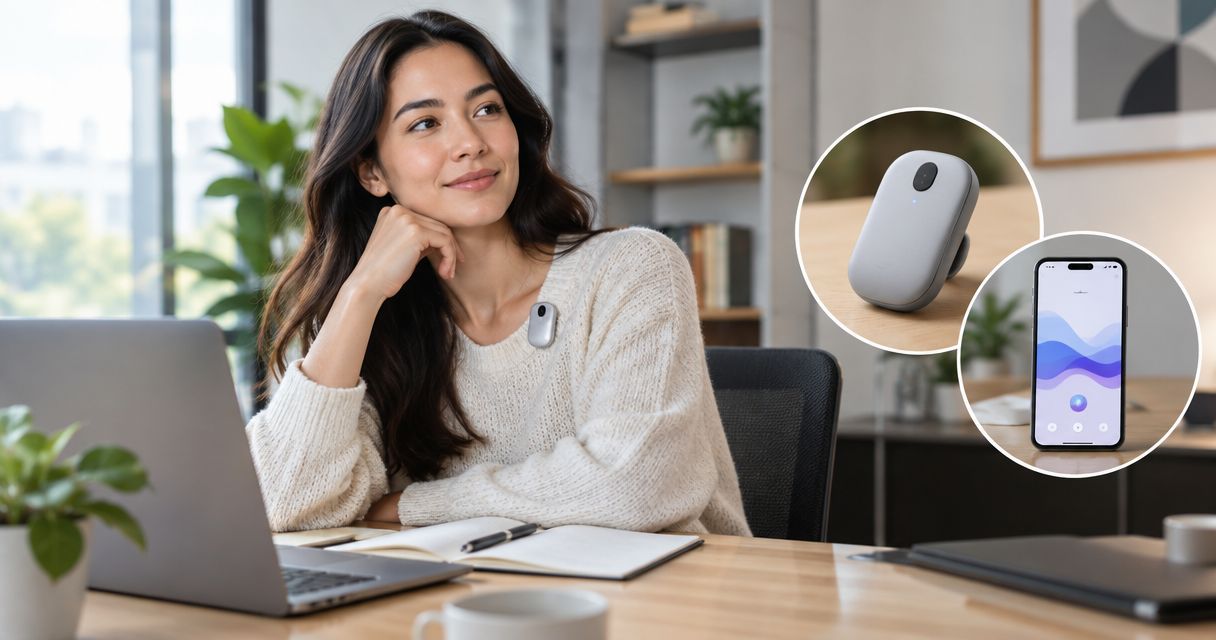
An AI wearable can turn a conversation into text, use that text to produce notes or replies, and retain information for later recall. What happens next depends on the product: deleting audio does not necessarily delete the transcript, and capturing a conversation does not mean a suggested action has been completed.
- What happens after an AI wearable records a conversation depends on its transcription, storage, memory and action settings.
- Moonshot separates Luna, the unshipped necklace, from Samantha, the AI available through a phone app.
- Samantha does not save incoming audio on the phone or server, but transcripts and memories remain until deleted.
- Choose capture for notes, recall for finding information, and follow-through for reviewing a next step before acting.
What happens after an AI wearable records a conversation?
The useful way to understand the process is to separate what the microphone captures from what the software keeps and does afterward. These are different stages, with different consequences for you and the people nearby.
| Stage | What it does | What you need to check |
|---|---|---|
| Audio capture | Takes in speech through a microphone | How you stop listening and tell whether capture is active |
| Transcription | Turns speech into written text | Where processing happens and whether the words are accurate |
| Storage | Retains audio, text or other records | Which records remain and how deletion works |
| Context and memory | Uses retained information to inform later responses | Whether a saved detail is a fact, a summary or an inference |
| Response or follow-through | Produces a reply or proposes a next step | What needs your approval and what has actually happened |
Do not assume that every product uses every stage in the same way. A recording indicator answers whether capture is active, not where the resulting transcript goes. For the capture question, start with how to know if an AI wearable is recording.
Moonshot is the company behind Luna and Samantha. Its product details here come from company-provided documentation dated November 4, 2026, not independent device testing. Luna is an unshipped necklace; the Luna reservation page is a reservation, not evidence of delivered hardware performance.
Why the processing matters
The recording is only the beginning of the data trail. A product can discard incoming audio while keeping a word-for-word transcript. That transcript can still contain names, commitments and things said by someone standing nearby.
The practical question is not simply whether a wearable records. Ask what survives the conversation, who processes it, and what the system treats as something to remember. Those answers determine whether the product fits your workplace, household or personal routine.
Separate usefulness from permission, too. A useful summary does not establish that everyone agreed to be recorded. Check the rules that apply to your setting and ask the people involved before capturing their conversation.
The processing steps
1. Audio capture
A microphone supplies the input. The microphone can belong to a wearable or a phone, so an app experience does not prove that the necklace hardware is doing the same work.
Luna has two microphones, according to the November 4, 2026 product notes. The stated control is a double tap to turn those microphones off. That control concerns future capture; it should not be treated as a promise to erase information already processed.
2. Transcription
Transcription turns speech into written words. Before relying on a name, date or commitment, compare the resulting text with what you remember saying. A polished summary is not a substitute for checking the underlying words.
Samantha streams input from the phone microphone, or from Luna in the described hardware workflow, through the company's server to a speech-processing provider. The supplied privacy description says neither the phone nor the server saves that incoming audio.
3. Stored records
The same privacy description says the server retains a word-for-word transcript and memories until deleted. The transcript includes what people nearby say. These records are stored in cloud infrastructure, not encrypted under a key held only by you.
No saved audio does not mean no saved conversation. Read retention statements by data type. Audio, transcript and memory are separate records, so a statement about one does not settle the others.
4. Context and memory
Saved information can provide context for later responses. But a direct statement and an interpretation are not interchangeable. Saying that you mentioned a friend is different from concluding that you want a reminder to contact that friend.
A conversation you captured is also not a public source. If a reply combines remembered conversation with outside information, you need to know which part comes from your words and which part needs an external source.
5. Response and approval
A reply can help you talk it through or identify the next step. That is different from completing the step. Treat a proposed task, an approved task and a completed task as separate states.
For Luna, proactive prompts and follow-through are product direction, not demonstrated customer outcomes. The hardware notes describe a glow and a buzz, with Samantha speaking through earbuds or the phone. They do not establish how well that experience works in daily use.
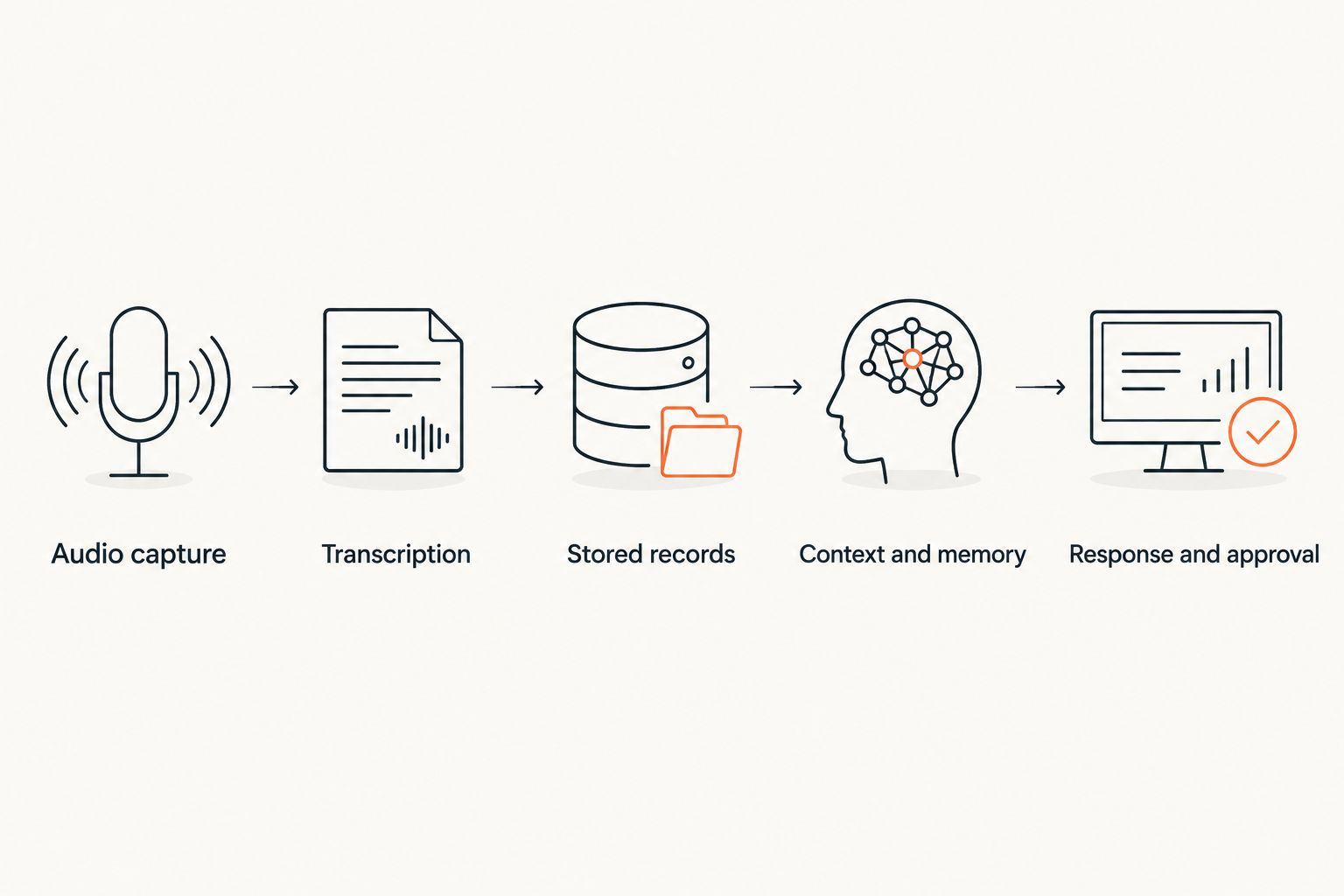
The order is a way to inspect a product, not a guarantee that every system follows an identical architecture. Ask for an explanation of each stage rather than accepting a single claim about recording.
Capture, recall and follow-through
Choose the job before choosing the form of the device. A necklace is a way to carry a microphone and receive signals. The value comes from what the connected software does with the information.
| Job | Best for | Useful outcome | Limitation to check |
|---|---|---|---|
| Capture | Keeping a record of an agreed conversation | Text you can review afterward | Capturing words does not establish accuracy or consent |
| Recall | Finding something you previously discussed | Retrieving a detail without rereading everything | A retrieved answer still needs context and checking |
| Follow-through | Turning a discussion into an approved next step | A clear proposal you can accept or reject | A suggestion is not proof of completed work |
| Companionship | Talking through an idea or recurring concern | A conversational response informed by context | A response can include interpretation, not just recorded facts |
If you only want a record of a specific conversation, choose a capture-focused workflow rather than buying on the promise of companionship. If you want to revisit ideas, examine recall. If your problem is unfinished intentions, inspect the approval and completion steps.
Moonshot's AI wearable direction is best suited to readers seeking conversational context and follow-through, not just transcripts. The limitation is equally important: Luna has not shipped, so this is a fit assessment based on stated direction, not a performance verdict.
A different product fits better when it already demonstrates the exact job you need and Luna does not yet provide evidence for it. That can mean choosing a focused note-taking product instead of waiting for a broader companion experience. Do not assume that proactive workflows are exclusive to Luna.
Luna and Samantha have different roles
Luna is the necklace. Samantha is the AI, also available through a phone app on iPhone and Android without Luna. Keeping those roles separate prevents a common purchasing mistake: treating software access as evidence that the wearable has shipped.
The supplied hardware notes describe Luna as 27 mm and about 7 g, with two microphones and no camera. Those details explain its physical form. They do not establish transcription accuracy, comfort over a full day or successful follow-through.
As of the November 4, 2026 documentation, Luna had not shipped. The described signals and proactive experience therefore belong in the planned hardware column, not the tested-results column. Samantha's existing phone app is a separate way to encounter the software without the necklace.
If you need a working device now, choose a product with documented delivery and evidence for your required workflow. If you are comfortable reserving unshipped hardware, make that decision on the stated plan and refund terms, not an assumed customer result.
Why the result varies
The same conversation can lead to a transcript, a useful response or an unhelpful inference. Check these factors before you judge the result:
- Input device: Establish whether the phone or necklace supplies the audio. Do not transfer a claim about one input to the other.
- Transcript accuracy: Check the actual wording before treating a summary as a reliable record of an agreement.
- Retention rules: Find out what happens to audio, transcripts and memories separately. A short audio policy does not explain text retention.
- Saved context: Distinguish information you stated from an interpretation the system formed. Both can affect later responses.
- Approval rules: Identify where your yes is required. A proposed next step must not be described as completed work.
- Product status: Separate an existing app function from planned hardware behavior. A reservation page is not a field test.
These checks are more useful than a broad promise that a product remembers your life. You need to know what the product remembers, where that information sits, and how it changes the next reply.
Does deleting the audio delete the conversation?
Deleting audio does not establish that the transcript or memories have been deleted. In the supplied Samantha privacy description, incoming audio is not saved on the phone or server, while transcripts and memories remain until deleted.
Before recording something sensitive, check deletion for each record type. Also check whether stopping the microphone changes only future capture or affects existing records. Do not assume the same control does both.
Does a wearable act on everything it hears?
Hearing a conversation is not permission to act on every sentence. A remark can be a passing thought, a question or someone else's suggestion. A useful workflow lets you distinguish those from a commitment you actually made.
For follow-through, ask to see the boundary between suggestion and approval. Then ask how completion is confirmed. Without those distinctions, an encouraging reply can look like progress even though nothing outside the conversation has changed.
What should you check before trying it?
Use an ordinary, non-sensitive example with everyone involved aware of the capture. Talk through something small, such as an idea you want to revisit. Then inspect what the software retained and how it describes the next step.
Look for three different outputs: the captured words, any interpretation, and any proposed action. Correct a mistaken detail before you rely on later recall. If the product cannot explain the difference between those outputs, do not use it as your only record of an important agreement.
For a 2026 purchase decision, keep evidence of current software separate from promises about future hardware. Your first decision is whether you need capture, recall, follow-through or companionship. The form factor comes after that.
FAQ
What happens after an AI wearable records a conversation?
The product can transcribe speech, retain text or memories, and use that information for notes, recall or replies. Check each stage separately because audio deletion does not establish transcript deletion.
Does Samantha save the original conversation audio?
The supplied privacy description says Samantha does not save incoming audio on the phone or server. It does retain a word-for-word transcript and memories until deleted, including words spoken by people nearby.
Can I use Samantha without wearing Luna?
Samantha is available through a phone app on iPhone and Android without Luna, according to the November 4, 2026 product notes. That software access is separate from the unshipped necklace.
Does stopping an AI wearable microphone erase earlier conversations?
Stopping a microphone does not establish that earlier conversations have been erased. Check the separate controls and terms for transcripts, memories and any retained audio.
Will an AI wearable automatically complete my tasks?
A suggested task is not proof that a task has been completed. Check what requires approval and how the product confirms an actual result; Luna's follow-through direction is not a demonstrated customer outcome.
Which AI wearable workflow is best for meeting records?
A capture-focused workflow fits readers who mainly need a record of a specific meeting. Check consent, transcription accuracy, retention and retrieval before considering broader companionship features.
Should I reserve Luna or choose a product that has shipped?
Choose a shipped product when you need documented hardware performance now. Consider a Luna reservation only if you accept that the necklace is unshipped and distinguish its stated direction from proven results.
One last thing
Ask what remains after the microphone stops. That question reveals more than asking whether a device records. In the supplied November 4, 2026 privacy description, the lasting record is text and memory, even though incoming audio is not saved on the phone or server.
Choose the workflow that helps you learn from your own life without confusing a record, an interpretation and a completed action. For Luna, take the next step only if the reservation fits your expectations for unshipped hardware.
Reserve Luna
Reserve for $1, refundable. Reply to the receipt to request your refund any day.